Decolonising the airwaves and improving froth flotation
- Wits University
Media Studies scholar Dr Kealeboga Aiseng and chemical engineer Dr Lisa October are the 2026 Friedel Sellschop Fellows.
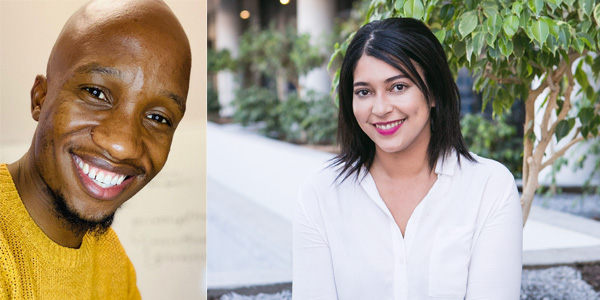
The fellowships, worth up to R145 000 each per annum for three years, are awarded annually to recognise and encourage exceptional early-stage researchers.
African voices as knowledge sources
Dr Kealeboga Aiseng is a Senior Lecturer in Media Studies in the School of Literature, Language and Media in the Faculty of Humanities.
His research focuses on developing a new theoretical framework for understanding African-language and African community media in the digital age.
“While these media forms are often described as ‘ethnic’ or ‘minority’ media in global scholarship, my work argues that such labels are conceptually inadequate in African contexts, where multilingualism is the norm and media in African languages function as central infrastructures of culture, politics, and everyday life,” explains Aiseng.
Aiseng says that the Sellschop award will enable him to advance a book-length project titled Decolonizing the Airwaves, which develops the first unified theory of African ethnic media grounded in African epistemologies such as orality, Ubuntu, and communal authorship.
The funding will support comparative fieldwork with radio producers, podcasters, digital creators, and language technologists across Southern, West, and East Africa, as well as the analysis of African-language media across platforms such as radio, YouTube, TikTok, and WhatsApp.
Ultimately, the project aims to reposition African media not as peripheral case studies, but as sites of theoretical innovation that can reshape global media studies, debates about digital platforms, and conversations around linguistic justice and decolonial knowledge production.
“This award gives me the time and resources to think seriously from Africa, rather than simply about Africa. At a moment when digital platforms are reshaping how people speak, listen, and belong, African-language media are offering powerful alternative models of communication grounded in community, memory, and relationality,” says Aiseng.
“My hope is that this research helps shift global media theory by taking African voices, languages, and media practices seriously as sources of knowledge in their own right.”
Mining strategies to improve mineral separation
Dr Lisa October is a Senior Lecturer in the School of Chemical and Metallurgical Engineering, Faculty of Engineering and the Built Environment, and holds a PhD in chemical engineering.
Her research focuses on improving a process called froth flotation, which is widely used in mining to separate valuable minerals – like copper, nickel, gold and the platinum group metals – from unwanted minerals (‘gangue’) that come associated with them.
Although froth flotation is essential to South Africa’s mining industry, it is becoming more challenging as ore grades decline and water becomes increasing scarce.
October says, “It thus becomes important to understand why certain unwanted minerals end up in the final concentrate, even when they shouldn’t. These unwanted minerals are often collected because of subtle electrostatic interactions (arising from varying water quality) that we don’t yet fully understand. When the gangue minerals are recovered unintentionally, they lower the grades of the valuable minerals we are trying to recover.”
As a Sellschop scholar, October can now research the specific water conditions that cause unwanted minerals to be recovered and, more importantly, the underlying mechanisms which allow this. Her research will ultimately support the development of strategies to improve mineral separation.
October joined Wits recently from UCT, where flotation chemistry research is exceptionally strong. She acknowledges leading figures in minerals processing at the Centre for Minerals Research who mentored her and with whom she is excited to continue collaborating as she builds on her work here at Wits.
“I’m truly grateful to receive this award. It not only enables me to answer important questions about managing the recovery of gangue minerals, but it also means something even bigger – it allows us to begin transforming our lab into a dedicated flotation chemistry facility, a space that can support not just my work, but the work of future students and researchers. That is incredibly meaningful to me.”
About the Friedel Sellschop Fellowships
The Friedel Sellschop awards are worth up to R145 000 each per annum for three years.
All members of academic staff in all faculties are eligible, subject to their:
- being permanent members of staff
- having completed a PhD or have comparable demonstrable achievement
- being within five years of their first academic appointment
- having produced a substantial body of research which is internationally recognised or will likely establish an international reputation as a leader in the field.
- A National Research Foundation rating is advantageous but not required.
Who was Friedel Sellschop?
Professor Friedel Sellschop (1930-2002) was the Dean of the Faculty of Science at Wits from 1979 to 1983, and Deputy Vice-Chancellor: Research, from 1984 to 1996. He was part of a research group that identified the first neutrino found in nature in one of South Africa’s gold mines. Neutrinos are tiny particles which are produced in stars and make up a considerable amount of matter in the universe. The University awards the Friedel Sellschop Fellowships annually in his honour.