
-
Problem 2: Combatting alien plants rooted in the heel of a dam and capping visitor numbers: Case of Injaka Dam
Presenter:
Dr Lombuso Precious Shabalala, Department of Applied Management, UNISA
Problem StatementThe Injaka Dam is situated in Mpumalanga Province, within the Bushbuckridge Local Municipality (Figure 1). It was initiated in 2001 mainly for relegation and domestic use. The Mgwaritjie River and the Mgwaritjana River form this dam. The buffer zone surrounding the dam is 100% claimed by Injaka Watervaal Communal Property Association (CPA).
The local community members were compensated for the Dam, but they hold title deeds for the buffer zones. The dam has the potential to be one of the province's top attractions, offering a range of water activities. A decision to develop this area into a resort has been supported by management.
A Memorandum of Agreement is in place between the Department of Water and Sanitation (DWS) and Bushbuckridge Local Municipality (BLM) for the dam management. The Resource Management Plan is in place.
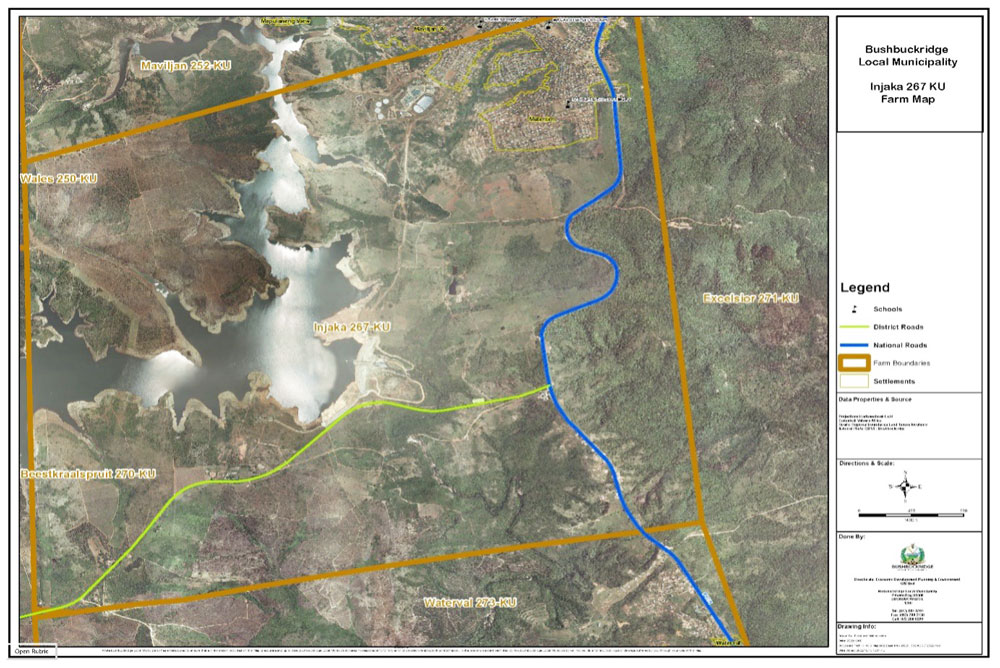 Figure 1: Injaka Dam. Source: Bushbuckridge Local Municipality, 2023.
Facts about Injaka Dam
- 4000 Hectares, which includes the dam and buffer zone.
- It is regarded as a national key point.
- Conducive for water sport facilities and activities such as fishing and boating.
- There are alien trees underneath the dam (some of which surface above the water), which could cause serious damage to boats.
- Level-height: 35 meters.
- Capacity: 132 843 m3.
Tourist attractions such as Injaka Dam are expected to implement user-pay strategies such as to entry which will require an appropriate regulatory framework and the ability to physically restrict access only to those willing to pay for the experience (Morgan & Lok, 1999:1-2). There are tourist attractions in Mpumalanga Province that are deserted. These tourist attractions have the potential to realise their sustainable development while practicing responsible tourism in their daily operational activities and generate healthy revenue. Tourism development in South Africa is guided by the key principles of Responsible Tourism stipulated in the 1996 White Paper.- South Africa is the first country to include Responsible Tourism in its national tourism policy, the 1996 White Paper on the Development and Promotion of Tourism in South Africa.
- Goodwin (2007) notes that Responsible Tourism is about “making better places for people to live in and better places for people to visit.” Responsible Tourism requires that operators, hoteliers, governments, local people and tourists take responsibility and take action to make tourism more sustainable.
Visitors’ expectations- Safe environment when participating or enjoying recreational activities (Customer satisfaction & value for money).
- Not an overpopulated attraction.
- Enough safe car parking.
- Camping site and picnic spots/braai areas.
- Adherence to environmental guidelines.
- Boat parking (fishing competition).
Fishing TournamentThe Injaka Dam is a popular venue for bass fishing competitions hosted by the South African Bass Angling Association (SABAA). The Team Tournament Trail Nationals was scheduled for late 2024 and early 2025. These events showcased the potential of the dam. It is worth noting that between late 2024 and 2025, several smaller-scale tournaments, such as Joey's Towing Trail, have regularly used Injaka Dam as their stop within event.
The problem to investigate
- Currently, there is a challenge with alien plants growing inside the dam rooted in the heel of the dam. These alien plants are a threat to the water activities currently taking place and potentially cause physical harm to competition participants or tourists using boats. In addition, it could jeopardise development and growth opportunities.
- Secondly, there is a possibility of overtourism, which is regarded as congestion from too many tourists in an area or attraction, resulting in conflict with locals and impacting customer satisfaction. Solving this problem could translate to a green economy reaching local communities and contribute to genuine sustainable development.
Building on these two points, the problem seeks to develop:- A mathematical model to identify the alien plants and the best way to remove them at an early stage and to optimise the conservation of life forms (fish) and tourism recreational activities.
- A mathematical model to determine the maximum number of people Injaka Dam tourist attraction can take at one time (carrying capacity) to prevent overtourism.
References- Bushbuckridge Local Municipality,2023. Injaka Dam Map.
- Goodwin, H., 2007.Taking responsibility for Tourism. Accessed date: 21 November 2022. Available from: https://haroldgoodwin.info/responsible-tourism/.
- Morgan, D. and Lok, L., 1999. Social Comfort Within Natural Tourist Attractions: A Case Study of Visitors to Hanging Rock, Victoria.
Additional Material- Bushbuckridge Tourism Organisation Facebook:
https://www.facebook.com/bushbuckridgeLTO/videos/sabaa-ttt-2024-nationals07-09-november-2024inyaka-dam/1512301189441872/. Access date: 10 Dec 2025. - Goodwin, H., 2017. The challenge of overtourism. Responsible tourism partnership, 4, pp.1-19.
- Linder.L. 2024. Lowveld Bass Trail triumphs on Injaka Dam. Available from: https://www.citizen.co.za/lowvelder/sports-news/2024/11/24/lowveld-bass-trail-team-triumphs-on-injaka-dam/ . Access Date: 10 Dec 2025.
- SAABAA. Custodian of the Competition. Available from: https://sabaa.co.za/ . Access date: 10 Dec 2025.
Acknowledgements to Mr Mkhonto and Mr Thwala (Injaka Dam employees) and Mr Modipane (BLM Tourism Officer).
First-day Presentation
- Download the presentation here.
Report back Slide Presentation by Students- Download the presentation here.
-
Problem 6: Inventory Optimization Problem with Two Conflicting Objectives
Presenter:
Professor Montaz Ali, School of Computer Science and Applied Mathematics, University of the Witwatersrand
Problem StatementA single-commodity inventory problem is considered. Customers arrive according to Poisson process at a single queue, single service channel. The arrival rate1 is modelled as 3 customers per hour. In the problem discussed here the customer demand and replenishment lead time are also random, as they follow distributions, making it a stochastic problem. Decision variables are reorder point r and reorder quantity Q, both discrete. These variables must be changed over predefined ranges (see Table 1) to optimize the two objective functions, which are service level (maximized) and (average) inventory cost (minimized). The inventory level is monitored, and when it falls below the recorder

point r, a reorder is initiated. After the lead time has elapsed, the inventory level is increased by the reorder quantity Q. The average inventory level is calculated over time to determine the average inventory cost, which is minimized. The unit time or the time interval can be considered as each day for 6 months, and so the total number of time intervals is 180. The cost for keeping one inventory per unit time is 1. One can minimize the total inventory cost but, in this case, it is better to minimize the average inventory cost i.e. cost per interval. The service level is defined as
Service level=Number of Customer serviced/Number of Customers requiring Service
The customers have a finite stochastic demand for the single commodity being sold following a Weibull distribution, namely ⌊Weibull(λ, k)⌋ = ⌊Weibull(1, 8)⌋. For the lead time the following distributions can be considered:
- Probability(Lead time=1)=0.25; Probability(Lead time=2)=0.5; Probability(Lead time=3)=0.25.
- Discrete Uniform Lead Time in {1, 2, 3}.
1In a Poisson distribution, the arrival rate (λ) is the average number of customers that arrive per unit of time or an interval, assuming these events happen randomly and independently.
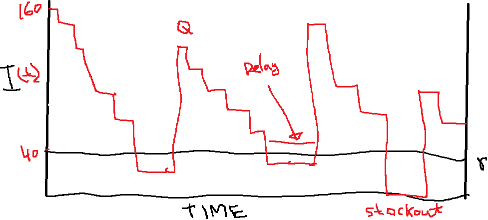
Figure 1: Inventory level I(t) vs Time
Simulation to be Carried Out:
The above problem is a stochastic programming problem involving two objective functions, which will not be so easy to solve during the modelling Camp period. However, students can simulate the process by writing a computer program where iid sample can
be drawn from Poisson as well as Weibull distribution. In particular, the participants of the modelling Camp can use r ∈ [100, 400] and Q ∈ [100, 400]. Using the pair (r, Q) value they can simulate the process, see Figure 1, for say 10 times and calculate the average (of average inventory cost) and the average service level over 10 simulations. This process can be repeated for a set of pairs of (r, Q) values and then try to locate pareto set using the corresponding average (cost, service level).
References
- Braglia, M., Castellano, D., Marrazzini, L. & Song, D. (2019). Continuous review, (q, r) inventory model for a deteriorating item with random demand and positive lead time. Computers Operations Research, 109, 102-121.
- Jackson, I., Tolujevs, J. & Kegenbekov, Z. (2020). Review of inventory control models: A classification based on methods of obtaining optimal control parameters. Transport and Telecommunication Journal, 21, 191-202.
First Day Presentation
-
Download the presentation here.
Report back Slide Presentation by Students
- Download the presentation here.