


Honours retreat
-
Writing in the Wild: Honours Retreat at Pullen Nature Reserve
By Tumelo Nhlapo
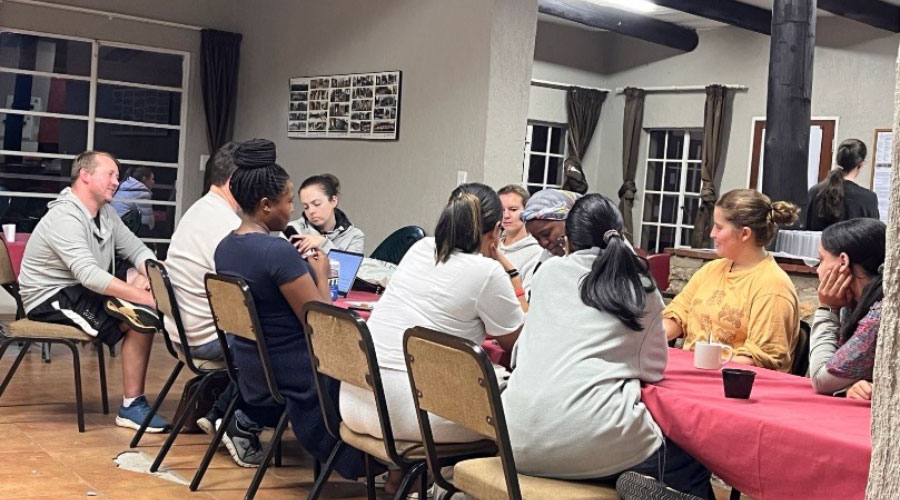
From the 19th – 23rd of March 2026, the Wits Honours class embarked on a unique academic journey. A proposal writing retreat at the serene Pullen Nature Reserve. This dedicated time is designed for the 23 students to focus deeply on their research proposals, supported by staff and postdoctoral fellows who were on hand to advise and answer questions.
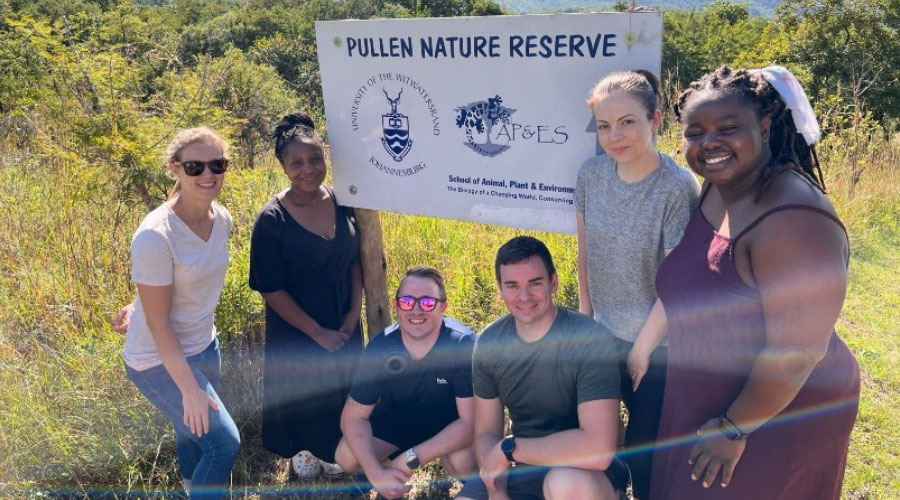
From left to right Dr Shannon Conradie, Dr Thando Twala, Dr Blair Cowie, Dr Matthew Noakes the Honours coordinator, Dr Kiara Haylock and Dr Nqobile Ndlhovu
This retreat also served as a well-deserved pause after the intensive Enabling Skills course in the first block, giving students space to recharge and strengthen bonds with their classmates.
Why Pullen Nature Reserve?
According to Dr Matthew J. Noakes, Honours Coordinator:
“It’s a peaceful place in the bush, allowing them to focus on writing with fewer distractions. It also introduces students to our APES field site, which they may consider for future MSc or PhD research.”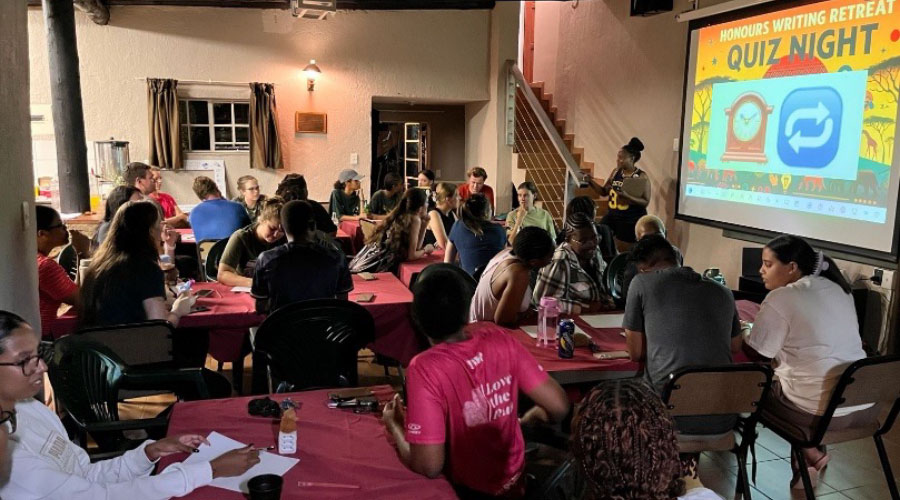
The reserve’s tranquil environment offers the perfect balance of productivity and reflection, making it an ideal setting for both academic growth and personal connection.
MSc candidate research at Pullen
-
Phiwase Khoza
Meet
 Phiwase Khoza, an MSc candidate in the School of Animal, Plant & Environmental Sciences. Phiwase's research focus is on investigating the factors influencing the co-existence of Bushbuck and Nyala.
Tumelo Nhlapo caught up with her to find out more about her research.
Why Pullen Nature Reserve?
“Everyone in the APES department always talks about how beautiful Pullen is. With little human activity, the reserve remains undisturbed, the perfect setting for meaningful ecological research.”
For Phiwase, Pullen Nature Reserve has always been a dream research site. Since her undergraduate years, she envisioned conducting her studies here. The reserve’s tranquil environment, coupled with the support of dedicated staff members during fieldwork, has made her research journey both manageable and rewarding.
 Research Highlights
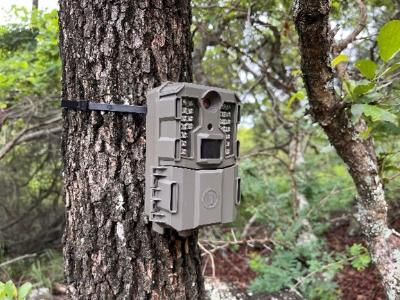
Gaining valuable fieldwork experience in a natural, undisturbed environment. Learning to work independently while still having access to expert guidance. Exploring the delicate balance between Bushbuck and Nyala co-existence a study that contributes to understanding biodiversity and conservation.
Pullen Nature Reserve, proudly owned and managed by the University of the Witwatersrand, continues to provide a unique space for students and researchers to explore, learn, and contribute to conservation science.
Written by Tumelo Nhlapo #PullenNatureReserve
Honeybee Navigation
-
Unlocking the Secrets of Honeybee Navigation
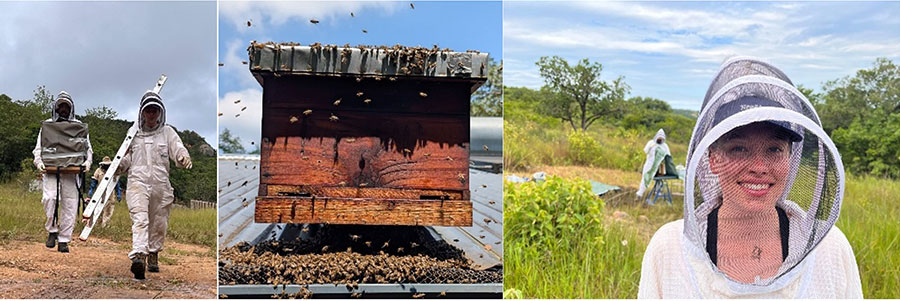 By Tumelo Nhlapo
At the heart of international research on insect communication and navigation is Frida Hildebrandt, a doctoral researcher at the International Max Planck Research School of Quantitative Behaviour, Ecology and Evolution and member of the Foster Lab at the University of Konstanz, Germany. Her PhD project, Follow the Leader – Propagation and Resolution of Incomplete Social Cues in Insects, explores how honeybees use the sun and polarised light as a solar compass, and how they share navigational information through the waggle dance.
Frida’s work contributes to a deeper understanding of collective behaviour in insects, offering insights into how social cues are transmitted and resolved within colonies.
While Frida leads the research, she is supported by Sverre Tautz, a bachelor’s student in Biological Sciences at the University of Konstanz and student assistant in the Foster Lab. Sverre contributes to the project by assisting with behavioural experiments and ecological fieldwork, gaining valuable hands-on experience.
Why Pullen Nature Reserve?
Pullen Nature Reserve provides a rare and invaluable research environment.
“Pullen offers natural sky conditions with very high solar elevations that do not occur in Europe, making it an ideal site for this research,” explains Frida.
Thanks to funding from the Journal of Experimental Biology Travelling Fellowship and the Doctoral Fund of the University of Konstanz, she was able to conduct her fieldwork at Pullen. The reserve’s undisturbed environment allows researchers to observe honeybee behaviour under natural conditions, making it a unique platform for groundbreaking ecological discoveries.
Highlights of the Experience
Conducting field-based experiments in a natural, open-sky environment. Investigating the waggle dance as a direct window into honeybee communication. Collaborating with international researchers on insect navigation. Gaining insights into how environmental conditions shape bee behaviour.