

WitsiesForGood: Mohamed Ameermia
Human rights advocate has turned personal injustice into lifelong legal advocacy. By Heather Dugmore
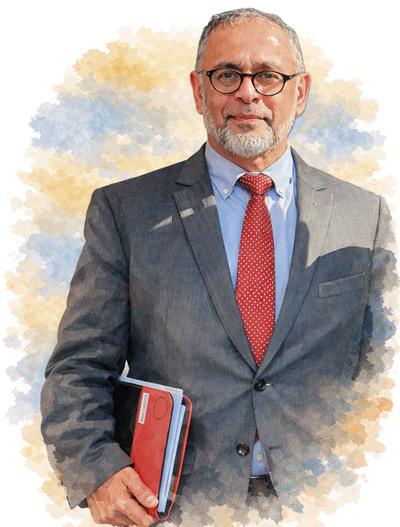 For Advocate Ameermia Mohamed Shafie (BA 1984, LLB 1990) the law has always been more than a profession. Shaped by the injustices he witnessed and experienced growing up under apartheid, and strengthened by his years at Wits, his career has been defined by a commitment to justice, dignity and service. Today, as national director of ProBono.Org, his work connects vulnerable people with free legal support through the voluntary service of South Africa’s private legal profession.
From his office on Constitution Hill, Johannesburg, Mohamed recounts his journey to becoming a human rights lawyer, starting in childhood in Bronkhorstspruit, 50km east of Pretoria. “My story is no different to other Indian families that lived and traded in country towns in the dark days of apartheid South Africa,” he recounts. “My grandparents came to South Africa in the 1890s from Surat, Gujarat, in India to start a new life here.
“We lived in Bronkhorstspruit, where my parents established a general dealer store in the town’s commercial hub, and traded until the apartheid era, when they suffered the brutality of the Group Areas Act. Our family property was expropriated in 1969, and we were forcibly relocated to the outskirts of town. Almost to the point of financial ruin, my parents had to start the family business all over again.
It was a very painful, difficult time.” Classified as Indian, Mohamed and his siblings attended schools in Laudium, outside Pretoria, and Lenasia, near Johannesburg, both areas established for Indians during apartheid.
“In 1993 my family was struck another blow because of my political activism in assisting victims of apartheid. The right-wing Afrikaner Weerstandsbeweging bombed the shopping centre where my parents’ relocated business was,” says Mohamed. “Once again my family had to rebuild their business from scratch.”
The power of a good education
“Our parents instilled in us the power of a good education as the key to opportunity, and I am most grateful to them for all the sacrifices they made in this regard,” says Mohamed, who matriculated from Nirvana High School in Lenasia in 1979, and was admitted to Wits.
“The harsh realities and injustices that I experienced from childhood, including almost daily harassment from the police, made me determined to pursue a law career in order to champion human rights and fight for justice, dignity, freedom, and equality for indigent and marginalised communities in South Africa.”
He credits Wits with instilling the values that continue to guide him. “Wits taught me to question power, to think critically, and to place justice at the centre of public life. Wits taught me that leadership is service, and that the law must always speak for those who cannot.”
In 1988, he became a student assistant in Wits’ Street Law Programme, deepening his commitment to community-based legal education. This experience proved formative. and the programme has since evolved into a global movement active in 45 countries.
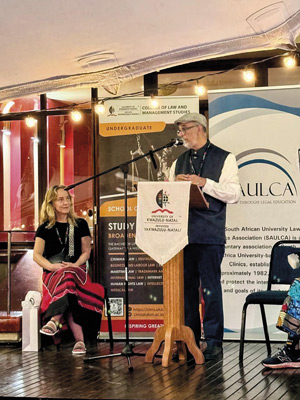
In September 2025 the Street Law movement celebrated its 50th anniversary at the University of KwaZulu-Natal, with Mohamed delivering the keynote address.
After completing his articles in 1993 with Constitutional Court Judge Justice Jody Kollapen (BProc 1978, LLB 1982), he was admitted as an advocate of the High Court in 1995.
A long journey of public service
Mohamed’s entry into public service was as the town secretary in Makhado in 1999. During this time, he also pursued an LLM through the University of Pretoria, and was subsequently awarded a fellowship in Public International Law and Arbitration at the Centre for American and International Law in Dallas, Texas.
On his return, his public-service work ranged from recovering R33 million in the Senoko tender-fraud matter to overseeing the delivery of 60 000 RDP homes, valued at R1billion, for vulnerable communities across Limpopo Province.
 In 2013, Mohamed was appointed as a Commissioner of the South African Human Rights Commission, where he served for seven years, including as acting chairperson. His work included landmark victories such as the Flemix case, which exposed unlawful microlending practices affecting 250 000 farm workers and led to critical reforms in microlending legislation.
His connection to Wits continued during this period, through his election to the executive committee of the Wits Convocation.
Mohamed is proud of the work at ProBono.Org under his leadership since September 2023. “In 2025 we doubled the number of cases we could handle, from 5 037 to 12 176 in just nine months,” Mohamed says. “A major driver of growth has been the implementation of a digital case management system, donated by the Empire Partner Foundation in 2024. We have digitalised our entire case management system, which has improved efficiency and allowed real-time tracking of legal assistance. It’s a wonderful example of a strategic collaboration strengthening the social justice ecosystem.”
“Justice must be humane and we are all about the journey to dignity,” he says. “If people arrive hungry, frightened, or unheard, the legal system has already failed them.”
One recent case involved the daughter of a widowed Congolese national. The daughter, who attended a school in Johannesburg’s inner city, had been denied the right to write her matric exam due to documentation issues. Within 48 hours, ProBono.Org resolved the matter. She passed matric and now aspires to become a teacher.
ProBono.Org also offers six internships annually to LLB graduates unable to secure their articles. “Our goal is to expand pro bono services into all nine provinces and to reach 20 million underserved South Africans facing justice barriers,” he says. The organisation aims to scale up to 250 000 to 500 000 resolved cases annually, delivering up to 2.5 million pro bono hours valued at R7.5 billion. To achieve this, the organisation is lobbying the legal profession to make 40 hours of pro bono work per year compulsory for all legal practitioners.
In 2023, Mohamed was appointed Robert Glidden Visiting Professor at Ohio University (US), and from 2023 to 2026 he was an Adjunct Professor at Wits in the Wits School of Education. His work has earned him numerous accolades, including the Robert G Storey International Leadership Award (2017) and an appointment as a Social Justice Cohesion Advocate by the Minister of Sports, Arts and Culture (2017-2022).
Mohamed received a Lifetime Achievement Award from the Empire Partner Foundation in 2025. The award celebrates individuals and organisations that use technology to drive social change.
“All these achievements would not have been possible without the support of my wife, Shenaz, my sons, Mahmood (BCom 2019, LLB 2021) and Aadil, and all my colleagues and friends who continue to walk this human rights journey with me.”