

Start main page content

Nuclear and Radiation Physics

The Nuclear Structure Research Group (NSRG) was founded in 1990, based on a collaboration that started at iThemba LABS (iTL), by Prof John Carter with an interest in studying Nuclear Giant Resonance excitation and decay. At the start, the K600 Magnetic Spectrometer at iThemba LABS had only one focal-plane detector covering a limited one-third of the length of the focal plane, a far cry from what is now available on the K600. 


Research

  • Nuclear Structure: Light-ion induced medium-energy reactions with investigations ranging from nuclear structure, nuclear reactions, nuclear clusters, and nuclear astrophysics using the K600 Magnetic Spectrometer at iThemba LABS SSC, Cape Town, and the TANDEM Accelerator at iThemba LABS Gauteng. Funding through NRF, DFG Germany, and South Africa – Joint Institute of Nuclear Research (SA-JINR), Russia.
  • Applied Nuclear Physics: Environmental Radiation in collaboration with Centre for Nuclear Safety and Security (CNSS) at NNR, Nuclear Forensics and Medical Physics.
  • Reactor Physics: Reactor Safety Analysis using MCNP and SCALE-VI in collaboration with Necsa RRT department, Nuclear Material Research using SAFARI-1 Reactor Neutron Activation Analysis (NAA) at Necsa, and Power Reactor Accidental Consequence Analysis with CNSS at NNR.
  • Development of efficient and accurate computational methods for analysis of experimental data and theoretical modelling in nuclear structure physics.
  • Supervision of postgraduate students and their involvement in and contribution to the research programme are essential ingredients of these activities.

The Nuclear Structure Research Group received funding from the University Research Committee through the Research Office, recognized as a Programme until 2002, following which funding principally came from the NRF and the  Deutsche Forschungsgemeinschaft (DFG) Agreement.
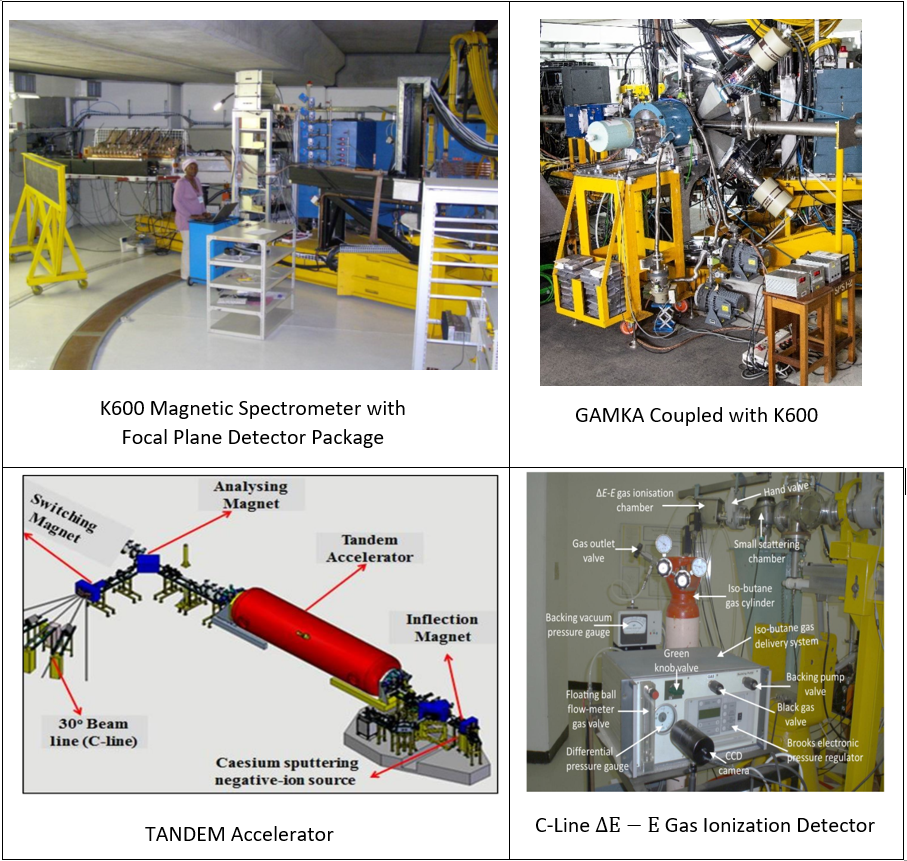
From top, left to right:  K600 Magnetic Spectrometer with Focal Plane Detector Package, GAMKA Coupled with K600, C-Line ∆E-E Gas Ionization Detector, TANDEM Accelerator.

Tandem Laboratory, iThemba LABS (Gauteng) formerly Schonland Institute

Nuclear structure investigations were pursued at the EN Tandem accelerator since the commissioning of the Tandem in 1973 to early 2000. The Nuclear Structure Research Group was one of the most prolific that used exclusively Schonland Institute resources to train higher-degree students. Unfortunately, no further experimental work could be undertaken from 2000 onwards due to the then computerisation of the Tandem accelerator. This remained the case up to the takeover of the Institute by the NRF in 2005 and the running of the laboratory as a National Facility by iThemba LABS. At this time, funding from the DST allowed for the upgrade of the Tandem Laboratory. Reliable light heavy-ion beams became available in 2008, allowing the nuclear structure beam line, the C-line, to be reestablished. A new project continued the investigations of elastic and inelastic scattering and transfer reactions of light heavy-ions on low-mass targets close to the Coulomb barrier. In 2012/13, research activity continued with the set-up of a kinematic coincidence system using a position-sensitive solid state detector and a standard silicon surface-barrier detector to investigate excited states in 12C using the 10B(6Li,α)12C* reaction with particular reference to the Hoyle state. Such low-energy nuclear astrophysics studies are ongoing and are very much dependent on the availability of light heavy-ion beams at the highest possible energy.

Measurement techniques were extended with the refurbishment of the high-resolution ΔE-E Gas Ionisation detector system, which was used for the continuing investigation of the 10B(6Li,α)12C* reaction. Together with the use of the large scattering chamber, a set-up for particle-gamma coincidence and later again for heavy-ion coincidence measurements, these facilities provide for Wits School of Physics Honours and MSc Projects. In addition, during this time, the aging multi-parameter data acquisition WIMPS (commissioned in the early 1990’s as an IBM OS2 CAMAC system) was replaced by the iThemba standard (Linux MIDAS CAMAC system), allowing for greater data rates and more reliability. The light-heavy-ion scattering investigations are ongoing.

Developments at the K600 Magnetic Spectrometer at the SSC Laboratory Cape Town

Funding from the NRF/DFG Germany Agreement (R 1.2m) based on the development of a “Zero-degrees Facility” for the spectrometer. It encompassed building two new vertical drift chambers at iThemba LABS, the purchase of new electronics to read out the over 700 wires with the associated electronics to process these data, as well as a new data acquisition system. While some of the equipment has already been used and commissioned, the completed facility came online towards the end of 2009. This makes the K600 spectrometer and the Grand Raiden Spectrometer at RCNP in Japan the only facilities in the world capable of nuclear studies at zero degrees in this energy range. Experiments were successfully performed in October 2009 and February 2010 utilising the Zero-degrees Facility for the excitation of the Isovector Giant Dipole Resonance (IVGDR) in nuclei across the periodic table from 27Al to 208Pb. A second approved project in 2010, looking at the effects of nuclear deformation in Neodymium isotopes 142,144,146,148,150Nd on the Isoscalar Giant Quadrupole Resonance (ISGQR), was completed in November 2010.

A strong German-Japanese-South African scientific collaboration has been built up, which is now coming into its own and holds promise for continuing excellent work well into the future. This culminated in an international workshop being held in November 2012 - International workshop on nuclear spectroscopy – Frontiers at magnetic spectrometers. South African and German physicists hosted a workshop from 19 to 22 November 2012 as part of the German-South African Year of Science 2012/2013 at the Stellenbosch Institute for Advanced Studies (STIAS) and focused on the physics vision for high-energy-resolution nuclear spectroscopy.

The NSRG of the Wits School of Physics was very fortunate to attract Dr. Luna Pellegri first as a postdoc and now on a joint appointment with the School and iThemba LABS. Dr. Pellegri has taken a leading role over the last few years in the development of the K600 magnetic spectrometer of a very powerful particle-gamma coincidence system. This now makes the K600 a unique facility worldwide for nuclear structure investigations in the medium-energy range.

Ongoing Research Projects
  1. The Pygmy Dipole Resonance (PDR) research from direct reactions PR251/PR298 144Sm/154Sm(a,a,g) at iThemba LABS, PR292: (LNS - Catania)
  2. 58Ni(p,p'g) at iThemba LABS, Trasfer reactions to populate PDR in 96Mo at INFN-LNS (Italy), approved proposal for 154Sm(g,g') at HigS (USA)
  3. PANDORA project (Photo-Absorption of Nuclei and Decay Observation for Reactions in Astrophysics): aims at systematic measurement on electric dipole excitation strengths and decay properties of stable nuclei below the mass of A=56. This project is primarily motivated by the study of the photodisintegration and energy loss processes of ultra-high energy cosmic ray (UHECR) nuclei in extra-galactic propagation.
  4. NUMEN @ iTL: installation of the MAGNEX Focal Plane Detector (FPD) at iThemba LABS to be used as FPD of the K600 magnetic spectrometer for experiments with heavy-ion beams. The purpose is to study Double Charge Exchange (DCE) reactions and competing quasi- elastic channels at incident energy higher than those explored at the INFN-Laboratori Nazion- ali del Sud (LNS) in Catania (Italy) within the framework of the NUMEN project.
  5. African Lanthanum Bromide Array – ALBA: Luna Pellegri is the project manager of the African Lanthanum Bromide Array (ALBA). This array consists of 23 large-volume LaBr3:Ce detectors for gamma-ray spectroscopy.
  6. Stability of the N=20 shell closure (NSCL, GANIL and iThemba LABS).
  7. Photon strength function in 133Xe (iThemba LABS).
  8. Photon strength function and nuclear level density in neutron-rich 67Ni and the impact on the i-process nucleosynthesis (HIE-ISOLDE CERN).
  9. The Scissors resonance in Sm isotopes (University of Oslo, Norway).
  10. The multipolarity of the low-energy enhancement - 56Fe (Argonne National Laboratory, USA).
  11. PR236: Fine structure of the Isoscalar Giant Monopole Resonance in 208Pb, 90Zr, 58Ni, and 40Ca, using alpha scattering at zero degree (iThemba LABS).
  12. PR326a: Fine structure of the IVGDR in 144,148,154Sm isotopes using proton inelastic scattering measurements at zero degrees. (iThemba LABS).
  13. CNSS0117-D8-WITS: Assessment of natural radioactivity in drinking water in the surroundings of former uranium mines: A few Case Studies (South African National Nuclear Regulator).
  14. Evaluation of Nuclear Radiation Damage on Lutetium-Aluminium and Indium Arsenide for Practical Applications Using Neutron Irradiation Technique (Wits-Necsa-MIT, USA)

In addition, local and international funding has been acquired towards research and human capital development within the group. Approximately 60% of our postgraduate students are female and South African citizens from a historically disadvantaged background. The NRF Research Chair in Nuclear Physics Tier 1 (SARChI) led by Prof Mathis Wiedeking under joint appointment with Wits School of Physics and iThemba LABS, provided significant research developments in Nuclear Astrophysics and Nucleosynthesis within the group.

Members of the NSRG
  • Prof Iyabo Usman (Group Leader)
  • Prof Luna Pellegri (Joint appointment Wits/iThemba LABS)
  • Prof Mathis Wiedeking ( SA Research Chair in Nuclear Physics, Wits/iThemba LABS)
  • Prof John Carter (Retired)
  • Prof Elias Sideras-Haddad (Retired)
Graduated Postgraduate Students
  • Ruth Wabwile (MSc 2004)
  • Iyabo Usman (MSc 2006, PhD 2009)
  • Marc Maree (MSc 2009)
  • Maxwel Jingo MSc 2010, PhD 2014)
  • Oscar Kureba (MSc 2010, PhD 2014)
  • Innocent Mayida (MSc 2011)
  • Anna Umeakubuike (MSc 2013)
  • Lindsay Donaldson (PhD 2016)
  • Mouftahou Latif (PhD 2017)
  • Linina Jurbandam (MSc 2018)
  • Lerato Baloyi (MSc 2019)
  • Chane Moodley (MSc 2019)
  • Litebo Ntsohi (MSc 2019)
  • Motshelo Boroto (MSc 2020)
  • Mistura Ajani (MSc 2017, PhD 2020)
  • Sunday Olorunfunmi (PhD 2020)
  • Abraham Avaa (PhD 2020)
  • Ayabulela Tsewu (MSc 2021)
  • Armand Bahini (PhD 2021)
  • Phumlani Sithole (MSc 2021)
  • Sebenzile Magagula (MSc 2021)
  • Sifundo Binda (MSc 2022)
  • Refilwe Molaeng (MSc 2022)    
  • Nthabiseng Mohlala (MSc 2022 )
  • Shanyn-Dee Hart (MSc 2023)
  • Harshna Jivan (PhD 2023)
  • Thulani Mabhengu (MSc 2023)
  • Thuthukile Kumalo (PhD, 2024)
  • Khombo Dumela (PhD 2024)    
  • Samuel Temaugee (PhD 2024)
  • Jacob Bekker (MSc 2022, PhD 2025)     
  • Ally Mathye (MSc 2025)
Current Postgraduate Students
  • Adivhaho Netshiya (PhD)
  • Sifundo Binda (PhD)     
  • Refilwe Molaeng (PhD)
  • Mbulelo Dondolo (PhD)
  • Kgabo Seemela (PhD)
  • Liteboho Ntsohi (PhD)
  • Ruth Wabwile (PhD)    
  • Kgomotso Lefenya (MSc)
  • Makungu Silaule (MSc)
  • Thabo Lepota (MSc)
  • Ephraim Matloba (MSc)
  • Kefentse Molema (MSc)   
Student Awards
  • Refilwe Molaeng was awarded an IAEA Marie Sklodowska-Curie Fellowship for her MSc program with a project focused on the development of proton inelastic gamma scattering detector capabilities used in conjunction with the k600 magnetic spectrometer of iThemba LABS, through the study of low-lying E1 strengths in 58Ni.
  • SAIP 2021 Student Prize winners
    • Sifundo Binda (joint prize for best MSc Oral)
    • Thuthukile Khumalo (prize for best PhD Oral)
    • Refilwe Molaeng (prize for best MSc Poster)
  • Samuel Temaugee received the Advanced Nuclear Science and Technology Techniques (ANSTT) -2022 Award: Best Oral Presentation.  https://twitter.com/Ln_z
  • And South African Institute of Physics(SAIP)-2023, Best PhD Poster (Applied Physics) Award. https://appliedphysics.co.za/awards/
Local and International Collaborations
  • Wits: John Carter, Luna Pellegri, Mathis Wiedeking, Elias Sideras-Haddad, Iyabo.T. Usman, Gordon Cooper
  • iTL: Retief Neveling, F.D. Smit, Lindsay Donaldson, Pete Jones, Peane Maleka
  • UCT: W. Fearick
  • Stellenbosch University: Shaun Wyngaardt
  • University of Johannesburg: Vincent Kheswa
  • Wits Medical School: Sonwabile Ngcezu, Mboyo-Di-Tamba Vangu
  • NECSA:, Armand Erlank, Graham Daniels
  • UJ: Risimati Mavunda, Simon Conell
  • ESKOM: Mosebetsi Leotlela
  • TU Darmstadt, Germany: Peter von Neumann-Cosel, Achim Richter, Joachim Wambach, Johann Isaak
  • U Osaka, Japan: Hirojiko Fujita, Yoshitaka Fujita, Atsushi Tamii
  • PANDORA Collaboration: Principal Investigators: Luna Pellegri (WITS/iTL), Atsushi Tamii (RCNP - Japan), P-A Soderstrom (ELI-NP - Romania)
  • NUMEN Collaboration: Main collaborators: Francesco Cappuzzello, Manuela Cavallaro, Clementina Agodi, INFN-LNL, Italy.
  • JINR Dubna, Russia: Valentin Nesterenko, V. Yu Ponomarev, Nikolay Arsenyev
  • IBS Daejon, South Korea: Panagiota Papakonstantinou
  • Western Michigan University, USA: Elena Litvinova
  • University of Oslo, Norway: Sunniva Siem, Andreas Goergen, Magne Guttormsen, Eda Sahin, Ann-Cecilie Larsen
  • INFN Catania, Italy: Edoardo G. Lanza
  • University of Trento, Italy: Chiara La Tessa
  • FRIB/NSCL, USA: Artemis Spyrou, Sean Liddick
  • Triumf, Canada: Dennis Mucher
  • Lawrence Berkeley National Laboratory, USA: Augusto Macchiavelli, Heather Crawford
  • University of California Berkeley, USA: Lee Bernsetin, Bethany Goldblum
  • Lawrence Livermore National Laboratory, USA: Darren Bleuel
  • GANIL, France: Olivier Sorlin, Antoine Lemasson
  • University de Libre Bruxelles: Stephane Goriely
  • INFN-LNS- Catania, Italy: Francesco Cappuzzello
  • Warsaw University, Poland: Kasia Hadynska Klek
  • Centre for Excellence in Basic Science, Mumbai, India: Dinesh Negi
  • Adelaide Radiotherapy Centre, Australia: Thulani Nyathi
  • Indiana University, USA: Michael Oderinde
Recent International Collaborations grants
  • South African-Joint Institute for Nuclear Research (SA-JINR) collaboration established with grants from SA-NRF and Russia-JINR for the mobility of researchers from both countries. Prof Iyabo Usman serves as the coordinator of the committee for the Nuclear Physics cluster.
  • Prof Iyabo Usman received the Massachusetts Institute of Technology (MIT) Global Seed Fund in collaboration with Prof Mike Shorts, Nuclear Science and Engineering, MIT, USA.
  • Prof Iyabo received the AFRETEC-CMU Inclusive Digital Transformation Research Grant Award 2024 in collaboration with the University of Nairobi, Kenya, and the University of Rwanda, Rwanda.
  • Prof Luna Pellegri received a research grant for SA-JSPS collaboration (2 years) between South Africa and Japan (Osaka) for the PANDORA project in 2021.
Share