

From Wits to careers in global medicine
- DFO
An invitation to try out rowing while studying medicine at Wits University brought Deborah Dunsire and Michael Hall together.
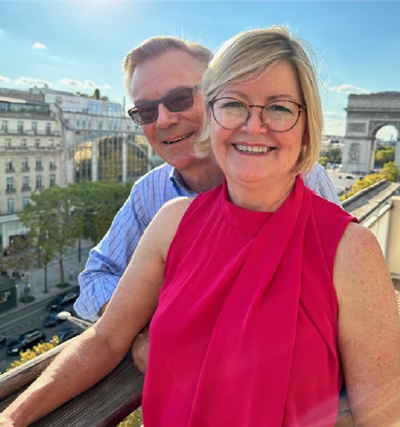 An invitation to try out rowing while studying medicine at Wits University brought Deborah Dunsire and Michael Hall together, forging a partnership that saw them build international careers in the pharmaceutical and biotechnology industries.
Michael was a rower while Deborah was a cox, firmly steering the boat. Deborah says that Michael always tells people that when they first met, “I was sitting in the coxswain seat yelling at him, and that has not changed since.”
Whatever their early relationship dynamic was, they were dedicated to their medical careers, supporting each other as they transitioned into new fields.
After their studies, Deborah practised as a GP in Johannesburg, while Michael worked in orthopaedics and emergency medicine. After a three -year stint as a GP, Deborah was given an opportunity to work in the pharmaceutical industry. She anticipated staying for nine months before becoming a registrar in ophthalmology.
“That company was Sandoz, and I was fortunate to have a wonderful CEO called Roger Trythall, who offered me many amazing opportunities.” The result was that Deborah never returned to mainstream clinical medicine.
Trythall told me that if I really wanted to have a career in the pharmaceutical industry, I needed international experience. So, in 1991, after three years with Sandoz in Johannesburg, I was offered a job at the international headquarters in Basel, Switzerland. Michael happily agreed to accompany me 'for the adventure'.
It was the start of what proved to be incredible careers for both.
Basel was home to three big pharmaceutical companies: Roche, Sandoz and Ciba-Geigy. Eventually, Sandoz and Ciba-Geigy merged to become Novartis.
For Michael, it was initially not quite so easy. “I started by knocking on doors and found that it was hard getting into clinical medicine, as most doctors spoke four languages beyond English and there was a long queue to get in.”
Michael eventually settled into clinical research and drug safety in Basel. “I unintentionally ended up on the clinical research side of Novartis.”
Early in their careers at Sandoz and Novartis, Deborah and Michael both worked in the field of organ transplantation, where Sandoz had pioneered the transformational medicine, cyclosporine.
“This was such an exciting medicine to work on, being the first major immunosuppressant that enabled solid-organ transplantation. And then others followed,” she said.
Michael, on the other hand, was involved in later innovations, including one to help in the acute phase after an organ had been transplanted, as an induction therapy, which intensified the immunosuppression in the post-transplant phase, when there is a high risk of rejection.
“That one was phenomenal. It was one of the early antibodies for which you needed to administer only two doses, which resulted in about a 30% reduction in rejection rates,” he said.
Deborah then moved into the emerging field of oncology, where she had the unique opportunity to be a part of the development and launch of imatinib, a groundbreaking treatment for chronic myelogenous leukaemia (CML) that was the first targeted therapy able to be taken by mouth. It transformed CML from a fatal disease in 3-5 years to one where people can be treated successfully for decades.
Over the course of her career, Deborah had the opportunity to be involved in launching multiple breakthrough therapies, enabling people with cancer to live longer, high-quality lives.
Early in his clinical research career, Michael worked across several areas, one of the most rewarding being the field of rare genetic diseases, such as childhood conditions in which he encountered severe enzyme deficiencies. Some of these cause the accumulation of by-products that can result in toxicity.
“So many of these youngsters die before they reach their teens and are often wheelchair bound. Some of the conditions included Fabry disease, Gaucher disease, and Hunter syndrome,” said Michael. “I was involved in advancing replacement therapy, replacing the enzyme in these patients and essentially putting them back on to a close-to-normal development path and giving them life. Many of these kids are now into adulthood and living normal lives, which is most gratifying.”
Deborah and Michael moved from Basel to New Jersey in 1994 and then to Boston in 2005. Deborah became a serial CEO, and Michael made the switch to biotechnology clinical development leadership in Boston, the major US biotech centre.
Apart from her tenure at Novartis, Deborah served in major leadership roles in Boston at Millennium Pharmaceuticals, Takeda Oncology, Forum Pharmaceuticals and XTuit Pharmaceuticals.
In 2018, the couple moved to Copenhagen for five years when Deborah took the position of CEO at Lundbeck, a pharmaceutical company that focuses on transforming outcomes for people living with mental illnesses and diseases of the brain. Michael took up the chief medical officer role at Zealand Pharmaceuticals.
They recently returned to Boston, where Deborah serves on several corporate and non-profit boards and where they have their family home.
Both Deborah and Michael are devoted to Wits and credit the university with much of their success, including the quality of their medical training, where they were expected to take on real responsibility.
They are among the list of Wits’ major donors. They originally decided to lend their support to Wits because they realised that in the US it is commonplace for alumni to support their universities later in life.
They believe that it is important to support the institution that gave them so many opportunities to build successful careers.
Initially, they started supporting students, particularly through a bridging programme that Wits used to run to help less advantaged students transition into the University’s academic environment.
Now they are engaged in supporting the Wits Interdisciplinary and Translational Science BioHub, which is currently being built in Houghton, Johannesburg.
Wits has described it as Africa’s first fully integrated “bedside-to-bench-to-breakthrough” innovation campus. The idea is to bring scientists, clinicians, researchers, entrepreneurs, and industry partners together, rather than having research carried out in separate institutional silos.
In effect, it is a development that resonates strongly with Deborah and Michael, and they cannot wait to see what it produces in innovative research and human capital.