

A partnership built on ambition, resilience and family
- DFO
Despite distance and many decades, South Africa and Wits remain important and foundational parts of Gail and Allan Kelly's story.
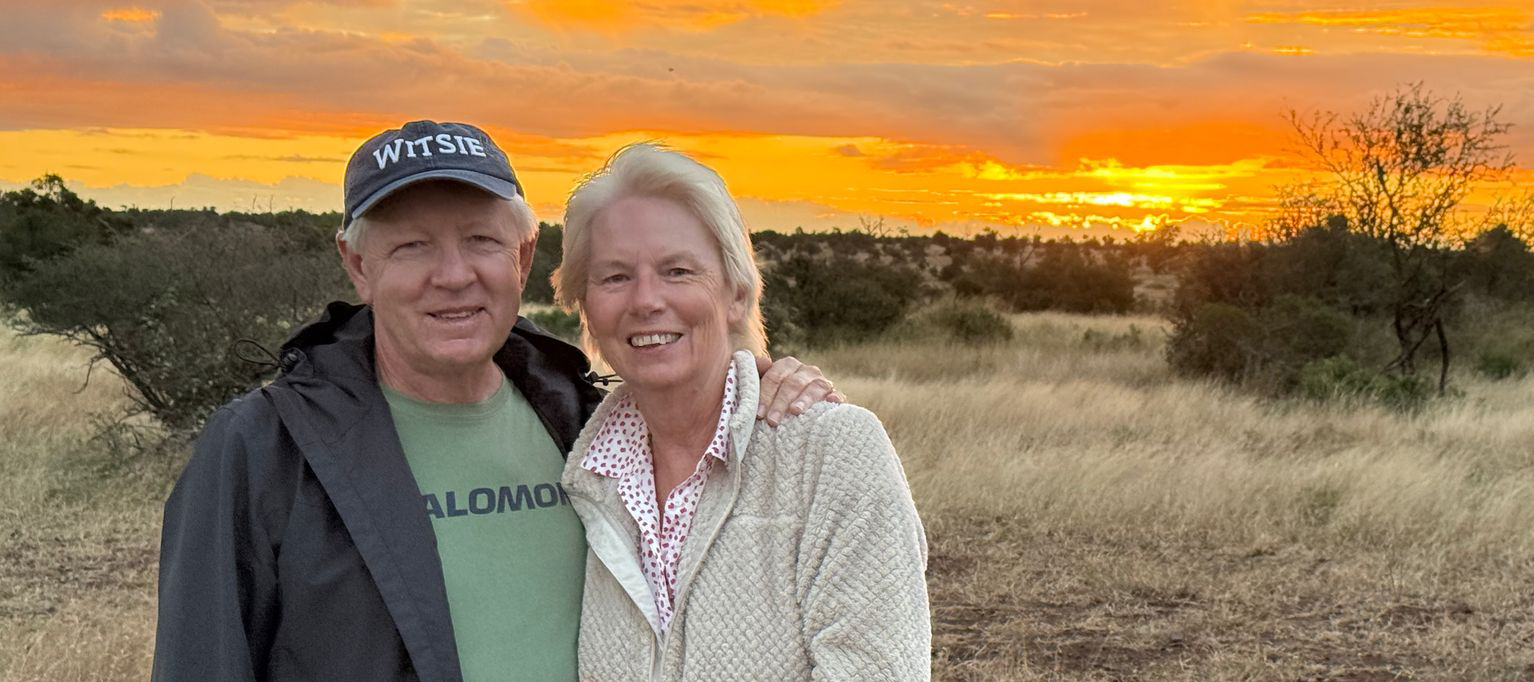 From UCT via Zimbabwe to Wits, and ultimately to Australia, Gail and Allan Kelly have followed very different professional paths. Yet their careers have complemented each other, and their shared southern African roots have remained an important part of their lives.
When Gail and Allan met as students at the University of Cape Town, neither could have known quite where their lives would lead.
Allan grew up in Bulawayo, and Gail many miles away in Pretoria. They met and fell in love while studying for their undergraduate degrees at UCT in the mid-1970s. Allan completed a Bachelor of Social Science and Gail a Bachelor of Arts, majoring in Latin and History. In keeping with her long-held dream to be a teacher, she went on to do a diploma in education.
After completing his degree in 1976, Allan returned to Bulawayo where he worked for a year as a social worker. Although Gail was still at university, they got engaged in early 1977 and married in December of that year. The first year of marriage was spent apart as Allan had been conscripted into the Rhodesian army. Gail managed to secure a position as a Latin teacher at Falcon College, which is a private boys’ boarding school deep in the bush way off the main road between Bulawayo and Beit Bridge. Thus it was that their year of engagement and their first of marriage were spent mostly apart. Many letters flowed between them, lovingly handwritten on whatever paper was available.
In the army, Allan trained as a medic, and it was thanks to this, and his exposure to rural clinics and hospitals, that he developed an interest in healthcare. This led to him applying for an MBBCh at Wits Medical School. His studies began in 1979, setting him on a lifelong career in medicine.
Upon returning to South Africa, the couple rented an apartment in the now infamous suburb of Hillbrow. Allan spent his days on the Wits Braamfontein campus in first-year medicine, and Gail sought to continue her teaching career. Gail had loved her year at Falcon College but found life in the public school system in Johannesburg rather disheartening. Not knowing what else she could do with a Latin and History degree, she got a job as a teller at the Perm Building Society. Her potential was soon recognised and she was sent on an advanced management programme. She rose steadily through the ranks at The Perm and subsequently Nedbank, and in the mid-1980s thought about embarking on an MBA at the Wits Business School.
Gail said, “I had applied for a place for 1986, but as luck would have it, somebody dropped out of the 1985 intake. Notwithstanding the short notice, Nedbank was very supportive and granted me a year’s study leave at short notice.”
Allan graduated from Wits in 1984 and went on to specialise in paediatrics, obtaining his FCP in 1990. Over the years he rotated through all the major Johannesburg public hospitals, the then ‘Joburg Gen,’ Coronation, ‘J.G. Strijdom’ and ‘Baragwanath’.
Gail recalls Allan's contribution with pride. “In addition to his work in general paediatrics and neonatology, he established an HIV clinic, supporting mothers living with HIV and their children, as well as initiatives addressing domestic violence.” For Gail, his departure from South Africa represented a loss to the public health care system as much as a change for their family.
Gail credits her Wits MBA, which she completed with distinction, with giving her more than financial and management skills. It taught her to back herself and gave her the confidence to take the next step in her career.
In the meantime, the couple’s family was growing. Following the birth of their daughter in 1986, the Kellys welcomed triplets, a daughter and two sons, in 1989. It is worth noting that all the children were born at the Joburg Gen where Allan was working as a paediatric registrar. Just a few months after the birth of the triplets, Nedbank offered Gail the position of General Manager of Human Resources. She assumed the role when the triplets were a year old. Within two years she was appointed as CEO of the Group’s Card Division, the first real line job she had occupied with full profit and loss responsibility.
“My rise through the banking sector was not driven by an ambition to become a chief executive. Instead, I concentrated on doing the best job I could do in each position.”
Gail’s willingness to work hard, contribute to teams and take on responsibility meant that others identified her as having potential and offered her opportunities even before she felt ready for them.
In 1997, Allan and Gail decided to emigrate to Australia to forge a new path for themselves and their family. It was not an easy move. Their eldest daughter, 11 years of age, and the triplets, eight, had to be settled into schools. While Australia recognised Allan’s undergraduate MBBCh, they did not accept his South African qualification in paediatrics. As a result, he had to undertake a year of ‘supervised training’ as a paediatric registrar and complete the Australian FRACP written and clinical exams. His subsequent choice of employment, as had been the case in South Africa, was to work in the public health system.
Life in Australia was also initially challenging. “Studying to requalify, working busy jobs and managing a family of four children with little support was like burning the candle at both ends. However, it did make us stronger as a family because we relied on each other totally,” Gail said.
Gail’s first position in Australia, which capitalised on her experience at Nedbank, was General Manager of Strategic Marketing at the Commonwealth Bank. From there she was promoted to head of the Customer Service Division, making her a member of the bank’s Executive Committee. In 2002, Gail was appointed CEO and Managing Director of St George Bank, Australia’s fifth largest bank, thus making her the first woman to head a significant Australian Bank. Under her leadership, the bank doubled its assets and net profit after tax.
In 2008, Gail was appointed Managing Director and CEO of Westpac Bank. Her first major challenge was amalgamating Westpac and her former bank, St George, in an AUD$18.6 billion merger. She successfully led Westpac through the 2008 financial crisis and retired in 2015 after a highly successful CEO career spanning 13 years. She has since moved into a “portfolio career” that involves serving on international corporate boards, performing a range of advisory roles, as well as academic, leadership and philanthropic work.
The Kelly children all live in Sydney, and all within half an hour of one another and their parents. The eldest daughter, Sharon, is a high school educator with three masters degrees and three children of her own. Of the triplets, Sean is a doctor nearing the end of his training in emergency medicine, Mark is a mechanical engineer in the renewable energy space, and Annie works in marketing and has two young daughters. The Kellys retain a strong connection to Wits, with plans for a family visit that will allow the next generation to explore the university that played such an important role in their parents' lives.
For Gail, that connection remains deeply emotional.
Although she has spent decades in Australia and received honorary doctorates from several Australian universities, the Wits honorary doctorate she received in December has special significance. South Africa, she says, remains an essential part of who she is.
Gail says that her parents placed a strong emphasis on education and taught her to work hard, to take responsibility, to look for opportunities and, above all, to back herself. Those lessons became central to the career that followed. The family's philanthropic outreach occurs through their Savannah Foundation and supports a number of charitable endeavours around the world, including funding two bursaries for Wits medical students through the Wits Centenary Fund.
For Gail and Allan, success has been about more than individual achievement. It has been a shared journey beginning with strong foundations in family and built on the excellent education available in South Africa and Zimbabwe. It has been about purpose, commitment, and the determination to make a difference wherever they have found themselves. It has been a journey of self, a journey of family, and a journey of community, of working with others in the wonderful African spirit of Ubuntu. It has been a journey of success built on the power of one and the power of many.
Despite all the distance and the many decades, South Africa and Wits University remain important, indeed foundational, parts of their story.