

Shaping the future of finance
- Wits University
Captains of industry convene to hear fintech ‘big bets’ from Wits researchers and to ‘open lines of enquiry for intellectual partnerships'.
Captains of industry from across the financial sector gathered at the Wits Anglo American Digital Dome on Tuesday, 3 February, for an invitation-only fintech research showcase that brought together CEOs and senior leadership from banking, fintech, and investment as well as eminent alumni and friends of Wits.
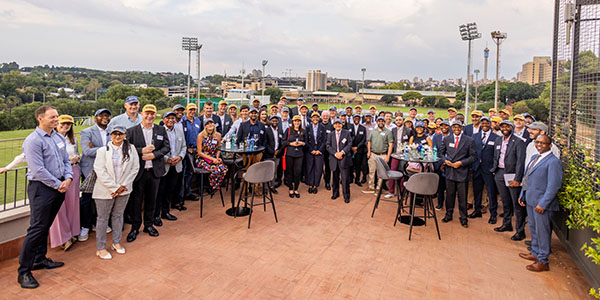
The sunset soirée and designer dinner created a high-level forum to explore how AI, quantum computing, and emerging technologies will shape the future of finance, and to open pathways for long-term intellectual partnerships.
The interdisciplinary showcase highlighted Wits University’s role in advancing and interrogating cutting-edge technologies—including artificial intelligence, quantum computing, blockchain, digital currencies, and data analytics—and their growing influence on the financial sector.
The event was convened by Wits alumna and Board of Governors member Ms Fatima Vawda, who is Group Executive and Head of Public Markets at 27Four, which co-sponsored the evening.
Director of Development and Fundraising Mr Peter Bezuidenhoudt served as Master of Ceremonies, while Vice-Chancellor and Principal Professor Zeblon Vilakazi FRS welcomed guests to “this conversation around the intersection of finance technology and institutional responsibility.”
Providing historical context, Vilakazi reminded the audience of Wits’ long-standing contribution to innovation. “One of the pioneers of AI is a Wits alumnus, Professor Seymour Papert, who was a professor at MIT, [and who] studied mathematics here at Wits in the 1950s. So we’ve always been in this game.”
The Vice-Chancellor encouraged industry leaders to engage beyond conventional funding models. “Not just transactional partnerships, but intellectual partnerships. That’s what this evening is about – to open lines of enquiry…We do not offer certainty, but we offer perspective.”
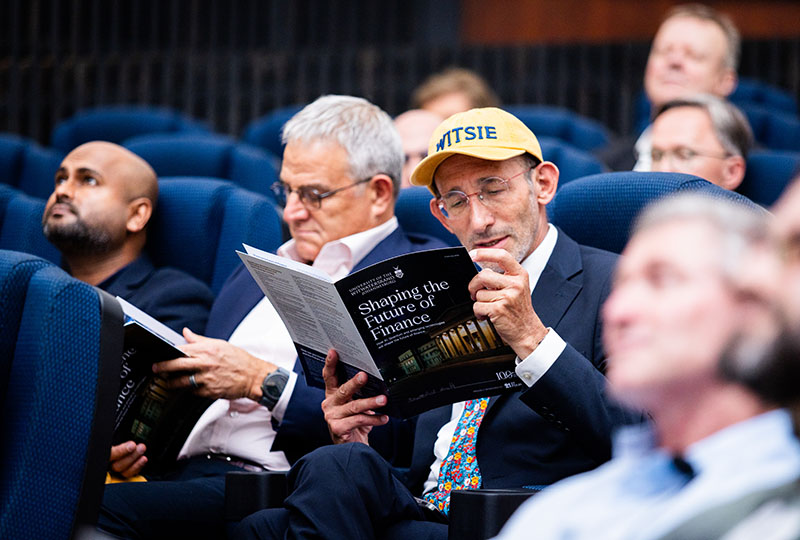
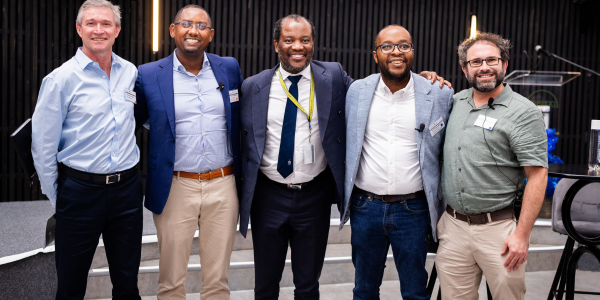
Professor Solomon Assefa, Vice-Chancellor’s Special Advisor and former Vice President of IBM Research led in-depth Q&A sessions with four Wits researchers presenting their work and its relevance to the fintech leaders.
“The moment that we’re in now in financial services is being reshaped profoundly: not just by technology, but also by geopolitical realities and changing expectations from society as well," said Assefa. "Coming back to the technology aspect – data, AI, fintech, quantum tech – they’re not really ‘future bets’ anymore; they’re already influencing relationships between nation states, policies and regulations, and how institutions compete.”
“We have been deliberately leaning into these ‘big bets’ with major investments into science and technology…not only on the frontier science, but also the applications through interdisciplinary platforms that connect them and research that’s happening with real-world partners,” said Assefa. “Tonight, four stellar professors from Wits will give you a glimpse into these ‘big bets’ we’re making.”
The speakers were Professor Andrew Forbes (Physics), Professor Rendani Mbuvha (Statistics and Actuarial Science), Professor Chimwemwe Chipeta (Economics and Finance and Director of the FinTech Hub), and Professor Benjamin Rosman (Computer Science and Applied Mathematics and Director of the Wits MIND Institute).
A quantum-literate workforce
Quantum physicist Professor Andrew Forbes, who leads South Africa’s National Strategy for Quantum, emphasized that quantum technologies have moved from theory to application. “We’ve moved from science fiction very much into the realm of science. This is a 100-year-old theory; the physics is not in question. What’s happened in the past 20 years is that we’ve transitioned from science to technology.”
Forbes stressed the need for industry readiness. “We want to see, not quantum students, but a quantum workforce, and we want to see industries and business that are quantum-literate.”
Explaining fintech relevance, he said, “In quantum communication, if a bank wants to talk to a customer, we can help show you that you can do this without transferring data between the two parties, so there’s no interception that can take place.”
Mobile money and regulation
Professor Chimwemwe Chipeta, Director of the FinTech Hub and board member of the Centre of Excellence in Financial Services, outlined the sector’s shared challenges. “Every executive that's present tonight is facing the same set of challenges right now,” he said. “The first is AI disruption, the second is regulatory pressures, and the third is the skills gap in AI and financial data science.”
“The fundamental constraint organisations face is the need to develop capabilities to close that skills gap. That is precisely why the fintech hub was established,” Chipeta added.
He identified mobile money as a major success story. “I think mobile money payments have really revolutionized the way we transact. Today about 50% of mobile money account holders globally are based in southern Africa.” The next frontier, he argued, lies in interoperability and cross-border regulatory settlement—his “magic wand” opportunity.
From climate risk modelling to protecting life and property
Actuarial scientist Associate Professor Rendani Mbuvha presented three interlinked problem statements: managing financial risk in a rapidly changing environment, addressing climate risk in Africa, and training professionals who can responsibly sign off advanced models.
With a focus on “enhancing the toolbox of the statistician,” Mbuvha highlighted Wits’ Master’s programme in predictive analytics for financial services. “We're looking at how you use these tools in product development, pricing, etc.”
Drawing on his experience as a Google Fellow, he described work on GraphCast, an AI-based global weather forecasting model. “What we were trying to do was to say, ‘well, how does this model actually work over Africa?’…What we saw is that there was a suggestion that the model was actually more accurate over Africa than the rest of the world.”
“But it’s not just about modelling,” Mbuvha emphasized. “It’s about what action you take using the models.” Early prediction of fires or floods only matters if institutions act on it. “Are these tools being adopted by the entities that are supposed to respond to this type of hazards?”
“This is the African opportunity,” he said. “We've got a big talent pool of young engineers who can actually build the tools to support these entities…That’s our theory of change.”
Tomorrow’s intelligence
Closing the evening, Professor Benjamin Rosman reflected on the pace of AI advancement. “There's been this huge shift in the world in the last three-and-a-bit years…we’re going from AI making pictures and writing text, to actually starting to make decisions for us.”
Rosman outlined three “big bets”: decision velocity as a competitive advantage, hybrid human–AI workforces, and increasingly operational risk as AI autonomy grows. “People tend to be thinking about last year's AI rather than tomorrow's AI,” he warned. “And with an area that's accelerating all the time, this becomes more and more risky.”
Through the MIND Institute, Rosman said, Wits aims to partner with organisations willing to help shape that future. “I want to support and engage on this broader mission, not just a narrow focus into what AI is today based on yesterday's technology.”