
From injury to innovation
- Wits University
What began as a child’s encounter with trauma has grown into a research programme committed to understanding recovery.
When she was in Grade 5, Dr Gillian Mahumane’s father suffered a traumatic brain injury. The sudden event altered not only his life but also Gillian’s family’s lives.
Before the injury, Gillian’s father had been a witty and thoughtful English teacher who often brought encyclopaedias home for his daughter to explore. Gillian relished those books.
The injury that followed, and the profound changes it brought to her father’s personality and abilities, left Gillian with an early awareness of how fragile the human brain can be.
For a child, this was not an abstract encounter with illness or disability. It was a confrontation with the unsettling reality that injury can transform the essence of someone you love and notions of ‘personhood’.
Years later, neural regeneration science would give language and direction to questions she had already lived with for much of her life.
Rethinking brain tissue
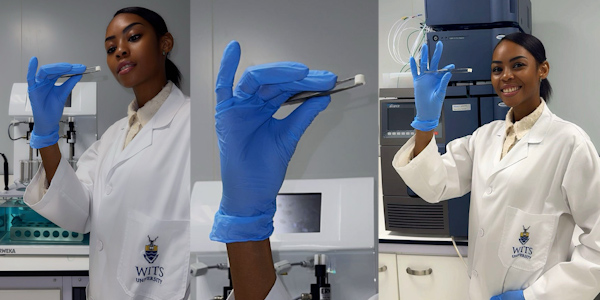
Today, Gillian is a researcher at the Wits Advanced Drug Delivery Platform (WADDP) and lectures biopharmaceutics in the Pharmaceutics division of the Department of Pharmacy and Pharmacology at the University of the Witwatersrand.
Her work at WADDP explores the interface between advanced therapeutic systems and the delivery of treatments that might also help create the conditions for recovery, reconnection, and restoration in tissues where damage has profound functional and human consequences.
Despite her early personal connection to brain injury, Gillian’s entry into neural tissue engineering happened almost by chance. As a student, she volunteered to rove the microphone during a lecture by the late Professor Viness Pillay. Instead of focusing only on the logistics of the event, she found herself absorbed by the science being presented.
Pillay described experiments demonstrating that rats could regain movement after implanting neural scaffolds.
“It was a bolt of lightning,” she recalls. “Realising that brain tissue can heal under the right conditions.”
That moment helped define the direction of her scientific career.
A mind for meaningful innovation
Gillian approaches the field through a translational pharmaceutics lens, combining material design, dosage-form thinking, and biological realism to develop therapeutic systems that are not only conceptually elegant but also usable and responsive to real clinical constraints.
Her scientific philosophy is anchored in the belief that meaningful innovation must be mechanistically sound, experimentally defensible, and ultimately oriented toward human need rather than novelty alone.
This is a long-standing tradition at the WADDP that holds the largest pharmaceutical patent portfolio on the continent.
Neural tissue engineering
Gillian’s doctoral research, supervised and completed at the WADDP, focused on the development of nano-reinforced hydro-filled three-dimensional scaffolds for neural tissue engineering.
The work explored how carefully designed biomaterial systems could provide structural support, biological compatibility, and therapeutic potential in contexts where damaged neural tissue has limited capacity for spontaneous repair.
Central to this research was a question that remains fundamental to her scientific identity: How can therapeutic interventions respect the complexity of injury while still making recovery more possible?
Answering this question required work across scaffold architecture, polymer selection, electrospun nanofibrous systems, hydrogel and cryogel design, drug incorporation strategies, and advanced physicochemical characterisation.
Rather than treating formulation as a downstream technical step, Gillian sees it as a site of scientific reasoning where therapeutic performance can be shaped through deliberate material and biopharmaceutical choices.
Repurposing therapeutics
One area that captured her interest early in the PhD was therapeutic repurposing, where she explored whether familiar medicines might take on new therapeutic roles when incorporated into advanced delivery systems.
“We realised that a familiar drug like N-acetylcysteine (NAC), which many people recognise from over-the-counter medicines used to loosen mucus, might be repurposed for local delivery within biomaterial scaffolds to help address secondary injury processes after trauma,” she explains.
When incorporated into a scaffold, NAC could help create a more favourable microenvironment by reducing oxidative stress and supporting cellular repair processes.
Although neural regeneration remains an important focus of her research at WADDP, Gillian has expanded to encompass a broader range of therapeutic technologies. Her work at the WADDP now spans advanced drug delivery systems for women’s health applications, antimicrobial innovation, and molecularly selective therapeutic materials.
Therapeutic platforms for integrated impact
Across these different domains, the unifying principle remains the same: the rational design of therapeutic platforms whose composition, responsiveness, and mode of action are matched to the biological environments in which they must function to make a clinically meaningful impact.
Gillian’s work is also marked by a refusal to separate scientific inquiry from the lived conditions that make it meaningful. Whether she is studying neural repair, infection control, or next-generation therapeutic technologies, she returns to the same underlying concern: how science can respond to vulnerability with rigour, imagination, and care.
In this sense, her focus area at the WADDP is about innovation and dignity, restoration, and the long often difficult work of building better therapeutic futures.
Recently, Gillian was awarded a Fellowship to the Population Council to develop a drug-eluting device for heavy menstrual bleeding (HMB). She is also involved in cross-institutional projects at WADDP with partners at the Medical University of Warsaw.
Beyond the laboratory, Gillian is committed to strengthening African scientific participation in global knowledge production. As a member of the Global Young Academy and a UCL-Wits Public Voices Fellow, she contributes to international conversations about science, research translation, and the broader societal stakes of biomedical innovation. Her work in these spaces reflects a commitment to communicating scientific research with clarity, ethical seriousness and public relevance.
She is equally dedicated to capacity building. Gillian mentors students at the undergraduate and postgraduate levels through peer-development initiatives and works to foster research cultures in which technical training, critical thinking, and scientific communication develop together.
Scientific ecosystems build health sovereignty
For Gillian, effective research depends on more than scientific insight.
“Effective research depends on interdisciplinary collaboration, specialised infrastructure, regulatory navigation, intellectual property stewardship and partnerships that can carry ideas beyond the laboratory,” she explains. “Moving a discovery from concept to product is a long and exacting process that is rarely linear, and it cannot be sustained by scientific ingenuity alone.”
This is why forward-thinking research and innovation platforms such as the Wits Advanced Drug Delivery Platform are so important.
For Gillian, WADDP is not only a research home, but part of the scientific ecosystem required to build health sovereignty. By bringing together diverse experts, the platform creates conditions for African-led health innovation that is scientifically rigorous, locally grounded and globally connected.
In this context, health sovereignty refers to the practical ability to identify priority health challenges, develop context-relevant therapeutic technologies, protect and translate intellectual property, strengthen local capacity and contribute to the long-term possibility that pharmaceutical technologies for African populations can increasingly be designed, evaluated and produced through African knowledge systems and institutional partnerships.
Achieving this goal requires more than individual discoveries.
“It requires ecosystems,” Mahumane says. “Spaces where scientists, pharmacists, engineers, clinicians, innovation offices and industry partners can work in concert rather than isolation. It also requires a deliberate commitment to capacity-building so that technical expertise and scientific leadership are cultivated across generations.”
Gillian’s scientific progress is therefore inseparable from the broader networks that sustain it. Public trust, regulatory stewardship, community engagement and cross-institutional partnerships all shape whether scientific advances remain isolated outputs or evolve into technologies that genuinely benefit society.
Yet beneath this expansive vision lies the same intimate starting point that first drew her toward science.
At its heart, Gillian’s work remains a lifelong attempt to give scientific form and then therapeutic consequence to questions first born of injury, loss, and the hope of repair.
What began as a child’s encounter with trauma has grown into a research programme committed to understanding recovery and to help create the scientific and institutional conditions that make it possible.