

From genomic discovery to better health in Africa
- Wits Faculty of Health Sciences
Genetic tests are increasingly moving towards clinical use on the continent. It requires investment in development, skills and health services.
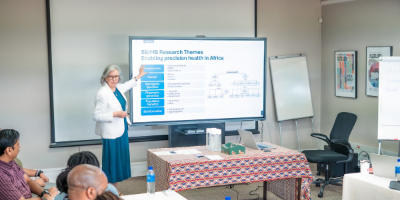
African researchers are developing genetic tests that could help doctors choose medicines and diagnose unexplained childhood conditions. Professor Michèle Ramsay argues that getting these products into everyday healthcare requires sustained investment in their development and the services that will use them.
Speaking to the African Genomics Centres of Excellence, Ramsay called for national commitments to integrate genomics into health services, supported by skills, partnerships and technologies developed with affordability in mind.
Her presentation, From Genomic Insight to Real-World Products, examined what it takes to turn a discovery into a useful test or intervention. Ramsay, who is the director of the Sydney Brenner Institute for Molecular Bioscience (SBIMB) at Wits University, presented examples already moving towards clinical use, alongside the work still needed to establish their value and make them accessible.
Tests that could change decisions
GenoPharm, developed by the African Institute of Biomedical Science and Technology, examines variation in 40 genes relevant to drug response, with implications for more than 100 medicines. Ramsay traced its development through analytical validation, a licence to manufacture a medical device and pilot clinical deployment in an African context.
This is pharmacogenomics: using genetic information to help guide the choice of medicine or dose where evidence supports it. A test must measure accurately, and its results must be useful to clinicians making prescribing decisions. Training and guidance are part of bringing that product into practice.
The Deciphering Developmental Disorders in Africa project (DDD-Africa) offers another example. As the project advances, the investigators are reporting a diagnostic yield comparable to studies conducted in the global north. For families seeking an explanation for a child’s condition, a diagnosis can inform care and genetic counselling, even when no cure is available.
The study also revealed many novel variants of uncertain significance in African families that require further investigation.
These applications give practical meaning to a challenge posed by Sydney Brenner in 1994, quoted in Ramsay’s presentation: “How to understand genomes and how to use them is going to be a central task of our research for the future.”
Understanding what genes do
Brenner also warned against biology becoming so focused on genes that it overlooked cells, the units in which their products function. Reading a genome gives researchers an inventory. Understanding what those instructions do within cells helps explain their consequences for health.
Research involving Black South African children with nephrotic syndrome illustrates this connection. The condition causes damaged kidneys to leak protein into the urine. A variant in the NPHS2 gene has been linked to resistance to steroid treatment in children with a particular form of kidney scarring.
The gene provides instructions for podocin, a protein involved in the kidneys’ filtration barrier. The V260E variant disrupts the protein’s location in the cell. Understanding this effect helps explain the clinical finding; testing could help clinicians anticipate treatment response and provide genetic counselling to families.
Evidence that reflects Africa
Developing reliable products also requires data that reflect the people who will use them. African populations have the greatest human genetic diversity, yet remain poorly represented in much of the research linking genetic variation to disease.
Ramsay highlighted the AGenDA project, which expands genomic datasets to include previously understudied African populations. Linking these data with clinical characteristics, behaviour and environmental exposures helps researchers interpret genetic findings in context.
Diversity within Africa matters too. It is well documented that a risk model developed elsewhere may perform poorly in an African population, but it is also now evident that findings from one African region may not transfer to another. Products therefore need validation in the populations they are intended to serve.
For South Africa, this work sits within a broader precision health approach. Ramsay, a co-chair of the Lancet Commission on Precision Health, emphasises that in addition to genetic and biological information, precision health needs to include data related to the environment, behavioural and social contexts.
The Commission emphasises tailoring prevention and care to groups with relevant shared characteristics, while considering effectiveness, safety, access and costs. Genomic information contributes to this approach when it helps answer a health question and supports a useful decision.
What it takes to reach patients
Ramsay’s definition of a product includes the resources that enable discovery and delivery: data, knowledge, trained people and partnerships. She identifies a need for bioinformatics and data science skills, alongside expertise in developing products and bringing them into use.
Product development also demands expertise that may sit outside a research team. Partnerships with industry can help turn a laboratory method into a test that can be produced and supplied, while regulatory oversight is needed as products move towards use in health services.
Collaboration between researchers, clinicians, industry, government and regulators is essential. Data sharing needs clear rules on consent, privacy and access. Communities need opportunities to shape research and how its benefits are developed and delivered.
Health services must also assess whether a product addresses a relevant need and offers value. That means evaluating patient outcomes alongside the costs of testing, training staff and providing the care that follows. Savings cannot be assumed simply because a technology allows more precise decisions.
A result must reach a clinician who can interpret it, and patients must be able to obtain the treatment at an affordable cost, together with the counselling or follow-up it indicates. These requirements make funding for implementation as consequential as funding for discovery.