

Mental Health Science Fair Highlights Synapses of Support
- FHS Communications
Mental Health and Neuroscience Fair
In neuroscience, synapses connect nerve cells to enable thought, memory, and movement. Similarly, communities thrive when care, mentorship, and solidarity create networks of support. High readmission rates in psychiatric hospitals show that treatment alone is not enough—community care is essential.
“Mental health remains a global challenge. In Africa, countless cases go undiagnosed or underdiagnosed, and access to appropriate care is far from optimal,” noted Professor Aletta Millen, Faculty of Health Sciences Assistant Dean for Research. She says addressing systemic barriers, cultural perceptions, and resource limitations is essential to transformative action.
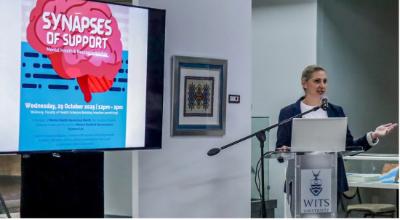
Caption: Faculty of Health Sciences Assistant Dean of Research, Professor Aletta Mille, speaking at the Mental Health Fair
On 29 October 2025, in honour of Mental Health Awareness Month, the Faculty of Health Sciences hosted its first Mental Health and Neuroscience Fair, featuring research-focused mental health presentations and stimulating activities.
The fair focused on mental health to encourage collaboration in an increasingly competitive research environment. By breaking down silos between clinicians and basic researchers, the event fostered stronger networks capable of securing impactful funding opportunities.
Science Meets Community
The event organiser, Professor Sooraj Baijnath, explained that the theme for the fair, ‘Synapses of Support’, showcases research in ways that allow audiences to engage. “The idea was to give researchers around the faculty an opportunity to showcase their research by providing different types of stalls where they could allow, viewers and spectators to interact with the research that they're doing to give a practical overview of what they are doing and how it impacts the community,” he said.
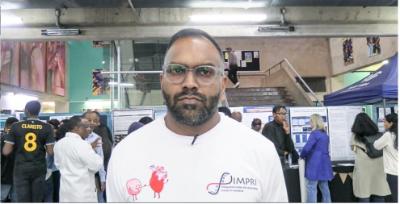
Caption: Associate Professor Sooraj Baijnath event organizer and co-founder of the Integrated Molecular Physiology Research Initiative (IMPRI) at the Wits Faculty of Health Sciences.
The highlights of the day included mapping the neuro‑circuit of emotion, exploring the gut‑brain axis (a system where gut microbes, nerves, and hormones influence both physical health and mental wellbeing), and using big data to redefine diagnosis and treatment. More than research, the day was about community, networking, and collaborating to address South Africa’s pressing health challenges.
Education and Empowerment
The five-minute-long “pop-up” presentations spanned various disciplines, demonstrating the complexity of mental health. From policy translation to treatment‑resistant depression. They also explored topics like innovations in neuropsychopharmacology, advanced drug delivery, and neurodegeneration. Other sessions highlighted students’ mental health, linking some cases to childhood traumas and vulnerabilities.
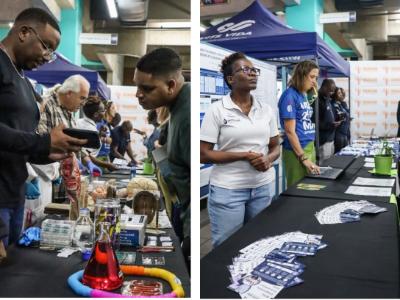
Caption: Stalls showcasing ongoing within the Faculty of Health Sciences and its research entities.
Accelerating neuroscience research
Professor Paul Manger, Research Professor at the Department of Anatomical Sciences, presented on the BRICS Neurosciences Society, which aims to establish a lab in each BRICS-affiliated country. Neuroscience is the study of the brain’s structure and function, including thoughts, emotions, and behaviours.
“We’re now drawing up documents between the governments across the BRIC countries and we’re hoping that next year we could start with phase one which is establishing the BRICS Neurosciences consortium which are five national key laboratories. One in each BRIC country,” explains Manger.
This initiative has the potential to put the spotlight on the universal surge in mental health diseases and disorders. “In the last 30 to 40 years, not a single neurological disease has been cured. Despite the amount of work done on so many different things. So, we thought we’re going to try something new.”
Set to begin in 2027, the program will offer 15 funding opportunities to support pioneering research advancing mental health treatments.
Up to 50 student, post-doctoral and staff travel fellowships will be awarded each year, with a total annual investment of $USD 500,000.
 Caption: Professor Paul Manger presenting the BRICS Neurosciences consortium initiative
The fair was enriched by the Art for Mental Health Exhibition, which showcased artwork by faculty staff, students and alumni. This annual exhibition runs throughout October to observe Mental Health Month. This year’s exhibition was themed ‘Glimmer’ – the opposite of a trigger. It comprised a cultural gallery of students' paintings, music, and photography, reminding us that mental health can be created both clinically and through creative therapy.
In conclusion, the inaugural Mental Health and Neuroscience Fair demonstrated that science and community are strongest when they connect. By combining research, creativity, and collaboration, the Faculty of Health Sciences highlighted both the challenges and the possibilities of mental health in South Africa and beyond. The fair not only showcased groundbreaking innovations but also fostered dialogue, cultural expression, and support networks.