West Coast Resources seeks cost order to silence community activist
Dawid Markus is a community activist from Hondeklipbaai in the Western Cape. For many years, he has been working tirelessly on environmental issues affecting the area. He aims to ensure that his community does not lose access to their land, that the mines in the area follow the correct environmental processes and that they provide benefits to the community. One such operation is a nearby diamond mine run by West Coast Resources (Pty) Ltd.
Since West Coast Resources took over the operation from De Beers, Mr Markus has made a number of attempts to meet with senior management at the company to discuss the mine’s impact on his community. In November 2016, he was involved in a small protest in a further effort to secure such a meeting with the mine’s managers. In response, the mining company sought an interdict against Mr Markus as a way to silence protest and prevent him from exercising his constitutional right to peaceful and unarmed demonstration. This process involved a number of court appearances, with a final interdict being partly granted against him while he did not have full legal representation.
West Coast Resources is now seeking an order of costs against Mr Markus, claiming that a disabled community activist should be responsible for their legal fees. The Centre for Applied Legal Studies (CALS) is representing Mr Markus in court today, arguing that there ought to be no order of costs against him where the mine was only partially successful in its application, and where he sought to defend his Constitutional rights.
“This is just one example of the kind of victimisation facing activists every day,” says CALS Deputy Director Lisa Chamberlain. “Granting an order of costs here would be financially devastating for a person who is simply acting in the best interests of his community by trying to ensure that mining companies follow the law.”
The matter is set to be heard on 3 February 2017 in the Northern Cape High Court, Kimberley.
Legal challenge to the transformative aspirations of the Mining Charter continues
The Mining Charter was first introduced in 2004 as a means of addressing the historical inequalities in the mining sector based on, for example, race and gender. The Charter aims to advance meaningful transformation and sustainable development in the industry by introducing a number of requirements for mining right holders. Many of these are already improving the lives of mine workers and their families, such as the requirement to convert overcrowded, dehumanising hostels into family units.
While the Mining Charter has so far been treated as a binding legal document, Malan Scholes Attorneys seeks to challenge this. In June 2015, the firm launched proceedings against the Department of Mineral Resources in the North Gauteng High Court, arguing that the Charter provides only guidelines that should not be interpreted as mandatory requirements.
On 15 March 2016, Judge Rabie of the North Gauteng High Court ordered that the Centre for Applied Legal Studies (CALS) be admitted as amicus curiae or ‘friend of the court’ in the matter. CALS recognises the importance of this case and seeks to assist the court by presenting evidence concerning the historical and persistant racism of the extractive industry in the country. Our legal submissions highlight the importance of the Charter in transforming the extractives industry.
“Having a binding Charter is critical for comprehensive transformation and addressing exploitation in the mining sector,” said Nomonde Nyembe, attorney at CALS. “If the applicants got their relief in this matter, it’s possible that transformation in the industry would be set back significantly.”
The matter is set to be heard on 7 and 8 February 2017. You can read the CALS court papers here.
A coalition of civil society groups resolved at a meeting on the sidelines of the Alternative Mining Indaba in Cape Town on Tuesday (Feb 7) to oppose in every way possible the draft mining law amendment returned to Parliament by President Jacob Zuma in 2015.
Mosebenzi Zwane, the Minister of Mineral Resources, promised business at the Investing in African Mining Indaba in Cape Town on Monday that the Mineral and Petroleum Resources Development Amendment Bill (2013) would be finalised by mid-year.
He did not mention strong criticism from civil society, including public interest legal NGOs, of Parliament’s processes in handling the Bill since Zuma sent it back with four reservations about its content and adoption.
Three of these reservations were rejected or addressed by Parliament, leaving only the President’s concern that the public participation process leading to its adoption in 2014 was too hurried.
The Department of Mineral Resources has, without consulting rural communities in any way, proposed an additional 54 amendments for adoption by the NCOP.
Delegates form 10 organisations represented at the Alternative Mining Indaba organised at the same time as the investors’ meeting resolved:
The organisations listed below, together with the communities they represent, call on the NCOP and the various provincial Parliaments currently assessing the Mineral and Petroleum Resources Development Amendment Bill, 2013 (Bill) to listen to communities;
The principle of Free Prior and Informed Consent must be adopted in South African legislation and implemented. Communities must have a right to say no to mining;
The President’s concern that the public participation process conducted by the National Council of Provinces in 2014 was too rushed cannot be addressed by a new round of public hearings because there is no provision in law to amend the Bill at this stage;
In processing the Bill, Parliament has deviated significantly from the prescripts of the Constitution and the Joint Rules of Parliament. It has failed to facilitate proper and meaningful public participation as required by the Constitution and affirmed by numerous Constitutional Court Judgements.
Legislation requires that public hearings should be “meaningful”. Hearings that cannot result in amendments to address concerns raised in those hearings don’t meet this test;
By considering the 54 new amendments proposed to the NCOP by the Department of Mineral Resources (DMR) at the end of January 2017, Parliament exceeded its Constitutional mandate;
The cynical attempt in these proposed amendments to remove the few remaining safeguards for community rights is symptomatic of government’s failure to recognise communities as legitimate stakeholders who have a right to determine their own developmental paths;
The Amendment Bill must be rejected by Parliament;
Mining-affected communities, artisanal and small-scale miners, community-based organisations and civil society organisations from all over South Africa reject the Mineral and Petroleum Resources Development Act, 2002 (MPRDA).
The MPRDA is a law designed to advance the interests of big mining companies and the politically connected elite, at the expense of poor communities that live near mines and artisanal miners who are dependent on mining for their livelihoods. Its provisions that seek to redress the imbalances of the past and to redistribute the wealth in the mining industry have abysmally failed and need to be radically reformed;
We will campaign actively for the repeal of the Mineral and Petroleum Resources Development Act (2002) because it is fatally flawed in that it does not protect the rights or interests of rural communities;
A new mining law must be drafted in close collaboration with rural communities directly affected by mining - one that promotes the well-being of people and the environment, and which ensures redistributive equality over corporate profit;
In particular, we call on Parliament to consider the set of minimum requirements for mining legislation in South Africa laid down in the Berea Declaration and the People’s Mining Charter, documents which were formulated through extensive and democratic consultation with over 150 communities, community-based organisations and civil society organisations.
Mining-affected communities, artisanal and small-scale miners, community-based organisations and civil society organisations from all over South Africa reject the Mineral and Petroleum Resources Development Act, 2002 (MPRDA). It is a law designed to advance the interests of big mining companies and the politically connected elite, at the expense of poor communities that live near mines and artisanal miners who are dependent on mining for their livelihoods. Its provisions that seek to redress the imbalances of the past and to redistribute the wealth in the mining industry have abysmally failed and need to be radically reformed.
One of the key principles highlighted in the Berea Declaration and the People’s Mining Charter is the principle of Free Prior and Informed Consent (FPIC). Communities should have the right to decide whether or not they want mining on their land and if so, under what conditions. The MPRDA allows mining companies to occupy communities’ land, to destroy their environment and to extract huge amounts of profit while giving communities nothing in return. This unhindered exploitative practises have led to great hardship for affected communities such as forced removals, ill-health, bad working conditions and the exclusion of local communities from economic opportunities stemming from mining.
Meshack Mbangula National Coordinator of MACUA said “for as long as the MPRDA does not incorporate the content of the People’s Mining Charter which was democratically adopted by over 150 mining affected communities, we will challenge the Amendments.”
The Civil Society Coalition has committed to work tirelessly to expose this attempt at maintaining and extending the colonial legacies of the past which keep communities impoverished and exploited.
MACUA and WAMUA will be leading a range of community mobilisations across the country to ensure that communities are heard at provincial and national levels which will culminate on a march to the Union Buildings.
Signed By:
Mining-Affected Communities United in Action (MACUA) Ctc: Meshack Mbangula
Women Affected by Mining United in Action (WAMUA) Ctc: Nester Ndebele
Mining and Environmental Justice Community Network of South Africa (MEJCON-SA) Ctc: Motome Kapa.
Land Access Movement of South Africa(LAMOSA) Ctc: Emily Tjale
ActionAid South Africa Ctc: Christopher Rutledge
Land and Accountability Research Centre (LARC) Ctc: Brandon Boyle
Womin: Ctc Samantha Hargreaves
Legal Advisors:
Centre for Applied Legal Studies (CALS) Ctc: Robert Krause
Centre for Environmental Rights (CER) Ctc: Marthán Theart
Lawyers for Human Rights (LHR) Ctc: Michael Clements
Legal Resources Centre (LRC) Ctc: Henk Smith
For further enquiries, please contact:
Christopher Rutledge (AASA) 082 7843333
Meshack Mbangula (MACUA) 074 977 55 88
Gladys Ndbele (WAMUA) 083 268 5705
Shelter case to be heard in the Constitutional Court
- Lee-Anne Bruce
CALS challenges the gendered impact of City of Johannesburg shelter rules
The Constitutional Court will tomorrow hear an appeal by residents of Ekuthuleni Shelter against the City of Johannesburg and Metropolitan Evangelical Services. The appeal challenges the constitutionality of rules imposed in shelter accommodation provided to people who would otherwise have become homeless after an eviction.
Ekuthuleni Shelter has been used as alternative accommodation by the City of Johannesburg since 2012 after a Constitutional Court ruling. At the time, the City of Johannesburg was ordered to provide temporary accommodation for people evicted from their homes in Saratoga Avenue. They were placed in Ekuthuleni Shelter, which is managed by an organisation called Metropolitan Evangelical Services and operates under a ‘managed care model’. The most troubling aspects of this model include rules which force residents to leave their homes between the hours of 8:00 and 17:30 on weekdays and 9:00 and 17:30 on weekends (the day-time lockout rule) and further prevent spouses and families from living together (the gender segregation rule).
The residents of Ekuthuleni, represented by the Socio-Economic Rights Institute (SERI), took the matter to court, arguing that these rules infringe on a number of their constitutional rights, including the rights to dignity, privacy and freedom and security of the person. The matter was heard in the South Gauteng High Court in August 2014 and the Court found that the rules are indeed an infringement of the residents’ rights. The City of Johannesburg subsequently appealed the judgment at the Supreme Court of Appeal and, in May 2016, the High Court’s decision was reversed. The residents were granted leave to appeal the Supreme Court’s decision to the Constitutional Court and the final appeal will be heard tomorrow.
The Centre for Applied Legal Studies (CALS) has intervened as amicus curiae or ‘friend of the court’ in both the High Court and Supreme Court of Appeal. CALS, represented by the Legal Resources Centre, continues to intervene in the matter at the Constitutional Court. CALS hopes to assist the Court by providing arguments on the need for gender-sensitive policies on housing guided by International Law. Our submissions argue that the shelter rules not only infringe on residents’ rights to dignity, privacy and freedom and security, but have a disproportionate impact on women. The lockout rule puts women at an increased risk of experiencing gender-based violence, and the gender segregation rule deprives them of intimacy and support from their partners. The shelter places particularly unfair burdens on women and therefore also infringe on their right to equality.
This case raises significant constitutional questions around the connection between the right to access adequate housing and the rights to dignity, equality, privacy and freedom and security of the person. The outcome of the case will have far-reaching implications as it will determine the City’s policy in other shelters which assist those who may face homelessness as a result of evictions, which remain a significant problem in inner city Johannesburg.
The matter is set to be heard on 16 February 2017 in the Constitutional Court. You can read more about the case including court papers here.
New report reveals shocking failure to uphold right of access to information
- Lee-Anne Bruce
New research by the Access to Information Network (ATI Network) has revealed a shocking dereliction of duties by public and private bodies to realise South Africans’ constitutional right of access to information.
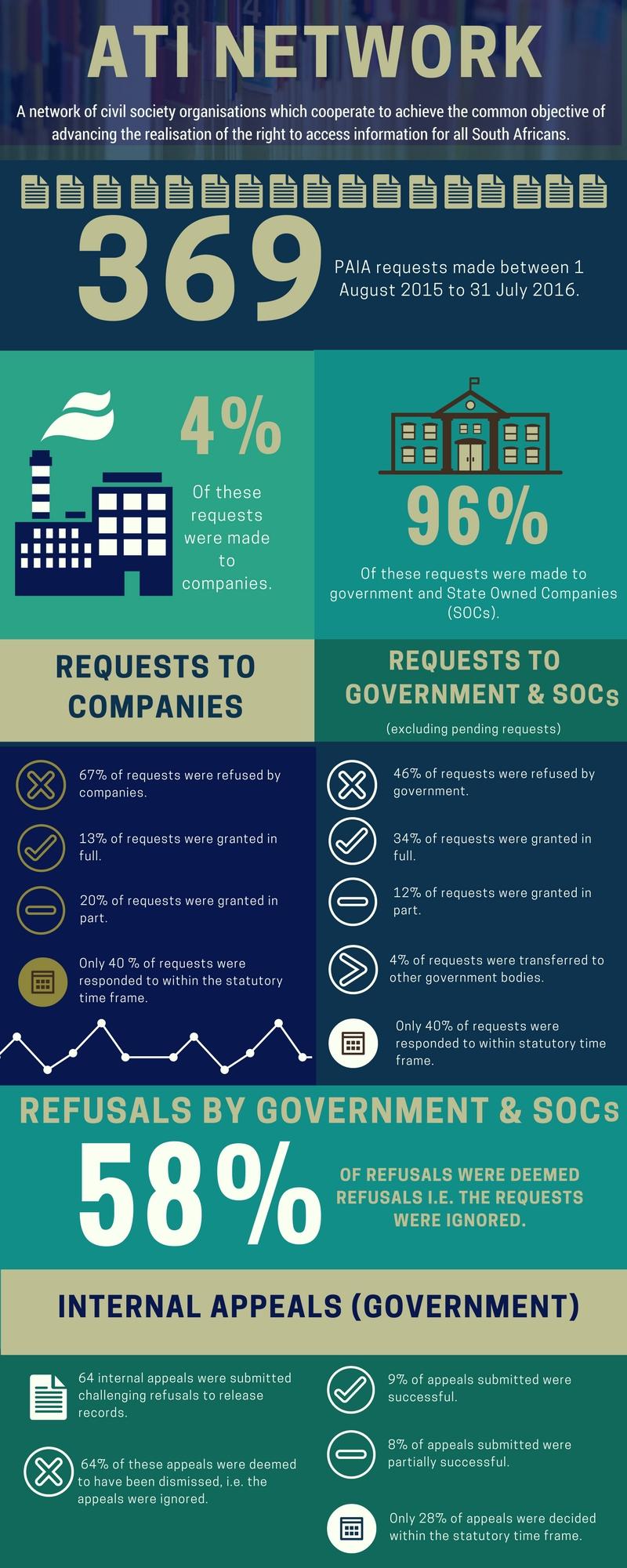
The Shadow Report 2016 was compiled with statistics from requests for information made using the Promotion of Access to Information Act, 2000 (PAIA) by the 13 civil society organisations which make up the ATI Network. The Report covers the period 1 August 2015 to 31 July 2016, during which ATI Network members submitted 369 PAIA requests to government and private bodies. Key findings of the Shadow Report 2016 are:
46% of requests submitted to government were refused – i.e. no information was provided.
58% of these refusals were deemed refusals – i.e. the requests were ignored.
Only 34% of requests submitted to government were granted in full.
64% of the appeals submitted to government were deemed to have been dismissed – i.e. the appeals were ignored.
67% of requests submitted to private companies were refused – i.e. no information was provided.
Only 13% of requests submitted to private companies were granted in full.
These findings, in particular the number of PAIA requests and appeals which are simply ignored by government, are deeply concerning. They point to a clear failure by both public and private bodies to realise our right of access to information.
We are, however, encouraged by the progress made in the extent to which certain public bodies are expanding the number and categories of records which they will make automatically available to the public, i.e. without the need to submit a PAIA request.
It is in the State’s interests to make information widely, publicly and automatically available. Making information automatically available not only significantly reduces the number of PAIA requests submitted, and therefore reduces the associated administrative burden, it also increases public trust in and cooperation with decision-makers.
The Shadow Report 2016 contains the following key recommendations:
Public bodies must be encouraged to broaden their categories of automatically available information, and all such information should be placed on their websites.
All licences should include a condition requiring the licence holder to make a copy of its licence available on its website or to anyone on request.
Greater adherence to the severability clauses in PAIA would promote the objectives of PAIA while protecting information that should not be disclosed.
The terms “trade secrets” and “commercial information” in PAIA should be clearly defined, to prevent their use as unsubstantiated excuses for failing to disclose records which should be publicly available.
Capacity constraints within public bodies need to be addressed to ensure that the obligations under PAIA can be met.
About the ATI Network
The ATI Network, formerly known as the Promotion of Access to Information Act (PAIA) Civil Society Network, was established in 2008 in response to the need for civil society collaboration to strengthen the effective use and implementation of PAIA, the mechanism via which our constitutional right to access information should be realised. The ATI Network currently consists of the following members (in alphabetical order):
Black Sash takes SASSA to Constitutional Court over grants
- Lee-Anne Bruce
The Black Sash Trust, represented by the Centre for Applied Legal Studies, launches Constitutional Court application against SASSA to protect social grants
The Centre for Applied Legal Studies, on behalf of the Black Sash Trust, has today launched an application to the Constitutional Court. The application asks the Court to compel the Minister of Social Development and the South African Social Security Agency (SASSA) to take necessary measures to ensure that the social grants system and its beneficiaries are protected when the contract between SASSA and Cash Paymaster Services (CPS) comes to an end on 31 March 2017.
It is the view of the Black Sash Trust that due to an urgency of SASSA’s own making, SASSA has no choice but to negotiate a further uncompetitive contract with CPS. CPS is currently the only entity capable of distributing social grants to over 17 million South Africans. The Black Sash Trust therefore is asking the Court to ensure that:
the continued relationship with CPS is based on terms not harmful to, or exploitative of, the grant system and its beneficiaries;
the personal data of beneficiaries is owned by SASSA; and
such data is kept confidential and not used for marketing purposes targeting grant beneficiaries.
CALS and the Black Sash Trust are deeply concerned that the payment of grants to over 17 million beneficiaries will be compromised due to the failure of SASSA to ensure that it was ready to take over payment of the grant system by 1 April 2017, or award a lawful competitive tender timeously. The result is that it appears SASSA has no choice but to enter into a further uncompetitive contract with CPS, which may exacerbate the longstanding concern of Black Sash that unlawful deductions are made from grants. The emergency situation created demonstrates that the Minister of Social Development does not have adequate oversight over SASSA. Black Sash is therefore also requesting that the Constitutional Court re-establish its oversight in respect of the process of social grant payments and provide milestones as well as timelines.
We can only hope to avoid more harm by ensuring that the contract going forward is not negotiated on terms only favourable to CPS and instead protects the constitutional rights of the people it is meant to benefit.
We, the undersigned civil society organisations write to you to raise concerns about the continued recurrence of xenophobic attacks against non-nationals living in the Republic of South Africa. In the past, we approached the Commission with similar concerns highlighting the need to impress on the government of South Africa to end xenophobic attacks perpetrated against non-nationals living in the country. As human rights organisations, we are particularly concerned about the absence of appropriate and practical action including the lack of serious interventions, poor policy response and inappropriate action by the government of South Africa to stop the recurrence of these attacks. We are also concerned about the limited responses by the criminal justice system to deal with the arrest and prosecution of perpetrators. We believe that the government of South Africa should undertake practical and policy measures to address the root causes of these attacks including addressing its social and economic obligations in order to meet the country’s constitutional, socio-economic and human rights obligations.
South Africa has experienced large scale xenophobic violence on numerous occasions.[1] In February 2017, parents reported that xenophobic prejudice was being extended to local schools.[2] Markedly, the Eastleigh Primary School in Edenvale, Gauteng, issued a letter to all foreign parents threatening to refuse their children access to education and to have children arrested if their papers are not in order. Targeting children for the purposes of immigration enforcement is a grave concern. Children must never be detained for immigration purposes. And all children in South Africa are equally entitled to education regardless of their immigration status or documentation. To this end, the South African Schools Act prohibits discrimination of any form when it comes to admission to school.
We believed that the notice given to parents by the Eastleigh Primary School were linked to the violent attacks against refugees, migrants and asylum seekers during February 2017. While the exact number of people affected by xenophobic attacks in South Africa is not known yet, there is need to take action to end these prejudicial and intolerant practises. We recall that between 2000 and 2008 close to 67 people died due to what became identified as xenophobic attacks in South Africa.[3] In May 2008, 62 people were killed and 600 injured as a result of xenophobic attacks.[4] Twenty-five of those killed were South Africans who were believed to be non-nationals. Since 2009, the number of attacks against refugees and migrants in South Africa escalated. At least one attack occurs annually. In April 2015 at least 5 people died and about 5000 others were displaced when there was an outbreak of xenophobic attacks in the KwaZulu Natal province. As in the past, these attacks caused loss of lives, injury, loss of livelihood and irreparable damage to property.
We note statements and requests from several governments of foreign communities resident in South Africa to provide assistance to individuals leaving the country. While those who wish to leave should be assisted to do so, we reiterate that the solution to the xenophobic violence should not be to repatriate non-citizens, but to ensure an environment in the country in which their rights are respected and protected.
In the context of South Africa, historical racial categories still dominate the public imagination, often obscuring the link between xenophobia and ethnic prejudice. This connection is clearly demonstrated by the victimisation of national minorities and the deaths of 25 South Africans during the 2008 xenophobic attacks. As a form of ethnic prejudice, xenophobia often claims justification from immigration laws; hence, stereotypes reduce all members of the ethnically, linguistically or culturally different group to “illegal migrants” regardless of their actual immigration status.[5]
We recall the African Commission’s response to our open letter referred to above when it issued Resolution 304[7] calling upon the government of South Africa to take the necessary measures to ensure that the rights of all migrants are protected in accordance with the applicable international and regional human rights instruments. The Resolution also urged South African authorities to take all the necessary steps to end the violence against refugees, migrants and asylum seekers, investigate the circumstances leading to the xenophobic attacks and to bring to justice the perpetrators of the attacks. In essence, these recommendations aimed to hold South African authorities to account to their obligations under the African Charter and other international and regional treaties. The 2015 Resolution of the African Commission remains relevant to the current situation in South Africa.
The relatively recent attacks against non-nationals which occurred in February and March 2017 in Pretoria shows that much needs to be done in order to stop these deadly and persistent attacks against foreign nationals. It is evident that further action needs to be taken to address xenophobia at the community level including by carrying out campaigns aimed to raise awareness and educate the public about the negative effects of xenophobia, protect potential victims and make clear that such harmful practices are unacceptable.
We urge the Commission to:
Issue an urgent appeal asking the South African government to take urgent measures to protect non-citizens in the country as obligated under regional and international human rights treaties to which it is a party;
Raise the above and other concerns relating to the attacks on refugees, migrants and asylum seekers with the South African government during the Commission’s planned promotion mission to the country; and
Remind the South African Government of its international and domestic obligations to ensure that every individual enjoys their rights to life and dignity regardless of their ethnicity or migration status.
We also urge the Commission to call on the South African government to:
Implement all the provisions of Resolution 304 and to report to the Commission on the steps taken to implement those provisions;
Recognise and strengthen those policies and laws which will promote tolerance and cater for appropriate sanctions for perpetrators of xenophobia;
Investigate and bring to justice perpetrators of xenophobic attacks in fair and transparent trials;
Put in place appropriate and practical socio-economic and other measures to address the root causes of xenophobic attacks; and
Ensure adequate protection for all refugees, migrants and asylum seekers in South Africa; and
Signed by the following organisations working on human rights issues on the African continent:
Southern Africa Litigation Centre, South Africa;
Humanitarian Information Facilitation Centre (HIFC), Zimbabwe;
Khulumani Support Group, South Africa;
Children’s Dignity Forum, Tanzania;
The Paralegal Alliance Network, Zambia;
Southern African Christian Initiative, Namibia;
Masimanyane Womans Support Centre, South Africa;
Communities Holistic Initiative for Social Advancement, Malawi;
Centre for Human Rights Education, Advice and Assistance, Malawi;
Equal Education Law Centre, South Africa; South Africa;
Centre for Human Rights and Social Advancement, Nigeria;
Associação OMUNGA, Angola;
Centro dos Direitos Humanos da Universidade Eduardo Mondlane, Mozambique;
Namibia Women’s Health Network, Namibia;
Secion 27, South Africa;
Ladder for rural development organization, Malawi;
MBAKITA, Angola;
Association of Human Rights Organizations, Uganda;
SAfAIDS, Zimbabwe;
Mozambican Bar Association’s Human Rights Commission, Mozambique;
Zambia Alliance of Women, Zambia;
Zimbabwe Human Rights Association, Zimbabwe;
WoMin African Alliance, South Africa;
Zimbabwe Lawyers for Human Rights, Zimbabwe;
Centre for the Study of Violence and Reconciliation, South Africa;
Lawyers for Human Rights, South Africa;
Legal Resources Foundation, Zambia;
Legal Assistance Centre, Namibia;
Women and Law in Southern Africa, Zambia;
International Community of Women Living with HIV in Zimbabwe, Zimbabwe;
Independent Advocates for Children, Adolescents and Young people in Zimbabwe, Zimbabwe;
Legal Resources Centre, South Africa;
Corruption Watch, South Africa;
Child Rights Advocacy;
Institute for Security Studies, South Africa;
Crisis in Zimbabwe Coalition, South Africa;
Org, South Africa;
Zimbabwe Human Rights NGO Forum, Zimbabwe;
Pan African Positive Women's Coalition, Zimbabwe;
African Men for Sexual Health and Rights, Senegal;
Lawyers against Abuse, South Africa;
International Alliance on Natural Resources in Africa, South Africa;
Africa Legal Aid, The Netherlands; and
COSPE, Swaziland;
Centre for Applied Legal Studies, South Africa
[1][1] For example, in May 2008 more than 60 people were killed, more than 600 injured and over 20 000 people were displaced in the Gauteng and Western Cape Provinces, according to Amnesty International’s report, “Talk For Us Please” published in September 2008. Available at: https://www.amnesty.org/en/documents/afr53/012/2008/en/
CALS welcomes Constitutional Court judgment on social grants
- Lee-Anne Bruce
The Centre for Applied Legal Studies (CALS) at Wits University welcomes today’s triumphant and historic judgment by the Constitutional Court. CALS represented the Black Sash Trust in launching this case against the Minister of Social Development, the South African Social Security Agency (SASSA) and Cash Paymaster Services (CPS) in an effort to ensure that the social grant system and its beneficiaries are protected.
The judgment confirms the importance of the constitutional right to social assistance, stating that
“[o]ne of the signature achievements of our constitutional democracy is the establishment of an inclusive and effective programme of social assistance... This judgment is, however, not an occasion to celebrate this achievement. To the contrary, it is necessitated by the extraordinary conduct of the Minister of Social Development and of the South African Social Security Agency that have placed that achievement in jeopardy.”
Today’s judgment granted all the relief we sought. It confirms the crucial role that civil society can, and must, play in holding both government and the private sector to account. In this historic moment, the Black Sash and CALS ensured that all parties were compelled to come to Court, resulting in a victory for the 17 million grant beneficiaries.
The Court ordered that:
CPS has a constitutional obligation to continue to pay grants for another 12 months without raising its fees;
During this period, SASSA and the Minister must develop a plan for the payment of grants beyond the 12 month period;
SASSA and the Minister must report to the court on progress it is making every three months;
Grant beneficiaries’ personal data should be protected; and
Minister must explain to the Court before the end of the month why she should not pay the costs of the application “out of her own pocket.”
This judgment is a victory not only for the protection it provides to the 17 million grant beneficiaries, but also for South Africa as a whole, which continues to see a robust judiciary protecting human rights.
CALS extends its condolences to the family and friends of anti-apartheid struggle veteran Ahmed Kathrada or ‘Uncle Kathy’ as he has become affectionately known.
Comrade Kathrada was a true revolutionary who devoted his life to the struggle against apartheid and for freedom, human dignity, equality and democracy: the values that are the bedrock of South Africa’s constitution. For this he was sentenced, along with most of his Rivonia trial colleagues, to life imprisonment in 1963 - ultimately serving 26 years in prison.
Ahmed Kathrada’s passionate opposition to injustice found continued expression in the democratic era. He remained, to the end, an outspoken supporter of Palestinian rights and against racism and the erosion of democratic gains in South Africa.
Kathrada’s character and the values he stood for remain vital as we face a world blighted by increasing economic inequality, and the growth of a politics of bigotry and repression. We hope that his spirit continues to guide us as we challenge injustice.
Save the date for this year's Public Interest Law Gathering from 24 - 26 July 2017 at the University of the Western Cape
Judgment in social grants deductions case tomorrow 9 May 2017
- Lee-Anne Bruce
On 9 May 2017 the North Gauteng High Court will hand down judgment in a matter brought by NET1 against SASSA. This judgment forms part of the ongoing litigation by the Centre for Applied Legal Studies (CALS) on behalf of the Black Sash Trust to ensure the protection of social grant beneficiaries and to maintain the integrity of the social assistance system.
In June 2016, NET1 and its affiliate companies launched an application in the Pretoria High Court seeking to allow deductions from social grants. CALS intervened in the matter on behalf of the Black Sash Trust to ensure that the State complies with its constitutional obligation to provide social assistance and that private companies do not deduct monies off these grants.
The Black Sash has requested the Court declare that the State has an obligation to protect social grants beneficiaries from exploitative practices that prevent beneficiaries from receiving their full grant, and that the Minister of Social Development be directed to make regulations that adequately protect social grant beneficiaries.
The Black Sash and CALS hope that the order will be another victory in protecting social grant beneficiaries and the integrity of the grant making process.
Judgment will be handed down in Pretoria High Court on 9 May 2017, 10h00 in Court 8B.
Teddy Bear Foundation and CALS Enter Sidney Frankel Sexual Assault Case
- Lee-Anne Bruce
Court to hear argument on prescription periods for prosecuting sexual assault
The Teddy Bear Foundation, represented by the Centre for Applied Legal Studies (CALS) at Wits University, has been admitted to intervene in the case as amicus curiae or ‘friend of the court’ in matter brought against accused sexual offender Sidney Frankel.
The matter will be heard at the South Gauteng High Court on 22 and 23 May 2017.
The application aims to challenge a section of law which gives the state a maximum of 20 years to prosecute a sexual assault while there is no such time limit for the crime of rape. This application was brought by eight individuals accusing Frankel of sexually abusing them as children.
“We wish to assist the Court with this important issue and support the applicants’ position that it is in the public interest for victims of all forms of sexual violence to be able to access justice at any time,” says Sheena Swemmer, Attorney at the Centre for Applied Legal Studies.
Drawing on the Teddy Bear Foundation’s extensive expertise, CALS argues that:
The sexual assault of children is an especially terrible crime which can cause severe trauma and long-term psychological impacts such as post-traumatic stress disorder. Often these impacts can have a comparable effect to those experienced by victims of rape. South African criminal law does not currently recognise this reality.
Children who are sexually assaulted are most often unable to come to terms with the experience until later in life, and they do so in many different forms. Typically, they disclose information about the experience over a long period as adults. Having a limited time in which they can report the crime effectively prevents these child victims from accessing justice.
The state has a duty to protect children, especially when they are in care facilities or places of safety and are particularly vulnerable to harm. In many instances, even if they are able to process what has happened to them, children are afraid to come forward or are coerced into remaining silent about it. The legal system needs to respond to victims of abuse and ensure that they are not retraumatised and are instead protected at whatever stage they come forward.
The need to protect vulnerable people remains an important issue for the Teddy Bear Foundation and the Centre for Applied Legal Studies.
“The protections offered to survivors of rape need to be extended to the survivors of sexual assault,” says Shaheda Omar, Clinical Director at the Teddy Bear Foundation. “All sexual offences must be sanctioned by the law. It is critical that all victims of sexual abuse be treated fairly and equally and be given the opportunity to be heard whenever they are ready.
The TBF (previously Teddy Bear Clinic) is an NGO that was established in 1986 to provide holistic child protection services. Through our facility in Parktown Johannesburg and satellite centres across the province we provide a range of services to abused children and their families. The TBF provides a range of Victim Support Services including counselling and court preparation programmes; Outreach initiatives; Diversion programmes and Multi-Disciplinary Training. For more on our activities visit www.tbbc.org.za
ABOUT CENTRE FOR APPLIED LEGAL STUDIES
The Centre for Applied Legal Studies (CALS) is a public interest law organisation based at the School of Law at the University of the Witwatersrand. Founded in 1978 by Professor John Dugard, CALS continues to use a combination of research, advocacy and litigation to advance human rights and social justice. Read more about our work at https://www.wits.ac.za/cals/
Family Lodges Claim Against Mining Companies for Rape & Murder of Binkey Mosiane
- Lee-Anne Bruce
The Mosiane family has lodged a civil claim against Anglo American Platinum Ltd (Anglo) and Kern Industrial Enterprises (Pty) Ltd (Kern) in relation to the rape and murder of Binkey Mosiane in 2012.
Binkey Mosiane was employed by Rustenburg Platinum Mines Limited — a subsidiary of Anglo as an underground mine worker. In 2012 she was raped and murdered underground and in 2014, Tutu Oliphant, an employee of Kern was found guilty of those crimes. The damages claim is brought by Mrs Mary Mosiane, Binkey Mosiane’s mother, assisted by the Centre for Applied Legal Studies (CALS), on behalf of herself and Binkey Mosiane’s daughter. It consists of claims for:
Medical expenses for Binkey Mosiane’s mother and daughter;
Loss of support for Binkey Mosiane’s daughter and
General damages for emotional and psychological harm for Binkey Mosiane’s mother and daughter.
For the past four years as part of the Binkey Mosiane Campaign, the 1in9 Campaign and Workers’ World Media Productions have monitored, advocated and brought to media attention the details of the criminal case and the importance of holding Anglo and Kern accountable for the safety of women workers underground.
“This case is only one example of the large scale war waged on women’s bodies on a day-to-day basis in this country; the lodging of the claim comes at a time when the South African society as a whole is forced to awaken to the realities of the violence we face as women in both our public and private lives” says Mpumi Mathabela, Campaign Coordinator for the 1in9 Campaign.
“Violence against women is not limited to the streets or the home but also takes place in the workplace,” says Dibuseng Phaloane of Workers World Media Productions. “Employers should be mindful of society’s construction and take steps of ensure that women are safe in the workplace.”
CALS hopes that a resolution can be found for the family that avoids the need for further harm. It is also hoped that the Department of Mineral Resources and mining companies take steps to ensure the safety of women, who are incorporated into the core functions of the mining sector, in terms of the Mining Charter.
Con Court orders that Minister Dlamini be joined to social grants case in personal capacity
Today, the Consitutional Court handed down their latest judgment in the matter brought by the Centre for Applied Legal Studies (CALS) on behalf of the Black Sash Trust against SASSA, the Minister of Social Development and Cash Paymaster Services. The Court has ordered that Minister Bathabile Dlamini be joined to the matter in her personal capacity, but has not ruled on whether she should be personally liable for the costs of the application. This decision is based on the fact that Minister Dlamini did not respond to the allegations in other submissions related to parallel work streams.
Instead, the Court has ordered that within 14 days all parties must report on whether they agree to a further investigative process in terms of section 38. Parties will be expected to discuss the terms of reference of the inquiry as well as potential referees to guide the process. After 14 days, the Court will then review submissions by the parties and will intervene with directives where agreement cannot be reached.
“This is a prudent decision in light of the contested issues in this case,” says Prof Bonita Meyersfeld, Director of CALS. “We will engage fully in the process as instructed by the Court. Our priority is finding an independent referee with knowledge of both the consitution and government structures and capacity.”
Teddy Bear Foundation and CALS Welcome Judgment In Sidney Frankel case
- Lee-Anne Bruce
Court finds prescription periods for prosecuting any sexual offences invalid
The Teddy Bear Foundation and Centre for Applied Legal Studies today welcomed the judgment by the South Gauteng High Court in a case brought against accused sexual offender the late Sidney Frankel. The application challenged a section of the Criminal Procedure Act which gives the state a maximum of 20 years to initiate prosecution for a crime of sexual assault while there is no such time limit for the crime of rape.
In a landmark judgment, Acting Judge Hartford today ruled that the prescription periods for sexual offences set out in the Criminal Procedure Act are invalid and that there should no longer be time limits for prosecuting these serious crimes, saying at paragraph 68:
“The law must encourage the prosecution of these nefarious offences, which are a cancer in South African society, and must support victims in coming forward, no matter how late in the day. The law should not smother a victim’s ability to bring sexual offenders to book, as it presently does.”
The Court has suspended the declaration of invalidity for 18 months to give Parliament time to amend the relevant legislation. This judgment will now need to be confirmed by the Constitutional Court.
The Teddy Bear Foundation, represented by the Centre for Applied Legal Studies at Wits University, entered the matter as a ‘friend of the court’ earlier this year to assist the Court with this important issue and support the applicants.
“This is a significant step towards ensuring that the criminal justice system is responsive to all victims of sexual offences no matter when they come forward,” says Sheena Swemmer, attorney at the Centre for Applied Legal Studies. “The judgment recognises the devastating effects of sexual violence in our country on children and adults; women and men.”
“It is critical that victims of sexual abuse be treated fairly and equally before the law,” says Shaheda Omar, Clinical Director of the Teddy Bear Foundation. “This judgment acknowledges the deep trauma that sexual violence of any kind may have on victims and the Court has now demonstrated its understanding that the process of disclosure is in itself painful, complicated, lengthy and takes great bravery.”
The TBF (previously Teddy Bear Clinic) is an NGO that was established in 1986 to provide holistic child protection services. Through our facility in Parktown Johannesburg and satellite centres across the province we provide a range of services to abused children and their families. The TBF provides a range of Victim Support Services including counselling and court preparation programmes; Outreach initiatives; Diversion programmes and Multi-Disciplinary Training. For more on our activities visit www.tbbc.org.za
ABOUT CENTRE FOR APPLIED LEGAL STUDIES
The Centre for Applied Legal Studies (CALS) is a public interest law organisation based at the School of Law at the University of the Witwatersrand. Founded in 1978 by Professor John Dugard, CALS continues to use a combination of research, advocacy and litigation to advance human rights and social justice. Read more about our work at https://www.wits.ac.za/cals/
CALS welcomes release of Mining Charter
- Lee-Anne Bruce
New Mining Charter incorporates transformative changes from CALS reports
The Centre for Applied Legal Studies (CALS) welcomes the release of the Reviewed Broad Based Black-Economic Empowerment Charter for the South African Mining and Minerals Industry (Mining Charter). The latest draft of the Charter was released on Thursday 15 June 2017 by the Department of Mineral Resources.
CALS is encouraged by the transformative amendments made to the Charter. We are particularly pleased to see several of the recommendations from our Social and Labour Plan Reports (see more here) reflected in the new Charter. These include:
Social and labour plans must now be made public automatically;
Social and labour plans must be published in English and other languages of affected communities;
Mining companies operating in the same area are encouraged to collaborate for greater impact;
Social and labour plans must be aligned to the municipalities’ development plans to ensure integrated development;
The contributions of mines to development must be proportional to the size of the investment;
There must be alignment of the social and labour plan system with the Mining Charter;
Mine workers and communities must have decent living conditions; and
There must be funding set aside for local economic development.
“This is a huge step for everyone working to transform the mining sector in South Africa,” says Louis Snyman, attorney in the Environmental Justice Programme at CALS. “This is an encouraging sign and we hope that community members stand to benefit from these amendments. Going forward, compliance monitoring and enforcement must be the highest priority.”
We do also note with concern a few elements of the Charter, including the lack of consultation in its development with affected community members; the lack of detail on the Mining Transformation and Development Agency, and its removal of the direct obligation to contribute a minimum of 1% of annual turnover to local economic development. Additionally, while we applaud the progress made with regards to access to information, we hope this extends to annual compliance reports as well.
Leave to appeal social grant deductions case refused
- Lee-Anne Bruce
Today the Black Sash Trust and social grant beneficiaries, represented by the Centre for Applied Legal Studies, argued for leave to appeal an earlier decision by the North Gauteng High Court. The decision, handed down on 9 May 2017, concerned an application brought by Net1 and some of its affiliate companies Money Line, Manje Mobile, FinBond and SmartLife against the Minister of Social Development and SASSA. The application sought to challenge the interpretation of new regulations issued by the Minister aimed at limiting deductions from social grants.
Black Sash and the grant beneficiaries sought to intervene in the application to ensure beneficiaries are protected and to maintain the integrity of the social assistance system. We asked the Court, if it found in favour of Net1 on their interpretation of the regulations, to order that the Minister issue new regulations which do protect grant beneficiaries. The Court granted the application in favour of Net1 and dismissed the application by the Black Sash and grant beneficiaries.
SASSA, the Minister of Social Development and Black Sash later sought leave to appeal this judgment believing that the Court’s decision left grant beneficiaries vulnerable. The leave to appeal application was heard today and was refused. In refusing the application, the Court found that there is no distinction between social grant beneficiaries’ accounts held at Grindrod Bank and any other bank account held at another bank; and that the regulations do not operate to restrict beneficiaries in the operation of their bank account.
“We are disappointed by today’s outcome, especially given the Constitutional Court’s March decision which recognised that grant beneficiaries’ accounts do require special protection,” says Lynette Maart, National Director of the Black Sash Trust. “We remain committed to protecting grant beneficiaries from exploitation and unlawful deductions from their social grants.”
CALS mourns the loss of one of our friends and patrons Lord Joel Joffe who passed away on 19 June 2017. Lord Joffe worked as a human rights lawyer from 1958 – 1965. In this time, he represented Nelson Mandela and other leaders of the ANC during the infamous Rivonia Trial. Lord Joffe worked tirelessly to defend those charged with conspiring to overthrow the apartheid government by armed revolution. The State v Nelson Mandela is considered one of the most important cases in our history, where the bigotry of the apartheid system was exposed.
Following his role in defending anti-apartheid activists, Lord Joffe was exiled to the UK. Throughout his life he continued to support South African causes and was awarded the Gold Order of the Baobab in 2010. He has promoted a miscellany of causes, including access to education for disadvantaged young people; anti-corruption work; women’s reproductive rights; the rights of the elderly and the right to die. He administered the Bram Fischer Fund, which has, among other things, helped to support our own internship programme. This programme funds interns from South Africa, the continent and the Global South to gain experience working at a human rights organisation. Because of these funds, we have managed to put over 25 young women and men through our programme, almost all of whom are working in the Global South in the social justice sector.
In his last visit to South Africa, he came to spend some time with us at CALS. He energised us and gave us his time, attention and mentorship, which was a most precious gift. We remain deeply saddened by his loss and and wish his family, friends, colleagues and comrades strength during this difficult time.
Government should support UN resolutions on women and children
- Lee-Anne Bruce
Civil society calls on government to support resolutions to address violence against women & to end child marriage currently before the UN Human Rights Council
Three important resolutions to address violence and discrimination against women and girls have been tabled at the 35th session of the United Nations Human Rights Council in Geneva. One focuses on the elimination of discrimination against women and girls, another on accelerating efforts to eliminate violence against women by engaging men and boys in preventing and responding to violence against all women and girls, and the other on child, early and forced marriage in humanitarian settings.
All three resolutions contain language that is in line with commitments laid out in South Africa’s Constitution. All three call on UN member states, including South Africa, to take action to address multiple and intersecting forms of violence against women and girls.
Despite South Africa’s ongoing crises of violence against women and girls, and despite now familiar reassurances from senior government officials that addressing and preventing violence against women is a national priority, South Africa chose not to join the nearly sixty countries which co- sponsored these resolutions when they were tabled last Thursday at the Human Rights Council.
To date, the South African government has still not indicated whether it will co-sponsor or support these resolutions when they go before the Human Rights Council this Thursday and Friday. Our government has also not provided a rationale for its inaction.
The civil society organisations listed below call on the South African Government to endorse these resolutions by immediately signing on as co-sponsors, opposing any hostile amendments tabled by conservative states and by voting for the resolutions later this week.
As women’s rights and gender equality organisations, we expect South Africa to act in line with its commitments to human rights as contained in national, regional and international law. Over the years we have observed an inconsistent approach by South Africa to women’s rights in UN and other inter-governmental spaces. This flies in the face of South Africa’s hard won largely progressive legislative framework on women’s rights. It also sends a message domestically that addressing violence and discrimination against women is simply not a priority in the face of other agendas.
All three resolutions contain progressive language and include commitments to action sorely needed to address and prevent endemic violence and discrimination against women in South Africa. None contain any language that could be construed as conflicting with our own laws.
While nearly 60 countries co-sponsored these resolutions, South Africa, a member of the Human Rights Council, has to date failed to indicate whether it will follow suit.
Drafted by Canada and co-sponsored by sixty countries including Ghana, Rwanda and Botswana, the Resolution on Accelerating Efforts to Eliminate Violence against Women is the first resolution ever in the Human Rights Council to call on States to implement strategies to engage men and boys in preventing and responding to violence against all women and girls. It includes strong and clearly articulated strategies sorely needed in South Africa. For instance, it identifies patriarchal norms as a root cause of gender based violence and it calls on States to “design, implement and regularly monitor the impact of national policies, programmes and strategies that address the roles and responsibilities of men and boys, including through transforming social-cultural norms and traditional and customary practices that condone violence against women and girls...”. Amidst concerns about the inadequacy of funding for women’s rights organizations, the resolution includes important language ensuring resources for women and girls are not compromised in order to fund initiatives focused on engaging men and boys.
The resolution drafted by Mexico and Colombia on the Elimination of Discrimination against Women and Girls was co-sponsored by forty-three countries, including Botswana and Rwanda in the Africa Group. It also includes commitments needed here at home. It urges States to challenge patriarchal attitudes and eliminate gender stereotypes, address unequal power relations that view women and girls as subordinate to men, reaffirms women’s bodily autonomy and right to make decisions over their lives and health, and calls on States to collaborate with “women’s and community-based organizations, feminist groups, women human rights defenders and girls’ and youth-led organizations”. These are all measures that are sorely needed in South Africa.
The resolution drafted by El Salvador and Sierra Leone on Child, Early and Forced Marriage in Humanitarian Settings represents an important step in putting the issue of child marriage in humanitarian contexts on the agenda of governments, UN agencies, humanitarian actors and others in crisis contexts. It calls upon States and a wide range of other actors to take specific actions to address child marriage, and for the first time says that these efforts are particularly important in humanitarian contexts. It advances the debate on child marriage in the UN context by acknowledging the basic need for access to justice, sexual and reproductive health and civil registration/vital statistics in humanitarian situations as ways to address child marriage; condemning attacks on educational institutions; and, by acknowledging that gender inequality is the root cause of child marriage.
The civil society organisations listed below call on government to indicate its support for these resolutions by immediately co-sponsoring them and opposing any hostile amendments proposed to limit their scope and potential impact.
We expect our Government to uphold the values and commitments enshrined in our constitution and in national law, including to equality, health, dignity, and physical and psychological integrity. Now more than ever we need clear and unequivocal action to advance women’s rights and to end violence against women and all forms of discrimination.
Endorsed by:
Amandla.Mobi
Centre for Applied Legal Studies, University of Witwatersrand
Centre for Law and Society, University of Cape Town
Critical Studies in Sexualities and Reproduction, Rhodes University
Coalition of African Lesbians
Equal Education Law Centre
Gender, Health & Justice Research Unit - Faculty of Health Sciences - University of Cape Town
Grassroot Soccer South Africa
Lawyers Against Abuse
Lawyers for Human Rights
Optimystic Bikers Against Abuse
Metro Community Service
MOSIAC
Rock Girl
Shukumisa Campaign
Sexual and Reproductive Justice Coalition
Sonke Gender Justice
Teddy Bear Foundation
Thando Care
The Southern Africa Litigation Centre
Treatment Action Campaign
Triangle Project
Trauma Centre for Survivors of Violence and Torture
Tshwaranang Legal Advocacy Centre to End Violence Against Women
Lawyers against Abuse (LvA) is an NGO based in Diepsloot, an informal settlement in the northern part of Johannesburg. We provide direct legal and psychosocial services to victims of gender-based violence (GBV), including sexual violence, domestic violence, and child abuse. LvA works closely with local state actors, including police officers, prosecutors, clerks, magistrates, and government health officials. LvA is also involved in empowerment-based community engagement initiatives school and community workshops.
LvA seeks to appoint a Staff Attorney on a full-time basis to be based in Diepsloot, Johannesburg.
Start date: As soon as possible
Salary: Negotiable, based on experience and qualifications
Responsibilities:
Provide direct legal services to clients, including assisting clients in obtaining protection orders and supporting clients through criminal cases including regular engagement with police officers, prosecutors and other court personnel to ensure the law is being applied accurately and effectively
Work with senior attorney to manage LvA’s legal casework, which includes maintaining individual case files as well as LvA’s case database
Work closely with psychosocial support team in order to implement LvA’s integrated services model
Other engagement with local state actors and community stakeholders as needed for purposes of relationship strengthening, capacity building, and advocating for victim-centred policies
Write reports and other documentation
Requirements:
LLB degree required
Experience providing direct legal services within a community and managing a large case load
Experience working with victims of gender-based violence or other vulnerable populations
Strong understanding of women’s rights and issues around gender-based violence
Minimum one-year experience working in the NGO sector, preferably in a community setting
Competencies
Fluency in isiZulu, Sepedi and/or Tshivenda
High levels of flexibility, strong leadership skills and a clear sense of purpose
An ability to find creative solutions to problems
Demonstrated ability to work efficiently, both individually and in a team
Analytical skills
Oral and written communication skills in English
Ability to exercise discretion and maintain the confidentiality required
Strong computer skills, especially with Microsoft Office suite
To apply, submit a CV and motivation letter to info@lva.org.za
Please quote the source of this advertisement in your application - NGO Pulse Portal
Late applications will not be considered.
Only shortlisted candidates will be contacted for an interview.
LvA reserves the right to not hire for this position should no suitable candidates apply.
To know more about Lawyers against Abuse, refer to www.lva.org.za
Victory for Community Activist Victimised by Mine
- Lee-Anne Bruce
Court overturns cost order sought against community activist by West Coast Resources
The Centre for Applied Legal Studies welcomes the judgment handed down by the Kimberley High Court on Friday 23 June. The Court overturned a cost order against our client Dawid Markus, an activist from Hondeklipbaai in Namaqualand. The cost order had been sought and obtained against Mr Markus, before he was legally represented, by West Coast Resources (Pty) Ltd – a diamond-mining company with operations in the Namaqualand region of the Northern Cape.
The case stems from longstanding attempts by the community of Hondeklipbaai to express their legitimate concerns about the mining activity in the area which resulted in a small, peaceful protest in November 2016. In response, West Coast Resources sought an interdict against one named person, Mr Markus, as a way to silence the community’s grievances and to prevent Mr Markus from exercising his constitutional right to peaceful and unarmed demonstration.
Following the protest, West Coast Resources obtained an interim interdict against Mr Markus, and consequent cost order. If this order had been executed, it would have left Mr Markus and his family homeless. With CALS’ representation at a hearing in February 2017, the court refused to grant a final interdict against Mr Markus, and the initial cost order against him has now been overturned.
“We often see community activists who speak truth to power face this kind of victimisation in our work,” says Wandisa Phama, attorney at CALS. “Seeking an order of costs was an obvious attempt to silence activists. The Court order acknowledges the importance of keeping the space open for communities to have a say about development that affects them.”
CALS is very proud to announce that Nomonde Nyembe has been listed as one of the Mail & Guardian's 200 Young South Africans for 2017
Read the profile of CALS attorney Nomonde Nyembe written by Aaisha Dadi Patel for the Mail & Guardian below. CALS would also like to extend our warmest congratulations to our friends and colleagues Alan Wallis, Silomo Khumalo, Buhle Lekokotla, Kelly-Jo Bluen, Michael Bishop, Sushila Dhever and Zinhle Ngwenya on making the list.
Nomonde Nyembe
Nomonde Nyembe is an attorney at the Centre for Applied Legal Studies (CALS), a former clerk of the Constitutional Court and former fellow of the UCLA-Sonke Health and Human Rights Fellowship. She currently leads the Business and Human Rights Programme at Cals and has been instrumental in litigating against the South African Social Security Agency (Sassa) during the recent social grants crisis. CALS, representing the Black Sash Trust, approached the Constitutional Court in February this year to ensure that the social grants system and its beneficiaries were protected when the contract between Sassa and Cash Paymaster Services came to an end in March. Nyembe is one of the unsung heroes of this victory.
She is also busy leading work on women in mining, representing the family of a woman raped and killed underground and hoping to hold the mine responsible for the protection of the female staff from gender-based violence.
Motivation for 31-year-old Nyembe to carry out the work that she does comes from her own lived experiences. “I am a black woman, I come from a black woman, and the experiences of black women resonate with me at a cellular level. Both patriarchy and racism are self-executing policies, although they were created to benefit some and exploit others. As such they have both latent and patent manifestations, and I have a responsibility to find ways to address them.”
She remains inspired by women: Bonita Meyersfeld, Sisonke Msimang, Vuyiseka Dubula, to name a few, and her mother and late grandmother. She also finds the young women she works with to be inspiring, and says that their unseen efforts are their greatest wins: inspiring and encouraging black women, and being willing to lower themselves to act as a ladder for black women — something she also strives to do.
While Nyembe has plenty to say about young people, she has a more important message for older people: “Create the opportunities for young people, build the ladders, expand the space and when they talk — listen.”
And her hopes for South Africa? “I would like South Africa to move from being one of the most unequal societies with regards to wealth, race and gender to an equal one.”
Call to end gross human rights violations in Sudan
- Lee-Anne Bruce
Call by Human Rights Organisations for Urgent Intervention by the South African government to stop gross human rights violations in the Republic of South Sudan
A group of human rights organizations in South Africa are calling on the South African government urgently to intervene in stopping the gross human rights violations in South Sudan. Indeed, according to the United Nations Commission on Human Rights in South Sudan, abuses include ‘the deliberate targeting of civilian populations on the basis of their ethnic identity by means of killings, abductions, unlawful detentions or deprivation of liberty, rape and sexual violence, and the burning of villages and looting’. The Special Advisor on the Prevention of Genocide has also warned that many of the indicators of genocide are in evidence. Scorched earth policies and the violent conflict have led to massive famine with over 5 million people being food insecure.
David Bilchitz, Director of the South African Institute for Advanced Constitutional, Public, Human Rights and International Law (SAIFAC), a centre of the University of Johannesburg, stated that ‘the situation has become utterly intolerable and is not receiving the priority attention it deserves so as to prevent the most shocking human rights violations. Silence in such a situation is complicity’.
His colleague, Prof Bonita Meyersfeld, Director of the Centre for Applied Legal Studies at the University of the Witwatersrand, goes further and states that ‘South Africa, as an important voice on the African continent, must use all diplomatic means at its disposal to find a solution. The protection of civilians against deliberate killing, sexual violence, the destruction of their homes and famine must become a priority of the African Union and international community’.
The conflict results from the eruption of violence between forces loyal to President Kiir and those loyal to the former Vice President Dr Riek Machar. The implementation of a peace agreement failed when fighting broke out in Juba in July 2016 between the two parties.
In the wake of this political dispute, thousands more civilians have been displaced and forced to to take refuge in neighboring countries. The United Nations High Commissioner for Refugees estimates that there are almost 2 million refugees out of a population of 12 million. Famine is wide-spread and, in the view of the UN, caused by the conflict. Armed forces have gone on therampage in civilian areas, killing, raping and pillaging houses in several states (Upper Nile,Unity, and the 3 Equatorias). Recently, deadly attacks have been reported in Pajok, Wanduruba,Yei, Lainya and Kajokeji (amongst others). Humanitarian aid workers have also been targetedwith over 67 being killed during the conflict.
Prof Frans Viljoen, of the Centre for Human Rights at the University of Pretoria, stated that ‘TheSouth African government must become more engaged in addressing the conflict in South Sudanand act as a neutral party to help resolve the conflict’.
Dr Mispa Roux, deputy director of SAIFAC, also calls on the South African government to usethis opportunity ‘to prove that it is willing to act in conformity with international legalobligations to prevent the commission of genocide and crimes against humanity, to prioritize theplight of the victims, and not to submit to regional and national politics. This will restore SouthAfrica’s reputation in the international community as a legitimate guardian of human rights and aleader in preventing gross human rights violations.’
The human rights organizations are issuing a collective call for the South African government totake the following steps:
Publicly, to condemn all forms of human rights violations in South Sudan;
Actively, to engage its African Union partners in seeking a common consensus on ensuring an end to the conflict;
Actively to intensify diplomatic efforts to resolve the conflict;
Being willing to engage the doctrine of humanitarian intervention to protect the civilian population from their leaders;
Taking any other measures that are possible to ensure that a cessation of hostilities and process of rebuilding the fragile political community in South Sudan takes place; and
Champion accountability for human rights violations, including, active support for the establishment of mechanisms such as the hybrid court
Issued on 25 July 2017
Signed by: South African Institute for Advanced Constitutional, Public, Human Rights and International Law, University of Johannesburg NRF Research Chair in International Law, University of Johannesburg The Centre for Human Rights, University of Pretoria The Centre for Applied Legal Studies, University of the Witwatersrand Johannesburg Holocaust and Genocide Centre
CALS and Black Sash seek to appeal ruling on social grant deductions
- Lee-Anne Bruce
On Thursday 20 July 2017, the Black Sash Trust and six social grant beneficiaries, represented by the Centre for Applied Legal Studies, launched an application for leave to appeal with the Supreme Court of Appeal (under case number 752/2017). They seek to appeal an earlier decision by the Gauteng Division of High Court, Pretoria. The decision, handed down on 9 May 2017, concerned an application brought by Net1 and some of its subsidiary companies Money Line, Manje Mobile, and SmartLife against the Minister of Social Development and SASSA. The application sought to challenge the interpretation of new Regulations issued by the Minister aimed at limiting deductions from social grants.
Black Sash and the grant beneficiaries sought to intervene in the application to ensure beneficiaries are protected from abuse and exploitation and to maintain the integrity of the social assistance system. We asked the High Court, if it found in favour of Net1 on their interpretation of the Regulations, to order that the Minister issue new Regulations which do protect grant beneficiaries. The High Court granted the application in favour of Net1 and dismissed the application by the Black Sash and social grant beneficiaries.
SASSA, the Minister of Social Development and Black Sash later sought leave to appeal this judgment believing that the Court’s decision left grant beneficiaries vulnerable. The leave to appeal application was heard on 20 June 2017 and was refused on the same day. In refusing the application, the Court found that there is no distinction between the social grant beneficiaries’ accounts held at Grindrod Bank and any other private bank account held at another bank; and that the Regulations do not operate to restrict beneficiaries in the operation of their bank account.
Following the decision refusing Black Sash and the social grant beneficiaries application to intervene on 9 May 2017 and the refusal of leave to appeal on 20 June 2017, Black Sash and social grant beneficiaries then approached the Supreme Court of Appeal on 20 July 2017. Black Sash and the social grant beneficiaries submit in their petition to the SCA that their intervention application in the High Court was relevant and flowed directly from the decision that the High Court ultimately made in favour of Net1. The other parties now have a period of one month to file answering affidavits.
“We remain steadfast in ensuring that social grant beneficiaries are protected and that the mearge means of livelihood is not depleted by deductions” says Lynette Maart, National Director of the Black Sash Trust. “We hope that the Supreme Court of Appeal will decide to hear our application for leave to appeal and grant the relief we request.” Nomonde Nyembe, an attorney at CALS, says that “social grants are the means by which the constitutional right of access to social assistance is realised; any dimunition thereof must be subjected to constitutional scrutiny.”
CALS and Black Sash welcome Con Court order on social grant enquiry
- Lee-Anne Bruce
Con Court orders Justice Bernard Ngoepe to be appointed as referee in case against SASSA
The Constitutional Court has made a new order in the matter brought by the Centre for Applied Legal Studies (CALS) on behalf of the Black Sash Trust against SASSA, the Minister of Social Development and Cash Paymaster Services. In a previous judgment on 15 June, the Court ordered that Minister Bathabile Dlamini be joined to the matter in her personal capacity. The Court also declared that there should be a further enquiry into her personal liability for the social grant crisis earlier this year which sparked the need for this litigation.
On 2 August, the Court ordered that Justice Bernard Ngoepe be appointed as the referee for the enquiry to investigate the outstanding issues in the case. The order further states that the enquiry should be open to the public and that SASSA will bear the costs of the appointed referee. CALS and the Black Sash Trust welcome this order and the chance to further investigate and strengthen the social grant system.
Community members take Municipality to court over lack of access to water
- Lee-Anne Bruce
The Centre for Applied Legal Studies (CALS) represents the residents of five villages in Limpopo which have not had access to water in eight years. In 2009, the Sekhukhune District Municipality stopped the water supply to the villages of Elandskraal, Morarela, Mbuzini, Dichoeng and Tsansabela. This forced the communities living in the area, mainly children and elderly men and women, to walk long distances to collect water from crocodile-infested rivers and springs shared with other animals.
The communities, assisted by CALS, approached the North Gauteng High Court in 2015 asking the Municipality to supply the villages with water. They argued that the lack of water particularly affects women whose safety is at risk when collecting water and who are most impacted by a lack of sanitation. The Municipality agreed to truck potable water to the villages twice a week as an interim measure until a more permanent solution could be implemented.
On 17 August 2017, the communities will return to court to challenge the constitutionality of the Municipality’s Free Basic Water policy and to ensure that medium to long-term solutions are secured. CALS will argue that the policy deprives the communities of water in a manner that is unlawful and unconstitutional. We will also argue that the Municipality's failure to consistently provide potable water is in direct violation of the communities' constitutional rights to access to water.
The matter will be heard at the Pretoria High Court on 17 August 2017 from 10:00
Municipality agrees to provide more consistent water supply to villages in Limpopo
- Lee-Anne Bruce
Today, residents of five Limpopo villages, represented by the Centre for Applied Legal Studies, negotiated a settlement with the Sekhukhune District Municipality. The villages of Elandskraal, Morarela, Mbuzini, Dichoeng and Tsansabela have not had access to water since 2009 when the Municipality cut off the existing water supply. This forced the residents to walk long distances to collect water from crocodile-infested rivers and put their safety and health at risk.
The communities approached the North Gauteng High Court in 2015 asking for water to be supplied to the villages urgently. The Municipality agreed to truck potable water to the villages twice a week as an interim measure until a more permanent solution could be implemented. The communities returned to court today to ensure that more long term solutions are effected.
The presiding judge asked that the parties try to negotiate to find a workable resolution. The communities have explained that the water the Municipality delivers by trucks as part of the interim measure is not always fit for drinking, and the water that does sometimes come from taps is raw, unpurified water. They have also insisted that the Municipality increase the number of water tanks per village and the number of times they provide water through the taps. The Municipality has agreed to this as a medium-term solution while it plans to build a water plant in the long-term. This agreement has been made an order of court.
The Court will be monitoring the compliance with the settlement and the Municipality will have to make monthly reports on its progress until the water plant is complete. Judge Fabricius will be managing the case to ensure that the Municipality complies with its obligations in this longstanding issue.
“We believe that this settlement will bring some relief to the communities living without an adequate water supply,” says Zeenat Sujee, attorney at CALS. “This is a progressive step along the way to realising the communities’ constitutional right to access water.”
Business and Human Rights Resource Centre is seeking a Programme Manager for its Corporate Legal Accountability work
Corporate Legal Accountability Programme Manager
Business & Human Rights Resource Centre
Details:
Location: New York, Washington DC, or London
Salary: $55,000-65,000; £37,000-44,000 per year (commensurate with experience) plus 5% pension contribution and standard health benefits
Contract Type: Full-time staff position
Closing Date: 01/09/2017
Business & Human Rights Resource Centre,a high-impact, global organization serving advocates around the world in the innovative field of business & human rights, is seeking a Programme Manager for its Corporate Legal Accountability (CLA) work, reporting to a director on the Senior Management Team.
Interview date: interviews will be arranged for 11-12 September 2017 (Candidates should be available during this time in case they are short-listed for interview.)
Applicants must have:
demonstrable commitment to human rights and/or social justice
experience, expertise and/or education in legal aspects of human rights and/or social justice
excellent English-language skills
To apply:Download and complete theapplication form, and send it by email to Anna Liberadzki with the subject line "Corporate Legal Accountability Programme Manager":liberadzki@business-humanrights.org. The application form is required; we cannot accept CVs.
THE POSITION
Lead the Resource Centre’s work on Corporate Legal Accountability:Provide an overall vision for the Corporate Legal Accountability Programme and ensure high quality delivery of its objectives (see above), and developing this work rapidly with key allies while building new contacts to enhance our impact.
This programme provides the leading global information hub about human rights legal claims against companies for involvement in human rights abuses by
demystifying these lawsuits for a non-legal audience in 8 languages
monitoring news about these lawsuits and providing updates to the global community working on corporate legal accountability
sharing legal filings and court decisions so that lawyers can learn from each other’s work
highlighting affected workers’ and communities’ struggle to access justice
raising the profile of human rights lawyers working for corporate accountability
providing analysis of both persistent barriers to remedy to fuel advocacy, and successful strategies that empower peer learning
The position will involve the management of the Senior Legal Researcher who contributes to the delivery of the programme.
Communications:In collaboration with the Resource Centre’s Senior Management Team and the Communications Officer, drive communications of the programme’s work through bulletins and briefings, external publications and social media to ensure maximum impact.
Strategy:Develop, with input from the Management Team and members of the Global Team, a powerful and inspiring strategy for the Corporate Legal Accountability Programme that reflects priority areas of the organization. This includes
development of regional strategies to enable the programme to better suit the specific and concrete needs of victims, lawyers and advocates to empower them, and
integration of legal strategies and analysis to support the organization’s work in its three priority thematic areas: Labour rights including modern slavery, freedom of association and living wage; Responsible natural resource use including climate justice; and Human rights defenders and civic space.
Fundraising:Work with the Fundraising team and the Finance Officer to develop funding proposals that fit the strategic goals of the organization and of the legal accountability programme, and deliver funders’ reports. Build sustained relationships with legal accountability donors.
Representation of the Resource Centre:Represent the Resource Centre at key legal accountability meetings and events. Assist in the design and organization of events to drive constructive debate on key legal accountability issues.
Other responsibilities:Take on other responsibilities as necessary for the health and development of the organization.
LINE MANAGEMENT RESPONSIBILITIES
Manage the Senior Legal Researcher and Legal Research Intern.
KEY COMPETENCIES
Strategic manager and leader:At least 3 years’ experience leading ambitious human rights or social justice projects and programmes. Proven ability to inspire and build high-performing teams with vision and purpose, and compelling high-impact programmes with strategic partners.
People manager:At least 2 years’ experience in line management and/or project management of people. Ability to delegate and empower team members with accountability. Ability to train and nurture talent. Experience of remote management highly desirable.
Programme manager:At least 3 years’ experience and demonstrable success in managing complex and large programmes or projects to make change happen with internal colleagues, external partners, funders, and other stakeholders.
Entrepreneurship: Proven experience in seeking and attracting substantial resources for new and developing programmes of work. Proven ability to build strong partnerships with funders. External awareness, and drive to build the resources of the Resource Centre to deliver our mission.
Human rights, social justice expertise:Demonstrable commitment and expertise in international human rights and social justice. At least 5 years’ work in this area. Understanding, vision, and strategic insight on human rights in business and/or in the global economy, and how to make change happen.
Legal experience/expertise: Experience, expertise and/or education in legal aspects of human rights and/or social justice: advanced degree in legal studies and at least 2 years’ legal work including litigation or other representational work, and/or legal research and analysis.
Team player:Experience of, and commitment to, working in and helping build high-performing teams that are highly collaborative and focused on outcomes.
Communications:
At least 3 years’ experience driving high-quality communications to a broad audience; experience communicating on legal issues and legal accountability to a non-legal audience highly desirable
Good knowledge of quality control issues in digital communications.
Excellent English-language skills. Fluency in one or more additional global languages highly desirable.
Commitment to our values:Demonstrable commitment to the values and model of change of the Resource Centre.
TERMS AND COMPENSATION
This is a full-time position based in New York, Washington DC, or London.
Starting salary: $55,000-65,000; £37,000-44,000 per year (commensurate with experience), plus 5% pension and standard health benefits
24 days of annual leave
Opportunity to play a central role in an enthusiastic and international team
If the successful applicant does not have the right to work in the US or the UK, we will work with them to obtain the necessary work permits.
Lawyers against Abuse is recruting
- Lee-Anne Bruce
LvA seeks to appoint an Attorney on a full-time basis, based in Diepsloot, Johannesburg
Lawyers against Abuse (LvA) is an NGO based in Diepsloot, an informal settlement in the northern part of Johannesburg. They provide direct legal and psychosocial services to victims of gender-based violence (GBV), including sexual violence, domestic violence, and child abuse. LvA works closely with local state actors, including police officers, prosecutors, clerks, magistrates, and government health officials. LvA is also involved in empowerment-based community engagement initiatives school and community workshops.
LvA seeks to appoint an Attorney on a full-time basis, based in Diepsloot, Johannesburg.
Expected Start Date: As soon as possible
Salary: Negotiable, based on experience and qualifications
Responsibilities:
Providing direct legal services to clients, including assisting clients in obtaining protection orders and supporting clients through criminal cases including regular engagement with police officers, prosecutors and other court personnel to ensure the law is being applied accurately and effectively
Managing LvA’s state actor accountability and capacity-building initiatives to address identified systemic gaps and shortcomings of local criminal justice system
Developing and leading local advocacy efforts in Diepsloot
Engaging with key community stakeholders to implement a coordinated response to GBV in Diepsloot
Engaging with broader NGO sector including other women’s rights and human rights organisations
Writing reports and other documentation
Requirements:
LLB degree required
LLM in human rights or Social Science degree preferred
Minimum of two years’ experience in community-based work, working effectively with various stakeholders
Experience working with victims of GBV or other vulnerable populations
Strong understanding of women’s rights and issues around GBV
Experience designing and leading advocacy campaigns
Prior experience working with state actors preferred
Fluency in isiZulu, Sepedi and/or Tshivenda
High levels of flexibility, strong leadership skills and a clear sense of purpose
An ability to find creative solutions to problems
Demonstrated ability to work efficiently, both individually and in a team
Analytical skills
Oral and written communication skills in English
Ability to exercise discretion and maintain the confidentiality required
Strong computer skills, especially with Microsoft Office suite
To apply, submit your CV and motivation letter toinfo@lva.org.za
Late applications will not be considered.
Only shortlisted candidates will be contacted for an interview.
LvA reserves the right to not hire for this position should no suitable candidates apply.
To know more about Lawyers against Abuse, refer to www.lva.org.za
CALS contributes to Amnesty International publication
- Lee-Anne Bruce
CALS Deputy Director Lisa Chamberlain adds to publication on accessing remedies for corporate human rights abuses
Amnesty International and Business & Human Rights Resource Centre have today published Creating a paradigm shift: Legal solutions to improve access to remedy for corporate human rights abuse.This briefing puts forward concrete legal proposals to tackle persistent hurdles to remedy in cases of corporate human rights abuse. The publication includes a paper by CALS Deputy Director Lisa Chamberlain entitled 'Meaningful Access to Information in Business and Human Rights Cases'.
The publication addresses:
the difficulties of holding parent companies legally accountable for abuses caused by their subsidiaries as a result of the “corporate veil”;
the risk for foreign claimants that their claims in countries where multinational companies are based, such as Canada and the USA, are rejected on forum non conveniens grounds, and;
the lack of access to human rights-relevant information, including evidence of detrimental impacts of corporate activities, which undermines the ability of affected individuals and communities to build a robust legal claim against alleged perpetrators.
This briefing seeks to move forward the agenda for legal reform. It is aimed at legal experts, legislators, national, regional and international policy-makers as well as civil society actors working in the field of business and human rights and seeks to both inform their work and/or prompt action to improve legal accountability and access to remedy for corporate human rights abuse.
The proposals in the briefing build from recommendations made in Amnesty International’s 2014 book Injustice Incorporated: Corporate Abuses and the Human Right to Remedy(Injustice Incorporated), as well as further research, analysis and expert input. The briefing is accompanied by five additional expert papers by Surya Deva, François Larocque, Lisa Chamberlain, Channa Samkalden, Elodie Aba and Sif Thorgeirsson, which discuss the obstacles and solutions underlined in Injustice Incorporated.
While the problems highlighted above persist, positive legislative developments in the last two years give cause for optimism: the French “Duty of Vigilance” law passed early this year imposing due diligence duties on certain large French companies to prevent environmental and human rights harm by their subsidiaries and other business relationships is remarkable, and a first of its kind; the 2015 EU Directive on Non-financial Reporting and 2015 UK Modern Slavery Act requiring disclosure of due diligence procedures to respect human rights, or to avoid slavery and trafficking, respectively, expand on the scope of what companies are currently required to report regarding human rights.
These significant legal developments, and ongoing legislative efforts in other countries such as Switzerland, Netherlands and Germany, point to the beginning of a paradigm shift in corporate accountability. Those driving legal reform must keep this momentum going and capitalise on the various legislative developments to initiate new or strengthen existing legal proposals. Amnesty International and Business & Human Rights Resource Centre hope this publication will help fuel those efforts and move the agenda for rights-focused legal reform forward.
Call for officials to face jail time for non-compliance with court order
- Lee-Anne Bruce
Client communities from five Limpopo villages are calling for officials to face jail time for failing to comply with a court order to provide water
Residents of five Limpopo villages are calling for the Executive Mayor and Municipal Manager of the Sekhukhune District Municipality to face jail time for failing to comply with a court order. The villages have not had proper access to water since 2009 when the Municipality cut off the existing water supply. They were forced to walk long distances to collect water from springs shared with animals, which put their safety and health at risk. After approaching the Court in 2015, the Municipality provided a limited supply of water in tanks.
Assisted by the Centre for Applied Legal Studies, the communities went back to court last month to compel the Municipality to provide them with an adequate interim water supply while a dam is built in the area. The Municipality agreed to provide an extra 37 water tanks to the villages, to fill the existing tanks every weekday and to provide drinkable water through the reticulation system twice a week. The Municipality has not complied with the order and the communities have been forced to institute contempt of court proceedings.
“This is not the first time the Municipality has shown a complete disregard for the authority of the Court,” says Zeenat Sujee, attorney at CALS. “Each time we reach an agreement with the Municipality, we have to go back to court to hold them in contempt. We are asking the Court to find them personally liable and consider jail time as a last resort.”
The matter will be heard in the Pretoria High Court on Tuesday 12 September at 10:00.
Call for Evidence for People's Tribunal on Economic Crime
- Lee-Anne Bruce
Constitutional Hill, Johannesburg
First Hearings: 8-12 November 2017
Given the failure of state institutions to fully investigate allegations of corruption and state capture, members of civil society have today announced the creation of a People’s Tribunal on Economic Crime in South Africa. We urge members of the public to submit information to be presented at the first hearings of the Tribunal to be held in November 2017.
The People’s Tribunal aims to allow an inclusive and evidence based discussion on the inter-connected nature of state capture in South Africa, joining the dots over the past four decades from Apartheid-era economic crime to the post-Apartheid Arms Deal and the current era of what we call ‘state capture’. The Tribunal will hear evidence relating to each of these eras over 5 days.
The People’s Tribunal is organised by citizens, and is not a statutory body. Members of the public can submit evidence, which will be introduced and examined by a small team of evidence leaders. A panel of seven adjudicators will consider these submissions and make a written report that will be presented to the public.
The first hearings will focus on the arms trade across the three eras identified above. We thus invite anyone with information on the following cases to submit this information to the organising committee:
Alleged breaches of International and South African law by actors who facilitated the illegal supply of weapons to apartheid South Africa between 1977 and 1994.
Alleged breaches of South African and International law by corporations and individuals in the process of the 1999 Arms Deal.
Alleged breaches of South African and International law in relation to current allegations of ‘state-capture’ as they relate to Denel.
People are encouraged to come forward with both documentary evidence and first-hand experience. All submissions will be treated confidentially, and it is not required to publicly present the evidence at the Tribunal. A select number of submissions will be given an opportunity for verbal presentation. Information will only be used with the consent of the witness and may be presented to the tribunal and adjudicators in different forms.
The Tribunal’s organising committee comprises a range of civil society organisations, including the Centre for Applied Legal Studies (CALS), Corruption Watch, Foundation for Human Rights, Open Secrets, Public Affairs Research Institute, Right2Know Campaign and the South African Council of Churches.
The deadline for submissions is 22 October 2017. All submissions should be made to the Tribunal Secretariat (c/o Open Secrets):
Dereliction of duties: how the constitutional right of access to information is being undermined
- Access to Information Network
The Access to Information Network releases its annual shadow report
Year after year, the Access to Information Network’s Shadow report have indicated poor levels of compliance with the Promotion of Access to Information Act, 2000 by government, state owned companies and private companies. The 2017 iteration of the Access to Information Network’s Shadow Report once again shows that PAIA compliance levels remain below expectations, despite PAIA having been around for 16 years now.
Statistics from PAIA requests for information submitted by members of the Access to Information Network (ATI Network), over the period 1 August 2016 till 31 July 2017, form the back bone of the report and are supplemented by narratives of specific experiences of network members. A grand total of 408 PAIA requests were submitted to both public institutions as well as private entities. The key findings of the report are as follows:
Outcomes of the requests to government and SOCs:
5% of requests were ignored ;
Access was granted, in full or in part, to 33.15% of requests;
The number of inter departmental transfers increased relative to the 2015/16 reporting period, with 11.8% of requests transferred in full or in part;
Compliance with prescribed statutory timeframes was alarming, with 65% of requests not responded to within the statutory time period of 30 days;
The most common ground for refusal was that the requested records do not exist and this was hardly ever confirmed by way of affidavit, as is required by PAIA; and
The ATI Network lodged 164 internal appeals. While five of those appeals were still pending at the date of reporting, 79.25% of the appeals were simply ignored.
Outcome of requests to private companies:
40% of requests were ignored by private companies; and
Access was granted, in full or in part, to 31.8 % of requests.
The ATI Network’s recommendations to improve the situation:
Stricter sanctions for statutory non-compliance, especially with respect to non-compliance with the statutory time frames;
Implement the proactive disclosure of records in terms of section 15 of PAIA;
De-formalisation of the PAIA request process;
The amendment of PAIA to include an emergency access to information provision for time sensitive requests; and
The provision of adequate resources by government to the Information Regulator and National Archive.
About the ATI Network
The ATI Network was established in 2008 in response to the need for civil society collaboration to strengthen the effective use and implementation of PAIA, the mechanism via which our constitutional right to access information should be realised. The ATI Network currently consists of the following members (in alphabetical order):
The Inquiry into Minister Bathabile Dlamini's involvement in the social grants crisis is set to begin on 22 January 2018
Yesterday, the Centre for Applied Legal Studies (CALS), along with the legal representatives for Freedom Under Law, the Minister for Social Development, SASSA and CPS met with Judge Bernard Ngoepe at the Office of the Chief Justice in Midrand. Judge Ngoepe was appointed by the Constitutional Court as the referee for the Section 38 Inquiry established to investigate any remaining issues relating to the case CALS brought in March this year to ensure the social grant system is protected.
The Inquiry's main focus is to investigate whether the Minister of Social Development should be liable for the legal costs of the case in her personal capacity. CALS and the other legal representatives agreed on procedural issues such as the timeframes for the request and submission of documents and a date for the Inquiry.
The Inquiry will be held between 22 and 26 January 2018 most likely at the Office of the Chief Justice
Call for abstracts: CALS/SAJHR Colloquium on Land and Property
- Lee-Anne Bruce
CALS and the South African Journal on Human Rights will convene a Colloquium on ‘Land and Property in a Contested Terrain’ in July 2018
Failure to transform the land/property landscape has become a primary cause of hostility towards South Africa’s post-1994 constitutional dispensation, as well as a subject of substantial litigation and a topic of heated scholarly discourse. A specific source of contestation has been section 25 of the Constitution, the so-called ‘property clause’, which is popularly viewed as an obstacle to transformation.
In this Colloquium, we aim to explore the parameters of problems concerning the rights to land and property, and to contribute towards a grounded interdisciplinary scholarship on related topics. The Colloquium will be organised around a number of themes, including:
Constitutional, legal and policy analyses;
The identity- and distribution-related dimensions of land and property rights;
The intersecting, layered and sometimes clashing dimensions of land/property ownership, use and occupation;
The complexities of formalising communal land rights and traditional leadership roles in respect of land rights;
The alignment (or not?) of plural legal forms of property rights;
The efficacy of government programmes to advance access to land and property; and
The predicament of mine-affected communities vis-à-vis land and mineral rights.
With a view to consolidating the Colloquium programme, we are inviting interested scholars and activists from a broad range of disciplines including social science, anthropology, philosophy and law to submit abstracts/expressions of interest (+/- 250 words) on any topic related to the broad themes of the Colloquium, by Monday 6 November 2017, addressed to Matimba Hlungwani at matimba.hlungwani@wits.ac.za.
In the course of 2019, the SAJHR will publish a special issue on the basis of Colloquium papers submitted to the Journal following the event, each of which will be subject to the normal peer-review process.
Mining Community Networks Apply to Join Mining Charter Case
- Lee-Anne Bruce
Mining communities demand meaningful engagement on the systems intended to benefit them
The Centre for Applied Legal Studies is launching an application to intervene in a case brought by the Chamber of Mines against the Minister of Mineral Resources concerning the Mining Charter. CALS acts on behalf of mining community networks: Mining Affected Communities United in Action, Women Affected by Mining United in Action and the Mining and Environmental Justice Network of South Africa. Together these groups represent over 150 activists and community-based organisations working on mining in the country.
The mining industry in South Africa is built on a legacy of inequality and exploitation. The Mining Charter is one of the most important mechanisms we have for addressing this legacy and promoting much-needed transformation in the sector. The most recent version of the Charter, released by the Department of Mineral Resources on 15 June this year, features some transformative amendments. These include ensuring mine workers and communities have decent living conditions and mines contribute to development in the areas where they operate.
However, this Charter and all previous versions were developed without engaging with the affected communities themselves. For the past 15 years, these negotiations have involved only three parties: the state, mining companies and organised labour. Despite being directly interested and affected parties, communities have not been afforded an opportunity to participate in negotiations for any iteration of the Mining Charter.
Mining affected communities continue to bear the greatest burdens of mining – losing farm land to mining operations, facing environmental harm and degradation and suffering from illnesses caused by pollution. They are a core stakeholder in mining and should be engaged meaningfully on policy and regulations for the sector and programmes intended to benefit them. We cannot have a truly transformed Mining Charter or a truly transformed mining industry without meaningful community participation.
Mining Affected Communities United in Action (MACUA), Women Affected by Mining United in Action (WAMUA) and the Mining and Environmental Justice Network of South Africa (MEJCON-SA) represented by CALS are therefore challenging the Charter. We are asking the Court to allow us to intervene in the case and to set aside the current Charter for this failure to meaningfully engage affected communities. We further seek a declaratory order that mining affected communities are recognised as a key stakeholder and must be meaningfully engaged when developing any new Charter through a process that is transformative, democratic and transparent in line with the Constitution.
The matter is set to be heard in the Pretoria High Court from 13 – 14 December 2017
Mining Affected Communities United in Action (MACUA) is a co-ordinating body representing and advancing the rights and interests of mine-affected communities across eight provinces of South Africa. The network is made up of 50 community organisations and calls for communities to be granted a greater say in issues that affect their human rights and which they believe is denied to them in current regulations governing the mining sector.
ABOUT WAMUA
Women Affected by Mining United in Action (WAMUA) is an official national platform formed within MACUA with the purpose of advancing the rights and interests of women in mining affected communities. WAMUA aims to advance and support women in mining affected communities to strengthen their participation in community decision making processes and influencing local, provincial and national policy and legislative process in the mining sector.
ABOUT MEJCON-SA
The Mining and Environmental Justice Community Network of South Africa (MEJCON-SA) is a network of communities, community based organisations and community members whose environmental and human rights are affected, directly or indirectly, by mining and mining-related activities. Since its constitution on 17 October 2012, MEJCON-SA’s membership has to grown to 70 members, including representatives of various individuals, community-based and civil-society organisations throughout South Africa.
ABOUT CALS
The Centre for Applied Legal Studies (CALS) is a public interest law organisation based at the School of Law at the University of the Witwatersrand. Founded in 1978 by Professor John Dugard, CALS continues to use a combination of research, advocacy and litigation to advance human rights and social justice. Read more about our work at https://www.wits.ac.za/cals/.
People's Tribunal on Economic Crime postponed
- Lee-Anne
The first hearings on the arms trade will take place from 3-7 February 2018 and Justice Zak Yacoob and Yasmin Sooka will form part of the panel of adjudicators
The People’s Tribunal on Economic Crime in South Africa’s Organising Committee has taken the decision to postpone the first hearings on the arms trade to 3-7 February 2018. The postponement will allow more time to process the wealth of evidence relating to the complex nature of the cases. As such the new deadline to submit evidence has been extended to 10 November 2017.
In preparation for the Tribunal we are assembling a high-calibre panel of adjudicators to hear the cases. We are excited to announce that Justice Zak Yacoob and Ms Yasmin Sooka have been confirmed as part of that panel.
Ms Yasmin Sooka is the Executive Director of the Foundation for Human Rights in South Africa. She is also a leading human rights lawyer, activist and international expert in the field of Transitional Justice, gender and international war crimes. With regards to her role at the Tribunal, she brings her valuable experience of acting as a Commissioner during South Africa’s Truth and Reconciliation Commission.
Justice Zak Yacoob served as a Constitutional Court judge from 1998 to 2013. He has been a lifelong human rights lawyer, rising to prominence during the apartheid years where he defended numerous activists and victims of apartheid in South African courts. Crucial to the upcoming Tribunal is Justice Yacoob’s role in leading an international panel of judges in the 2015 International People’s Tribunal on the 1965 mass killings in Indonesia.
The People’s Tribunal on Economic Crime in South Africa will address the conspicuous failure of South African institutions to investigate the growing body of evidence relating to corruption and economic crime. This civil-society led intervention is the first in the world explicitly aimed at tackling these issues in light of state failure to do so.
City of Johannesburg fails to provide services in Zondi
- Lee-Anne Bruce
Owners of properties in Soweto are charged rates and taxes though their stands are not connected to basic services and they are unable to occupy their own land
On 2 October 2017, the Centre for Applied Legal Studies (CALS) brought an application against the City of Johannesburg, the Johannesburg Property Company and the Department of Housing on behalf of nine individuals.
These individuals all bought properties in Zondi, Soweto, under the Land Regularisation Programme between 2009 and 2014. When they tried to connect their stands to water services, they found that the City had not installed the necessary infrastructure and they were unable to build homes on their properties. These nine men and women are forced to pay rent to live elsewhere and incur extra transport costs because they cannot live on their own stands closer to schools, hospitals and places of work.
In addition, the City of Johannesburg has since started charging them for rates and taxes despite the fact that they are not connected to services and are unable to build and live on their own properties. The unpaid accounts have been handed over to debt collectors, which negatively impacts on their credit histories. They have tried many times to engage with the City and the Johannesburg Property Company with no success.
The community has approached the South Gauteng High Court, asking for an order declaring that the City’s conduct has been unconstitutional and to direct them to install the necessary infrastructure, as well as write off the rates and taxes they have been charged while they have no access to basic services.
“The City of Johannesburg is responsible for providing water, sanitation and electricity,” says Lubabalo Mabhenxa from the Centre for Applied Legal Studies. “The City has done nothing to fulfil its constitutional obligations in Zondi. There are many structural barriers to the ownership of land for many disenfranchised people in our country. Even when they do finally obtain it, the Municipality is not able to do its part to ensure that that land is sufficiently serviced.”
The City of Johannesburg is opposing the application.
Mining company threatens environmental activists
- Lee-Anne Bruce
Mineral Sands Resources uses ‘defamation’ case in an attempt to intimidate and silence human rights defenders
On 24 October 2017, the Centre for Applied Legal Studies (CALS) applied to the Western Cape High Court to intervene as amicus curiae or ‘friend of the court’ in a matter brought by Mineral Sands Resources against two environmental lawyers and a community activist.
Mineral Sands Resources alleges that Christine Reddell and Tracey Davies from the Centre for Environmental Rights and activist Davine Cloete made ‘defamatory’ statements during a lecture at the Unversity of Cape Town’s Summer School Programme in January 2017. Reddell, Davies and Cloete were presenting their thoughts on a previous case against the company’s Tormin mine, which had been investigated for poor environmental practices. They made these statements in exercising their rights to freedom of expression and to protect the environment.
This ‘defamation’ case appears to be an attempt by Mineral Sands Resources to censor, intimidate and silence its critics. This could be seen as an example of strategic litigation against public participation, otherwise known as a ‘SLAPP’ suit. These kinds of law suits are used around the world as a tactic to threaten and distract environmental activists and take up their already limited resources.
CALS has applied to intervene in the matter to assist the Court with this important issue. We argue that this kind of litigation can have a devastating effect on activists who are simply defending their rights or the rights of their clients and communities. We further argue that this particular case is an issue of academic freedom and that being able to critique cases and bring real world examples into a classroom is essential to academia in general and teaching environmental law in particular.
CALS has also applied to the Court to present evidence in the form of a research report on the nature and prevalence of activist intimidation in South Africa, focusing on the Eastern Cape, KwaZulu Natal, Limpopo, Mpumalanga, the North West, and the Western Cape. The research is set to be completed by 28 February 2018.
“The free exchange of ideas is a cornerstone of any open and democratic society,” says Lubabalo Mabhenxa from CALS. “SLAPP suits have the effect of closing down spaces for participation, discouraging free speech and costing activists time and money despite the fact that they are often entirely baseless and may have no prospects of success.”
IMC urged to fast-track SASSA, SAPO deal
- Lee-Anne Bruce
CALS and the Black Sash Trust are monitoring developments in the social grant payments system
The Constitutional Court's decision extending the suspension of invalidity on the contract between the South African Social Security Agency (SASSA) and Cash Paymaster Services (CPS) ends on 31 March 2018. For SASSA to meet its legal obligations, it needs an alternative grant payment system and in the interim a new service provider. However, since the Constitutional Court judgment on 17 March 2017, there has been no progress.
Chairperson of the Inter-Ministerial Committee (IMC) for Comprehensive Social Security, Minister in the Presidency Jeff Radebe, told the joint hearing of Parliament’s Standing Committee on Public Accounts (SCOPA) and the Social Development Portfolio Committee today that government will move with the necessary speed to introduce an integrated payment system which will be provided by government through a partnership between SASSA and the South African Post Office (SAPO), working with entities like Home Affairs. A project plan will be developed by Friday 17 November 2017. While the intervention by the IMC is welcomed at this late stage, we would like to see concrete action by 21 November 2017.
It is also unclear what is meant by a hybrid model for the payment of grants and how the banks will be involved. The Banking Association of South Africa (BASA) indicated its willingness to assist. One of its members, Grindrod Bank, with IT support from Net1, has created the SASSA bank account and recently the EasyPay Everywhere bank account to facilitate debit orders and other deductions particularly for Net1 subsidiaries.
In the course of our community monitoring work, we have taken up many cases of unauthorised, fraudulent and unlawful deductions and debit orders. We do not want a repeat of the past where profit is the sole motive of the service provider and grant beneficiaries’ constitutional right to social security and social assistance is violated. In order to re-establish the integrity of the social grant system the Black Sash would like to reiterate the important considerations below:
The personal confidential data collected during the social grant registration process must be protected and used only for the payment of grants. It should not be used for the marketing and sales of financial and other services. This protection should also include the bank cards issued to grant beneficiaries, the machines reading these cards and the control of access to confidential data.
The bank accounts of grant beneficiaries must be ring fenced and protected from debit orders and unauthorised, fraudulent and unlawful deductions. Child support grants and temporary grants need particular protection.
The new bank account should include some free services such as no transaction costs should be charged for cash withdrawals from ATMs, and grant beneficiaries should receive at least one free bank statement a month.
Grant beneficiaries must be able to navigate the recourse system themselves, with no cost which is currently almost impossible.
CALS and the Black Sash will continue to monitor these developments and look forward to the report on 21 November 2017
TBF argues against time limits for prosecuting sexual offences
- Lee-Anne Bruce
CALS will represent the Teddy Bear Foundation at the Constitutional Court on 14 November 2017 to argue there should be no prescription for sexual offences
The Teddy Bear Foundation, represented by the Centre for Applied Legal Studies at Wits University, will appear at the Constitutional Court on Tuesday to argue that there should be no time limit for prosecuting any sexual offences.
On 22 – 23 May 2017, the Johannesburg High Court heard a case brought against the late Sidney Frankel, an accused sexual offender. The case challenged a section of the Criminal Procedure Act which gives the state a maximum of 20 years to prosecute a crime of sexual assault when there is no such limit for rape. The Teddy Bear Foundation entered the case as a ‘friend of the court’ to support the applicants and provide evidence on the nature of sexual abuse, delayed disclosure and the obligation on the state to protect children from abuse.
Acting Judge Hartford ruled on 19 June 2017 that the 20 year period in which to prosecute sexual offences is invalid and unconstitutional, saying: “The law must encourage the prosecution of these nefarious offences, which are a cancer in South African society, and must support victims in coming forward, no matter how late in the day. The law should not smother a victim’s ability to bring sexual offenders to book, as it presently does.”
The applicants who alleged abuse by Mr Frankel, have now approached the Constitutional Court to confirm this judgment. The Centre for Applied Legal Studies, on behalf of the Teddy Bear Foundation, argues that the ruling should be upheld. The distinction in the law between rape and sexual assault is arbitrary. It fails to recognise that sexual assault may be just as harmful and traumatic as rape, and that generally victims are silenced and therefore take a long time to process what has happened and come forward. This may be especially true for children.
“Curtailing periods for prosecuting sexual offences does a disservice to society,” says Sheena Swemmer, attorney at the Centre for Applied Legal Studies. “Currently, the law fails to protect the most vulnerable groups. Instead, it should sanction these crimes and give victims access to justice no matter when they come forward to restore trust in the systems that are meant to protect them.”
“There should be no time limits on reporting for any victim of any sexual crime,” says Shaheda Omar, Clinical Director at the Teddy Bear Foundation. “We remain committed to ensuring the protection of all victims of sexual abuse, recognising the widespread and devastating effects it has on our society.”
The matter is set to be heard on 14 November 2017 at the Constitutional Court.
Community participation in Mining Charter Review opposed by Chamber of Mines
- Lee-Anne Bruce
The Chamber of Mines complains the Mining Charter was developed without meaningful consultation, yet opposes community networks joining its review
On 24 October, three mining community networks launched an application in the Pretoria High Court to join a case brought by the Chamber of Mines against the Minister of Mineral Resources concerning the Mining Charter. The Chamber of Mines argues that the current Mining Charter was developed without adequately consulting them and its publication went beyond the powers of the Minister.
The Centre for Applied Legal Studies acts on behalf of the three mining community networks: Mining Affected Communities United in Action (MACUA), Women Affected by Mining United in Action (WAMUA), and the Mining and Environmental Justice Network of South Africa (MEJCON-SA). Together these groups represent over 150 activists and community-based organisations working on mining in the country.
For the past 15 years, negotiations around the Mining Charter have involved only three parties: the state, mining companies and trade unions. Despite the fact that the Mining Charter is intended to address inequality in the sector and benefit communities living in poverty bearing the burdens of mining, it has been developed largely without them. MACUA, WAMUA and MEJCON-SA have therefore asked the Court to admit them as parties in the case and order that mining affected communities are a key stakeholder who should be meaningfully engaged when reviewing and developing the Mining Charter.
While the Minister of Mineral Resources has recognised the importance of including community networks in the review, the Chamber of Mines is opposing our application. In their founding papers, the Chamber argues that the Mining Charter was developed in a way that was procedurally unfair because “no meaningful consultation took place” with them. Though they have brought a review showing concern for their own inclusion in the process of developing the Charter, they continue to insist on the exclusion of affected communities from being part of the conversation about laws and policies that impact them.
“The Chamber of Mines has consistently failed to recognise community-based organisations as formal stakeholders, despite persistent attempts to be part of the Mining Charter process,” says Meshack Mbangula, National Co-ordinator of MACUA. “Precluding a community voice from being part of this case would further exclude community rights and interests in any new regime for transformation in the mining sector.”
The procedural application for MACUA, WAMUA and MEJCON-SA to join the case between Chamber and the Minister of Mineral Resources is set down for hearing in the Pretoria High Court on 14 November 2017. The main review application is set to be heard on 13 and 14 December.
Mining Affected Communities United in Action (MACUA) is a co-ordinating body representing and advancing the rights and interests of mine-affected communities across eight provinces of South Africa. The network is made up of 50 community organisations and calls for communities to be granted a greater say in issues that affect their human rights and which they believe is denied to them in current regulations governing the mining sector.
ABOUT WAMUA
Women Affected by Mining United in Action (WAMUA) is an official national platform formed within MACUA with the purpose of advancing the rights and interests of women in mining affected communities. WAMUA aims to advance and support women in mining affected communities to strengthen their participation in community decision making processes and influencing local, provincial and national policy and legislative process in the mining sector.
ABOUT MEJCON-SA
The Mining and Environmental Justice Community Network of South Africa (MEJCON-SA) is a network of communities, community based organisations and community members whose environmental and human rights are affected, directly or indirectly, by mining and mining-related activities. Since its constitution on 17 October 2012, MEJCON-SA’s membership has continued to grow and includes representatives of various individuals, community-based and civil-society organisations throughout South Africa.
ABOUT CALS
The Centre for Applied Legal Studies (CALS) is a public interest law organisation based at the School of Law at the University of the Witwatersrand. Founded in 1978 by Professor John Dugard, CALS continues to use a combination of research, advocacy and litigation to advance human rights and social justice. Read more about our work at https://www.wits.ac.za/cals/.
Victory for mining community networks
- Lee-Anne Bruce
High Court rules community networks must be joined to Mining Charter review and Chamber of Mines must pay costs for opposing their application
Today the Pretoria High Court ruled that mining community networks be granted leave to intervene in the review of the Mining Charter brought by the Chamber of Mines against the Minister of Mineral Resources. The Court further ordered that the Chamber of Mines must pay legal costs for opposing the community networks’ intervention in the case.
Mining Affected Communities United in Action (MACUA), Women Affected by Mining United in Action (WAMUA), and the Mining and Environmental Justice Network of South Africa (MEJCON-SA), represented by the Centre for Applied Legal Studies, have now been joined to the Mining Charter review. During today’s hearing, the Minister of Mineral Resources made it clear that community networks were welcome to join the review provided that they were able to keep to the agreed time frames. The Chamber of Mines made it equally clear that they opposed the communities’ intervention.
“We are very pleased with today’s ruling, which promises communities will have a voice in the Mining Charter review,” says Nester Ndebele, National Convenor of MACUA. “This is a step towards recognising that communities are a core stakeholder in mining and must have a say in the laws and policies that affect them.”
“The Court has acknowledged the urgency of this application and accepted that the community networks would not delay the review or prejudice the other parties by intervening,” says Wandisa Phama, attorney at the Centre for Applied Legal Studies. “It is gratifying that the Court recognised there was no basis for the Chamber of Mines opposing the communities’ intervention by awarding a cost order against them.”
The main review is set to be heard on 13 and 14 December 2017
Mining Affected Communities United in Action (MACUA) is a co-ordinating body representing and advancing the rights and interests of mine-affected communities across eight provinces of South Africa. The network is made up of 50 community organisations and calls for communities to be granted a greater say in issues that affect their human rights and which they believe is denied to them in current regulations governing the mining sector.
ABOUT WAMUA
Women Affected by Mining United in Action (WAMUA) is an official national platform formed within MACUA with the purpose of advancing the rights and interests of women in mining affected communities. WAMUA aims to advance and support women in mining affected communities to strengthen their participation in community decision making processes and influencing local, provincial and national policy and legislative process in the mining sector.
ABOUT MEJCON-SA
The Mining and Environmental Justice Community Network of South Africa (MEJCON-SA) is a network of communities, community based organisations and community members whose environmental and human rights are affected, directly or indirectly, by mining and mining-related activities. Since its constitution on 17 October 2012, MEJCON-SA’s membership has continued to grow and includes representatives of various individuals, community-based and civil-society organisations throughout South Africa.
ABOUT CALS
The Centre for Applied Legal Studies (CALS) is a public interest law organisation based at the School of Law at the University of the Witwatersrand. Founded in 1978 by Professor John Dugard, CALS continues to use a combination of research, advocacy and litigation to advance human rights and social justice. Read more about our work athttps://www.wits.ac.za/cals/.
Independent report disputes CPS disclosed full extent of profit
- Lee-Anne Bruce
CPS financial statement submitted to the Constitutional Court, audited by KPMG, has not provided enough information to determine how much the company benefited
The Black Sash Trust and the Centre for Applied Legal Studies commissioned the Alternative Information and Development Centre (AIDC) to analyse financial statements filed by Cash Paymaster Services (CPS) with the Constitutional Court in May this year.
In April 2014, the Court ruled that CPS’ contract with the South African Security Agency (SASSA) to distribute social grants was unlawful; that they had no right to benefit from this unlawful contract; and that they must provide an audited financial statement of their expenses, income and net profit from the five-year contract when it was completed. The Court suspended its order of invalidity to ensure beneficiaries continued to receive their grants without interruption.
CPS duly submitted their statement, audited by KPMG, to the Court in May this year (view the statement here). Even on the face of it, the seven-page statement (that only contains half a page of figures) purporting to account for a five year period, of a massive government tender worth billions, is remarkable in its brevity.
A critical review of the financial statement has shown that CPS has not provided sufficient information to draw a definite conclusion on how much net profit was made from the unlawful contract. In particular, the report by AIDC finds:
The statement appears to underestimate the pre-tax profits of CPS from the unlawful contract by between R214.2 million and R614.4 million. The figures in the statement do not match the revenue from social grant distribution in South Africa outlined in Annual Reports from Net1 (its parent company) to its shareholders. The figures also include a BEE transaction for 1 million and cash bonuses for senior managers related to the contract of R41.8 million that should not be defined as CPS’ expenses.
The statement does not indicate whether the figures outlined are for Cash Paymaster Services (Pty) Ltd alone or include the profits of its subsidiaries which are also involved in grant distribution and security. This ought to be clarified by CPS and its auditors at KPMG.
Net1 clearly outlines in its Annual Reports that its proximity to social grant beneficiaries is used by its other South African subsidiaries for targeted advertising. It seems clear that these affiliates of CPS have also profited from its unlawful contract.
The statement does not include any financial information to show when CPS started making a profit in terms of the unlawful contract – which the Court’s judgment indicated it ought to disclose.
Significantly, the report demonstrates that Cash Paymaster Services has not disclosed the full extent of its profits from the unlawful contract with SASSA as directed by the Constitutional Court. Read the full report here.
There is no firm plan yet in place to ensure the uninterrupted payment of social grants come 1 April 2018. The looming crisis could again result in a further extension of CPS’ unlawful contract. Quite apart from the ongoing contestation between beneficiaries and CPS about unauthorised deductions, this report also suggests additional staggering costs to the state.
For enquiries, please contact:
From the Alternative Information and Development Centre (AIDC):
Constitutional Court declares City of Johannesburg shelter rules unconstitutional
Today, the Constitutional Court handed down judgment in an appeal brought by residents of the Ekuthuleni Shelter against the City of Johannesburg and Metropolitan Evangelical Services (MES). The Court declared that the rules implemented in Ekuthuleni Shelter which force families to separate and lock residents out of their homes during the day are unconstitutional, impacting on their rights to dignity, privacy and freedom and security. The judgment interdicts the City of Johannesburg and MES from enforcing the rules and orders the City to pay the applicants’ costs.
Ekuthuleni Shelter has been used as alternative accommodation by the City of Johannesburg since 2012. The Shelter is managed by MES and operates under a ‘managed care model’. The most troubling aspects of this model include rules which force residents to leave their homes between the hours of 8:00 and 17:30 on weekdays and 9:00 and 17:30 on weekends and which prevent spouses and families from living together. The residents of Ekuthuleni, represented by the Socio-Economic Rights Institute (SERI), took the matter to court, arguing that these rules infringe on their constitutional rights. The matter was heard in the High Court and subsequently appealed to the Supreme Court of Appeal and the Constitutional Court, where it was heard in February 2017.
The Centre for Applied Legal Studies (CALS), represented by the Legal Resources Centre, intervened in the matter as ‘friend of the court’, focusing on the gendered nature of the rules and the need for gender-sensitive policies on housing. Our submissions argue that the shelter rules not only infringe on residents’ rights to dignity, privacy and freedom and security, but have a disproportionate impact on women. The lockout rule puts women at an increased risk of experiencing gender-based violence, and the gender segregation rule deprives them of intimacy and support from their partners. The Shelter rules place particularly unfair burdens on women and therefore also infringe on their right to equality.
The Constitutional Court found today that the shelter rules infringe on the residents’ rights to dignity, privacy and freedom and security. The Court further interdicted the City of Johannesburg from imposing these rules on the residents, saying “…the Constitution confers the rights guaranteed by section 10, 12 and 14 on everyone, regardless of where they are at a given time. These rights attach to every person and are enjoyed everywhere in the country.”
“This is a great victory not only for the residents but for all people facing homelessness and awaiting temporary emergency accommodation in South Africa,” says Zeenat Sujee, attorney at CALS. “The judgment reinforces the City’s obligation to protect peoples rights to dignity, privacy and freedom and security.”
The African Coalition for Corporate Accountability is recruiting for a project co-ordinator
POSITION SUMMARY
The priority of the Project Coordinator is to coordinate the substantive work of the ACCA. The ACCA is a coalition of civil society organizations in Africa working on issues around business and human rights, and corporate accountability. The ACCA is looking for a dedicated, creative, and energetic leader who will serve as the coalition’s first Project Coordinator. Together with the membership, the Project Coordinator will be responsible for the planning, coordination, and management of ACCA’s substantive work-streams. In addition to helping to develop and manage the coalition’s programme of research, and policy and advocacy campaigns, the Project Coordinator will work closely with the Communications and Development Coordinator to formulate strategies for the ACCA, and do fundraising accordingly.
This posting is for a FULL-TIME (40 HOURS PER WEEK) contract position, for a period of ONE YEAR, with the option to extend after completion of the first year.
ESSENTIAL DUTIES AND RESPONSIBILITIES
Strategy and project development
Stay abreast of business and human rights developments at domestic, regional and global levels;
Identify gaps and opportunities in the business and human rights, and corporate accountability frameworks in Africa;
Formulate strategies and project proposals to address those gaps through research and advocacy;
Offer support to the substantive work done by ACCA members that is in line with the objectives of the ACCA;
Advocacy
Help to implement advocacy campaigns to change the actions of corporations and African governments, in both legislative and administrative forums;
Assist ACCA members in developing advocacy strategies;
Represent ACCA in meetings and in public platforms, along agreed-upon positions;
Develop position statements along agreed-upon work streams;
Assist in other research and writing tasks as needed;
Financial Planning and Fundraising
Set and manage budgets for the implementation of ACCA projects;
Identify relevant funders and funding opportunities;
Develop and submit proposals that would give effect to the ACCA’s strategic objectives;
PREFERRED QUALIFICATIONS
A minimum of three years of professional experience with non-profit organizations, advocacy campaigns, government offices, or relevant positions in the private sector;
A keen interest in or understanding of business and human rights;
A successful track record of raising funds for not-for-profit organizations from major donors, foundations, and members;
Excellent writing and speaking skills;
Pre-existing relationships within or knowledge of the NGO community, as well as with foundations, media, and relevant policymakers, are desirable;
Minimum of a bachelor’s degree; advanced degrees in fields related to human rights and business are desirable;
Experience working in a multicultural setting preferred;
KNOWLEDGE, SKILLS, AND ABILITIES
Fluency in both English and French highly desirable; additional languages, such as Swahili or Portuguese, a plus;
Enthusiasm for the organization’s mission and campaigns;
Excellent interpersonal and leadership skills;
Experience working in coalition-based organizations;
Highly motivated and disciplined;
Ability to juggle multiple tasks and consistently meet deadlines;
Confidence and the ability to be proactive, think quickly, and work independently;
Familiarity with international and regional human rights treaties, the UN system, and international legal frameworks relevant to corporate accountability, including the UN Guiding Principles on Business and Human Rights;
Requires regional and international work-related travel;
ORGANIZATIONAL RELATIONSHIPS
The Project Coordinator will be expected to:
Interact with ACCA’s Steering Committee, members, partners, and networks;
Interact with government representatives, as well as representatives from intergovernmental bodies and regional/international organizations (e.g., the UN Working Group on Business and Human Rights);
Interact with some business representatives;
Interact with funders;
WORK ENVIRONMENT
Ability to use mediums of communication including telephone, e-mail, and Skype;
Desk-based work for periods of time;
Ability to work remotely, either from home or from the office;
REMUNERATION WILL BE DETERMINED BASED ON THE QUALIFICATIONS AND WORK EXPERIENCE OF THE APPLICANTS
ABOUT ACCA
The African Coalition for Corporate Accountability (ACCA) was launched in November 2013. The ACCA is a coalition of 116 civil society organizations based in Africa and supporting communities and individuals whose human rights are adversely impacted daily by the activities of corporations, both multi-national and domestic.
ACCA’s members work on issues ranging from mining and other extractive industries to public and private security sector accountability; natural resource rights, including land acquisition, tenure, and property rights; financial regulatory policy; accountability mechanisms for human and peoples’ rights; and environmental rights.
ACCA’s vision is a continent where business is done in a manner that is respectful of human rights, and where victims and affected communities of human rights violations have access to adequate and effective remedies. ACCA’s overall goal is to facilitate an alliance that crosses borders and creates a strong and united African network of civil society organizations and communities, and to protect and promote human rights in relation to business activity.
In aiming to fulfill this goal, ACCA will use policy advocacy, evidence-based research, capacity building, and technical support to promote community rights, while also focusing on regional and international standards and mechanisms.
ABOUT THE BUSINESS AND HUMAN RIGHTS UNIT AT THE CHR
The Business and Human Rights unit at the CHR started operating in early 2013, and has since been involved in various projects focusing on different aspects of business and human rights. Its focus include issues around the extractive industries in Africa, international developments around business and human rights, supporting the special mechanisms of the African Commission on Human and Peoples’ Rights and the United Nations, and education and capacity building in the field of business and human rights.
NB – PLEASE NOTE THAT, DUE TO LABOUR LAW REQUIREMENTS, APPLICANTS WITH SOUTH AFRICAN CITIZENSHIP, PERMANENT RESIDENCY, OR OFFICIAL WORK PERMITS WILL BE GIVEN PREFERENCE
TO APPLY
Please send cover letter, CV (not longer than 4 pages), and list of three references to josua.loots@up.ac.za before 18 December 2017.
World Bank to investigate complaint on Lonmin's social and environmental impacts
- Lee-Anne Bruce
The Compliance Advisor Ombudsman will investigate a complaint by the women of Marikana on Lonmin’s failure to comply with its social and labour plans
On 4 December 2017, the Office of the Compliance Advisor Ombudsman (CAO) completed its appraisal of a complaint lodged by the women of Sikhala Sonke, assisted by the Centre for Applied Legal Studies. The complaint focuses on the International Finance Corporation’s (IFC) investment in Lonmin Plc. The appraisal concludes that the IFC should be investigated for failing to ensure Lonmin complied with its performance standards, especially as they relate to the company’s impacts on the environment and failure to comply with its social and labour plan.
In June 2015, Sikhala Sonke lodged the complaint with the Office of the CAO, an independent entity which reviews complaints from communities affected by development projects undertaken by the private sector lending arms of the World Bank, including the IFC. In 2007, the IFC made a $50 million investment in Lonmin which was earmarked for Lonmin’s local economic development programme. The funding was granted to ensure Lonmin contributed to the development of nearby affected communities by providing infrastructure, basic services and poverty eradication programmes in line with its social and labour plan commitments.
Ten years after receiving this funding, the living conditions of the communities near Lonmin’s Marikana mine remain dire. Lonmin has failed to comply with its commitments and the IFC’s performance standards and the purpose for which the funding was granted. The complaint lodged by Sikhala Sonke, with the assistance of the Centre for Applied Legal Studies, highlights the women’s concerns with the living conditions in Nkaneng, an informal settlement near Marikana. These concerns relate to access to housing, water, and sanitation, and ensuring sound and effective environmental management, gender empowerment, education and black economic empowerment.
It is clear that the IFC has failed to properly monitor Lonmin’s compliance with its own standards. The IFC funds companies that commit human rights violations all over the world, but is not subject to litigation. The only mechanism for holding the entity to account is the CAO, which will be investigating this complaint despite the fact that the IFC is no longer a shareholder in Lonmin. No other complaint from South Africa has ever reached this far in holding the IFC accountable for its investments.
“This investigation could have a huge impact on development projects in South Africa and beyond,” says Nomonde Nyembe, attorney at CALS. “The IFC has a great deal of immunity, but this could result in the entity changing its methods of operation in other contracts and ensuring the companies they invest in, such as Net1, comply with their safeguards and human rights standards.”