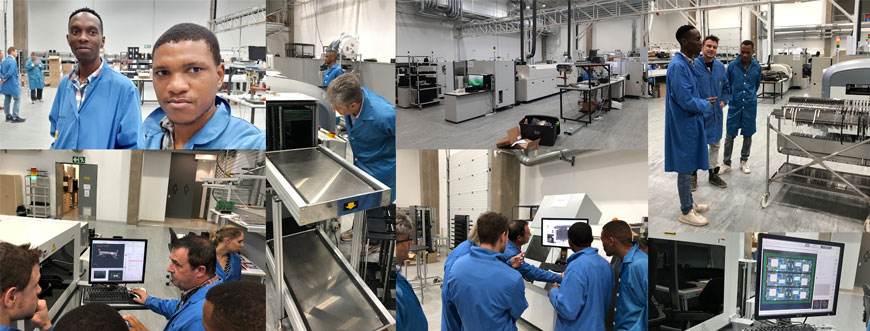
Jemstech has populated the electronics boards for the first prototype made in South Africa of the LVPS for the upgraded Tile Calorimeter of the ATLAS Detector at CERN, the European Laboratory for Particle Physics, where the Large Hadron Collider (LHC), the world’s largest and most powerful particle accelerator, is housed. (*)
The LVPS will power the future on-detector electronics of the Tile Hadronic Calorimeter – one of components of the ATLAS calorimetry system – that is being designed for the Phase-II upgrade of this detector.
South Africa is responsible for the production of over 1000 of these boards, where the printed circuit boards (PCBs) designed at Wits are manufactured by Trax Interconnect in Cape Town and then passed to Jemstech for population.
The Wits team in charge of the South African production is composed of Edward Nkadimeng, Nkhosiphendule Njara, Thabo Lepota, Ryan McKenzie, Charles Sandrock, Roger van Rensburg and Bruce Mellado. They are part of the ICPP in the Wits School of Physics.
“We discussed quality control issues, details of the bill of materials and other components as well as the implementation of Artificial Intelligence in the process of quality control assessment,” says Professor Bruce Mellado, Director of the ICPP.
(*) Calorimeters measure the energy a particle loses as it passes through the detector. It is usually designed to stop entire or “absorb” most of the particles coming from a collision, forcing them to deposit all of their energy within the detector.
Wits academics play leading role in Future Earth 2020 report
- Wits University
The Future Earth Report is an overview of some of the various risks faced by humanity, where it comes to our sustainable future on the planet.
Two senior academics from Wits University’s Global Change Institute played leading roles in the writing and editing of the new Future Earth Report, published by the International Science Council (ISC), in association with global science organisations, including the United Nations.
Several of the leading international scientists that contributed to the report are South African, including Richard Calland from the University of Cape Town and Odirilwe Selomane from Stellenbosch. Wits University’s Professor Bob Scholes sat on the report’s Editorial Board, while Professor Coleen Vogel co-authored an article on transformation in the 53-page report.
The 2020 Future Earth report is an overview of some of the various risks faced by humanity, where it comes to our sustainable future on the planet. According to Amy Luers, Executive Director of Future Earth, the report “aims to tell the story of where we are on our collective journey by connecting the dots between what society is currently experiencing – from fires to food shortages to a rise in populism – with recent developments in the research community”.
The report is a step away from the traditional manner of communicating the science around the planet’s risks, through processes like the IPCC, to a more direct approach of communication between scientists and the public. All the articles are co-generated in a collaborative process between a leading scientist and a science journalist.
The articles in the report tackle the difficulties and challenges that society is facing on Earth, including climate, politics and political economy, the deep ocean, forced migration, fake news biodiversity, food and transformation. The aim is to highlight the challenges in each of these fields, with an attempt to find a sustainable way forward to our future.
“We live in an era where it is declared that humans are one of the biggest forces on Earth, as opposed to the planet’s natural forces such as tectonics, volcanism and ocean processes,” says Scholes. “At the moment we are heading for a future with a 3.5 degree increase in global temperatures, where the Paris accord was trying to limit the rise to 2 degrees. We are not getting close to that.”
One of the key challenges of our time is trying to find ways to navigate our way into the future in just and sustainable ways. The Sustainable Development Goals, the climate and disaster risk reductions challenges facing us all require purposeful considerations of how we ‘live’.
“Transformations will be required including how we design and do business and think about our economic future; how we feed ourselves and how we consider, design and construct our livelihoods, homes and how we think about the meaning of work and design workplaces,” says Vogel. “We also need to think about how we relate to each other and to nature. Transformations of how we can align our everyday realities and future change will thus need to be balanced with what the planet can sustain and will ultimately require personal and systems wide transformations.”
Writing in the foreword of the report, former Prime Minister of Norway, Gro Harlem Brundtland says “Our world stands at a crossroads. We face existential threats that demand urgent action, from the climate crisis to the risk of nuclear war. In 2020, we need to make a bold, collective, and positive choice to work together to secure our common future, and not retreat into tired dogma, failed policies, or defeatism … I firmly believe that a collaborative and inclusive approach is essential”.
The report was launched in South Africa at an event hosted by The Future Earth Regional Office for Southern Africa (FEROSA) and the National Research Foundation (NRF) in Pretoria on Thursday, 13 February.
Roadmap to a win-win against invasive weeds
- Wits University
Researchers at Wits University have created the world’s first framework, to better guide the management of terrestrial invasive species.
Researchers at Wits University in Johannesburg, South Africa, have created the world’s first framework, to better guide the management of terrestrial invasive species.
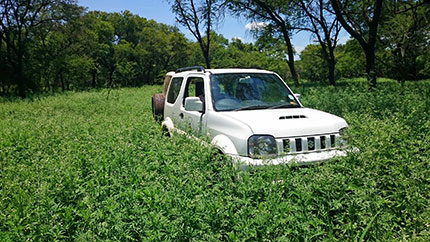
By using a big data approach and combining information from the South African National Census of 2011, with the South African Plant Invaders Atlas, the researchers found a way to prioritise targets in the control of invasive species. This will ensure the greatest benefits for both the environment and rural communities.
“South Africa spends R1,5 billion per year on controlling invasive species and while the country is really at the forefront alien species control in the world, we still have a wicked problem,” says lead author, Dr Chevonne Reynolds, a lecturer at Wits University. “However, by using our new framework, we can now target invasive control activities by prioritising localities that are most impacted. Typically, these are the poorest municipalities in the country.”
Invasive species cost South Africa’s economy R6,5 billion in damage from fire, loss of viable land and drinking water. These weeds also threaten our biodiversity and ecosystem services. as
The main finding of the research, published in the journal Ecosystem Services, shows that poorer rural communities are the most heavily impacted by the negative effects of invasive weeds.
“We looked at the livelihoods of people on a national level, what their household income is and how they use natural resources to aid or supplement their daily living need, and then examined how this is affected by invasive species,” says Reynolds.
While invasive species have both positive and negative impacts on the environment and communities, the team weighed up these trade-offs for a variety of invasive species to find their overall impact on the livelihoods of all South Africans.
For instance, people use the fruit of the prickly pear cactus (Opuntia ficus-indica) to supplement their diet and income. However, because it aggressively invades grassland it makes pastures unsuitable for livestock, while also competingfor water and other resources. So, overall it has a negative impact on the affected community.
The team combined data on household incomes and their use of natural resource (provisioning ecosystem services) for all municipalities in South Africa, with the distribution data of 57 invasive weeds establish which communities are most affected.
“We found that poorer rural communities are the most impacted by invasive species, as these people make most use of natural resources on a day-to-day basis,” says Reynolds. “Their ability to make a living is severely restricted by the invasion of alien species in their environments.”
Some of the worst affected municipalities are Port St Johns, Nyandeni, King Sabata Dalindyebo and Mbhashe municipalities all in the Eastern Cape. Stellenbosch and Knysna are the municipalities with the highest diversity of invasive weeds but depend less on natural resources.
“What we have done iscreate a framework for government to direct efforts to eradicate invasive species more effectively, by targeting municipalities where both people and the environment are most at risk,” says Reynolds. “Our model can also be used and adapted for other countries with a similar problem, where the novel approach of combining big data with citizen science can provide answers to problems.”

 Several of the leading international scientists that contributed to the report are South African, including Richard Calland from the University of Cape Town and Odirilwe Selomane from Stellenbosch. Wits University’s Professor Bob Scholes sat on the report’s Editorial Board, while Professor Coleen Vogel co-authored an article on transformation in the 53-page report.
 By using a big data approach and combining information from the South African National Census of 2011, with the South African Plant Invaders Atlas, the researchers found a way to prioritise targets in the control of invasive species. This will ensure the greatest benefits for