

Co-designing the smart African city
- Deryn Graham
Smart cities depend on more than technology to serve communities.
While President Ramaphosa might have grandiose ideas for building the first new city in democratic South Africa, the Lanseria Airport City Mega project, which he first mentioned in his 2020 State of the Nation Address, one Wits professor and a PhD student have a more modest, human-centric vision for improvements to one of Johannesburg’s existing suburbs.
Rennie Naidoo, Professor of Information Systems and Research Director at the Wits School of Business Sciences and PhD student Terence Fenn piloted the Participatory Futures Method of research in Westbury, a resource-scarce but culturally vibrant neighbourhood in the west of Johannesburg. Adapted from the US developed Design Science Research model which has been used primarily in blue chip companies to help them optimise profitability, the method, as its name suggests is more participatory, following the movement to make research less about rigour and more about relevance.
Hierarchy of needs
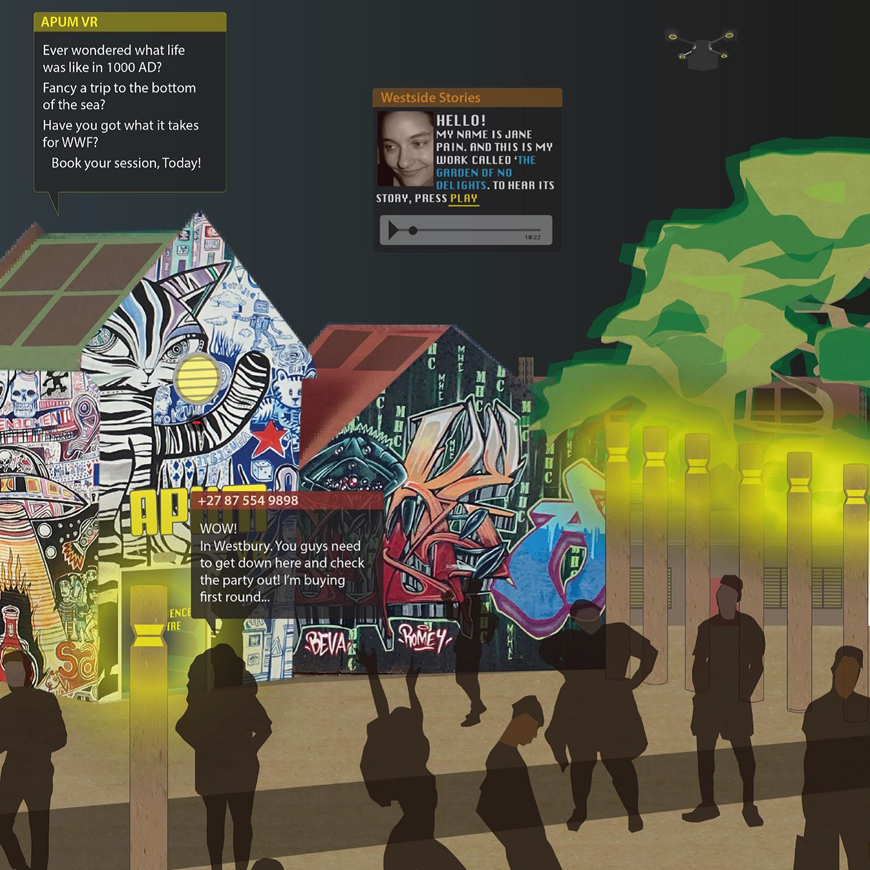
The objective of Fenn’s research was to find out from the members of the Westbury community itself at grassroots level, how they envision thriving through smart urban technologies. Naidoo was surprised by the creativity and deep thought that went into some of the community’s responses.
“Despite the serious socioeconomic challenges facing Westbury, arts and music is still very much part of the community’s mindset – the community members talked about establishing a cultural precinct, as well as recycling kiosks,” says Naidoo. “In their hierarchy of needs, I was surprised but I soon realised how much cultural enrichment and safety and security matter.”
Using technology including cellphones and the internet, Westbury residents want safety without surveillance overreach, creativity without exclusion and smart infrastructure that empowers rather than controls. Participants imagined tech enabled community centres, solar powered resilience hubs and streets designed for culture, not just cars.
Westbury’s vision does not exactly align with Ramaphosa’s – government may want South Africa to go head-to-head with America and China in developing heavy mega smart cities – but Fenn and Naidoo found that this community rejects top-down techno-utopias and instead sees a future rooted in collective memory, local agency and ubuntu.
Naidoo believes that national government is out of touch with the needs of communities and he believes that when local government leaders are absent, government fails to see what communities want.
“A representative democracy is one in which politicians are far more engaged with their constituents,” elaborates Naidoo.
Our own vision for smart cities includes sustainable urban planning, minimal environmental impact, resource efficient buildings and systems, parks, gardens and communal spaces for working, living and playing.
Technology has the capacity to widen inequalities, as well as to enhance urban lifestyles and it is in finding the best use of increasingly less expensive tech programmes, apps, systems and the internet that we can create smart communities and then scale up to create smart cities.
Cities as co-created spaces
Naidoo and Fenn’s research invites a rethinking of smart cities, not as systems we impose on people and communities but as futures we co-create. It has revealed that to thrive in the cities of the future, we must rewire not just our technology but our imaginations.
For Naidoo and Fenn, collaboration, co-creation and participation are all buzzwords as much as AI, the internet and smart technology, in our quest to create smart African cities that work financially, spatially, practically and in the context of each community.
“Given that projections put 60% of the African population in cities by 2050, it is important that we get our planning right,” says Naidoo. “We may not have the budget for grand sweeping projects such as Lanseria but the cumulative effect of small, transformative projects within communities can have a dramatic impact on our living conditions.”
Ultimately, it’s not cities that thrive but the people who inhabit them.
- Deryn Graham is a freelance writer.
- This article first appeared in CURIOS.TY, a research magazine produced by Wits Communications and the Research Office.
- Read more in the 20thissue, themed #Thrive, which explores what it truly means to flourish — across a lifespan, within communities, and on and with our planet.