

The infinite promise and application of tiny particles
- Wits University
After decades of building systems to detect subatomic particles, physicist Prof. Bruce Mellado has turned the same scientific thinking towards air quality.
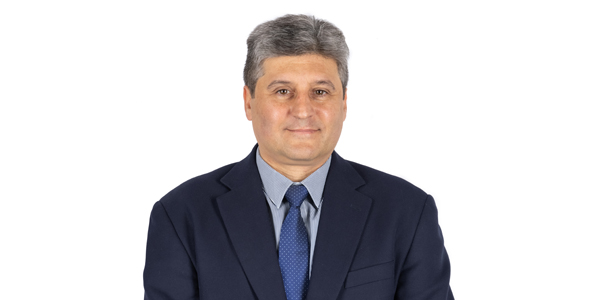
The result is that AIrSynQ, an AI-powered system developed by Wits researchers and partnerships, won the 2025/2026 NSTF-South32 Innovation Award for Small, Medium and Micro Enterprises.
Professor Bruce Mellado in the Wits School of Physics and Director of the SA Consortium of Air Quality Monitoring (SACAQM) has spent years shaping air-quality research into a scalable environmental risk service.
AIrSynQ brings together affordable sensors, wireless communication and artificial intelligence to help organisations detect poor air quality before it becomes hazardous.
For Mellado, the Innovation Award recognises an act of scientific translation. Indeed, his system, rooted in the search for the smallest known particles on Earth, is now tracking invisible clouds of pollution.
Give something back
The shift to making science translate began with a conversation over lunch.
Mellado had recently moved to South Africa from the United States, where he had been a professor at the University of Wisconsin. The late Dr Daniel Adams, then a senior official in South Africa’s Department of Science and Technology, challenged him to think beyond the boundaries of particle physics.
"He said, 'Bruce, you need to think broadly. Identify those areas in your research that could be useful for other people and have an impact in society,'" Mellado recalls. "He was the one who said, 'We are giving you all this support. Just give back to society.'"
Adams played a pivotal role in establishing air quality as a collaborative project with CERN, the European Organisation for Nuclear Research. The work grew into Wits-based SACAQM and its AI_r research platform, tested in settings including schools, hospitals, libraries, research centres, and community facilities.
Adams died shortly after retiring, but Mellado still locates the project's purpose in that early challenge.
From particle detectors to pollution clouds
At first glance, particle physics and air-quality monitoring seem to have little in common.
Particle physicists design and operate vast, integrated systems. Detectors collect enormous volumes of data that must be moved, checked and analysed, often in real time. Mellado has worked in this world for more than 30 years, including at CERN's Large Hadron Collider, where he contributed to the discovery of the Higgs boson in 2012.
The Higgs boson is a minute particle that proves the existence of an invisible, universe-wide energy field. It acts like ‘sticky molasses’, giving other particles their weight. The Higgs boson’s nickname is the ‘God Particle.’
"Particle physicists are not afraid of large amounts of data. We understand how to design scalable systems. We understand real-time analysis and how to use artificial intelligence, all integrated in one system. For us, it is the air we breathe."
AIrSynQ applies that architecture.
In this system, sensors use laser light to measure particle concentrations and can be adapted to detect other pollutants. Wireless Internet of Things (IoT) technology sends the readings to a cloud-based platform. AI then checks and interprets the data, identifies unusual conditions and forecasts what may happen next.
AIrSynQ describes this as a "sense, interpret, predict, act" pipeline. A single sensor can produce a reading; a network of hundreds produces a flood of data that is expensive to interpret without automation. The system is designed to work whether an organisation deploys one device, ten, or a thousand.
AIrSynQ now turns that work into services for mines, hospitals, hotels, commercial buildings and industrial sites.
In a deep-level mine, dust, gases and volatile organic compounds can affect alertness and safety. In a hospital, an air-quality event may place already vulnerable patients at greater risk. In an office or classroom, elevated carbon dioxide can impair concentration.
Mellado leads a team spanning AI and data science, operations, commercial development and deployment. Dr Edward Nkadimeng, a Lecturer in the Wits School of Physics, heads AI and operations, while Dominique Adams leads marketing and commercial operations. Postgraduate researchers remain embedded in the programme, and manufacturing is carried out in South Africa.
“Within months of the company's creation, we had begun generating revenue from mining and hospitality, and this provided evidence that research could sustain a South African business,” says Mellado.
Seeing the spike, not just the average
The team had to grapple with deeply complex challenges when it came to outdoor air, however. City-wide averages can conceal what is happening street by street and hour by hour.
"Pollution is concentrated in clouds, and so we wanted to create a map of where the hot spots and cold spots are located," says Mellado.
The AI_r network has shown how localised and mobile the hot spots are. Mellado says the team's early-detection work can identify a pollution cloud and use wind direction to anticipate where it may travel. A person with asthma or another health condition could receive an alert and take precautions before the spike arrives.
Sensors tracked smoke from recurring illegal dump fires in various locations as the fires spread across Johannesburg. More than 500 devices are being deployed across Gauteng now, building a denser picture of where pollution gathers and how it moves.
"You will get an alert on your cellphone saying: you are in the middle of a cloud and you are going to be in it for the next couple of hours. Or we can predict that a cloud is coming your way and will be there in two hours."
A scientific detour through a pandemic
Covid-19 sharpened Mellado's understanding of how modelling could serve government and the public. As an adviser to then Gauteng Premier David Makhura, he led a team responsible for provincial modelling and forecasting.
During the wave in the pandemic during which the Omicron variant emerged, the team saw an abrupt acceleration in cases that did not fit earlier variants. The team could not identify the variant itself – that required genomic analysis – but Mellado says they alerted government to the change in transmission dynamics before the genomic announcement.
The experience showed him how fundamental science could move into urgent public use. It also reinforced that the work was incomplete if its meaning stayed among specialists.
"Once you develop a sophisticated tool to help solve societal problems, it is very important to convey that to the public," he says. "You need to explain a finding so that it can be interpreted by somebody who is not an expert."
South Africa as a place to build
Mellado was born in Sydney, Australia, lived in Europe, completed his PhD at Columbia University in New York and became a professor in the United States. He moved to South Africa in 2013, drawn by the country's investment in science and the potential for technology transfer between CERN and South Africa.
His own route into the field was less grandly planned. As a young person, he debated becoming a doctor or an engineer, until his memory made the decision for him.
"There was no way I was going to learn the names of hundreds of muscles, joints and bones,” says Mellado.
Engineering led him to physics, and physics eventually brought him to a problem measured in breathing rather than particles.
Mellado now spends time in China, where he is studying advances in agentic AI. He sees systems that can complete complex tasks with greater independence as the next stage of AIrSynQ's development – but insists that people must remain in control. AI can process volumes of data no person could manage; people must still supervise its decisions and test its results.
"The human always has to be at the helm," he says.
That balance runs through AIrSynQ. The aim is not to pretend that monitoring alone can end pollution, or that economic activity can simply be stopped whenever emissions rise. It is to make risk visible early enough to manage it.
"We can manage that emission. That is the key,” he says.
That lunch-table instruction to give something back has become a network of sensors, a growing South African company, and an early-warning system for the air around us. For a physicist accustomed to finding meaning in invisible data, it is a natural progression, and perhaps the most immediate one yet.