

Innovation specialist visits Wits innovation ecosystem
- Wits Innovation Centre
Distinguished expert in university innovation, Tom Hockaday, says the Wits innovation ecosystem holds promise.
Hockaday spoke recently at the Innovators' Meeting, convened by the Wits Innovation Centre (WIC). These regular meetings are intended to be an opportunity for those in the innovation ecosystem to connect and exchange ideas around how to stimulate and promote innovation within the University.
Hockaday is the director of Technology Transfer Innovation in the United Kingdom and author of the book University Technology Transfer: What It Is and How to Do It. After an illustrious career spanning thirty years and including Oxford University, he now consults universities internationally. Hockaday is also on the investment committee for the University Technology Fund I and II in South Africa, which has supported Wits innovation.
Professor Lynn Morris, the Deputy Vice-Chancellor of Research and Innovation at Wits, noted in her welcome that Hockaday’s presence over a week has been a valuable resource. “This is a dynamic space, but we're talking to the right people,” she says.
She said that it was especially helpful to speak to Hockaday about the role of commercialisation guidelines, which Wits rolled out in 2024. “This is a new era for Wits as we consider how we help our innovators commercialise,” she said.
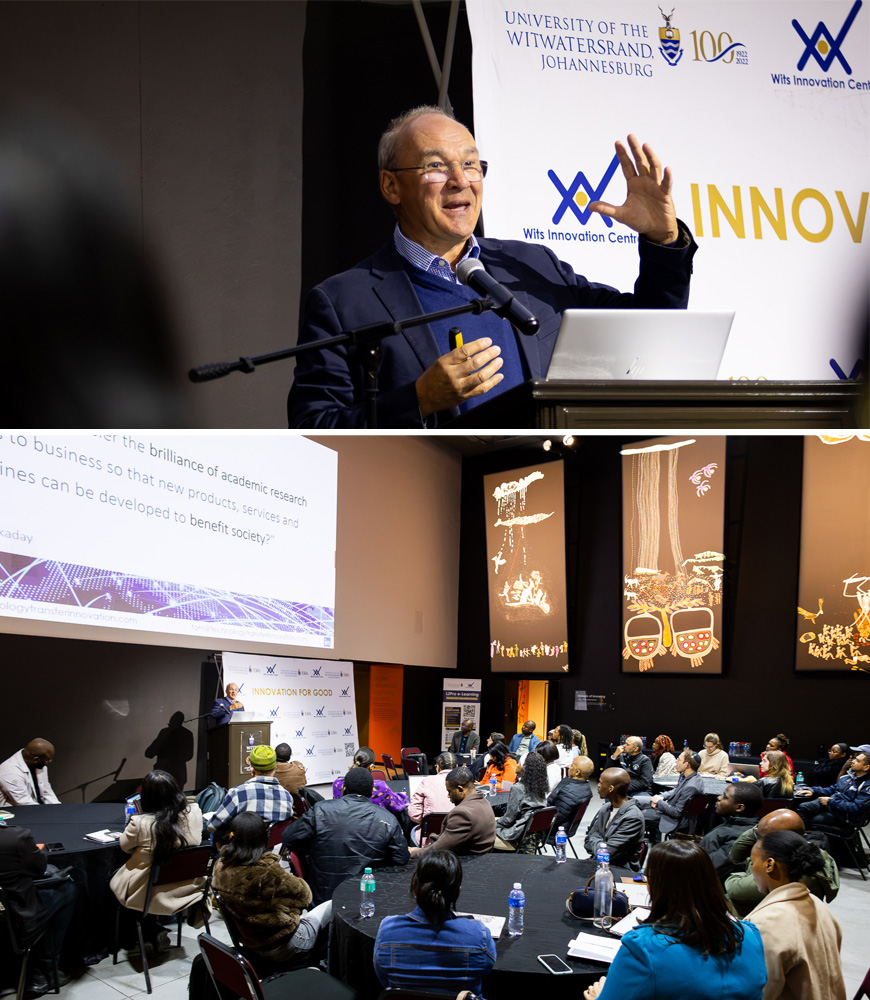
Hockaday explains that the innovation ecosystem in a university is important because sometimes the commercial route is the best way to deliver benefits from university research results. “How do we transfer the brilliance of academic research results to business so that new products, services and medicines can be developed to benefit society?” he says as the driving question behind the work.
At the core of doing this successfully is building community. “We want to do deals, but that comes second,” Hockaday notes. “We need to build relationships first.” He explains that knowing and trusting people is usually the foundation for successful business deals in this sphere.
Hockaday jokes that this involves throwing a lot of parties. These networking events can take on a number of forms but essentially give an opportunity for stakeholders to meet and share ideas.
The Director of the WIC, Letlotlo Phohole, chuckles at the idea of calling them parties but agrees that networking events are key. “It's all about the culture of innovation and promoting it”
Hockaday gives the example of the Oxford Innovation Society, which was set up in June 1990. Regular dinners and events invited paying members within the university and industry to connect. Interestingly, they would regularly invite people they did not yet know, and this would start important relationships.
When connecting, Hockaday says it is not just about the numbers and data, but the narrative one creates around it. “I can tell you the number of patent applications we used to file, and I can represent them in very sort of fancy graphical terms, but it's not very interesting. What is far more interesting is stories that come out of university business interactions and technology transfer.”
He advises those in the innovation ecosystem to think about how to tell interesting and engaging stories to anyone they interact with, about the work already being done.
Hockaday also addresses innovation rankings, which are often considered an important reflection of a university’s work in this area. Notably, Wits ranked first in Sub-Saharan Africa for innovation performance in the 2025 Global Innovation Index (GII).
“Enjoy them while you can,” he jokes, noting that there are lots of different rankings available, and it can be enticing to try to get to the top. While he acknowledges that the rating systems are highly data-driven and well thought through, he cautions against getting too fixated on the results.
“I generally think you want to do a bunch of things that you think are really good and important for you as a university, and then you do well in the rankings,” Hockaday says. “But I think if you start following the rankings, then you're starting slightly to lose control of what you actually think you're all about. “
Phohole says he finds this perspective encouraging, because his team had been focusing on doing their best work, not earning rankings. “It was important for him to actually say that rankings are good but let's look at the underlying things, like the innovation community”.
Morris confirms that the interactions with Hockaday are set to continue. He, in turn, speaks highly of his interactions with the Wits innovation team.
“It's clear that with the infrastructure you've got here and the events and parties that you're having, I think this place is changing, and it has a sort of innovation vibe about it, which is great.”