
Wits case studies selected to demonstrate societal impact
- Wits University
TB, HIV, Covid diagnostics save lives and applied theatre technique addresses increasing HIV infection in youth.
Universities South Africa (USAf), an umbrella body representative of the country’s 26 public universities, has selected two case studies from Wits University to demonstrate the societal impact of the academic work conducted at the institution.
Following an open call to all South African universities in August, USAf selected the Biomimicry to democratize access to infectious disease diagnostics case study, submitted by Professor Bavesh Kana, and Drama for Life’s Knowledge Unzipped sexual and reproductive health and rights project, submitted by Mr Hamish Mabala Neill.
Both case studies have now been published under the Societal Impact tag on USAf’s website to demonstrate how evidence-based research at Wits University changes lives, for good.
Furthermore, from the 23 case studies selected for publication on the USAf website, the assessors recommended that selected case studies further be used at an envisaged public event and/or in a publication to celebrate the societal impact of South African universities. Professor Bavesh Kana's infectious diseases biomimicry project is amongst this selection.
Biomimicry to democratize access to infectious disease diagnostics
USAf selected seven case studies for the Medical and Health Sciences category, including Wits’ Biomimicry to democratize access to infectious disease diagnostics.
The battle against diseases such as tuberculosis (TB) and Covid-19 requires fast and accurate mass testing. However, traditional diagnostic verification required live TB bacteria that posed major safety risks, creating a critical stumbling block.
The Wits biomimicry research team developed a groundbreaking suite of diagnostic controls using harmless bacteria modified with genetic elements from pathogenic organisms, thus mimicking them safely in testing platforms.
This innovation enabled verification of TB, Covid-19, and HIV diagnostics in 51 countries, directly impacting millions of lives globally.
For TB-infected individuals, an accurate, timeous diagnosis is the first step to accessing appropriate care. The team's products enabled diagnostic labs to run quality assurance programmes, allowing TB testing to be brought online nationwide and globally.
To maximize impact, Wits spun out SmartSpot Quality (Pty) Ltd to market diagnostic controls globally. In terms of social impact, the products have enabled hundreds of thousands of patients to access diagnostic tests for drug-sensitive TB in 51 countries (84,834 quality assurance specimens used), and drug-resistant TB in 28 countries (4,487 specimens tested).
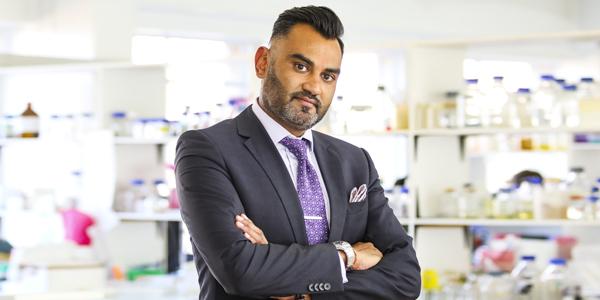
Professor Bavesh Kana is Head of the School of Pathology at Wits and a Research Fellow at Wits’ Infectious Diseases and Oncology Research Institute (IDORI). Kana and his team have a solid track record of producing research with impact, most notably in TB molecular diagnostics (innovations which he pivoted during the pandemic to address Covid diagnostics), TB vaccinology, and biomimicry, which 'mimic' the models, systems and elements in nature to solve complex problems in people.
Unzipped, a Sexual and Reproductive Health and Rights Programme for SA’s Youth
USAf selected six case studies for the Humanities and Social Sciences category, including Wits’ Drama for Life Knowledge Unzipped project.
Knowledge Unzipped is a multi-modal, applied theatre-based sexual and reproductive health and rights project. Run by Drama for Life in partnership with the Charlize Theron Africa Outreach Project, it provides updated strategies for implementing, training and assessing applied arts in public health.
Specifically, Unzipped is an applied theatre technique developed by Wits’ Hamish Mabala Neill and Robert ‘Bobby’ Gordon at UCLA that used Theatre-in-Education, Theatre-of-the-Oppressed, and South African workshop theatre aesthetics to craft a refreshed comprehensive sexual health education model for southern African youth to address research-informed indications of an incoming rise in HIV-infection rates in 15-24-year-olds.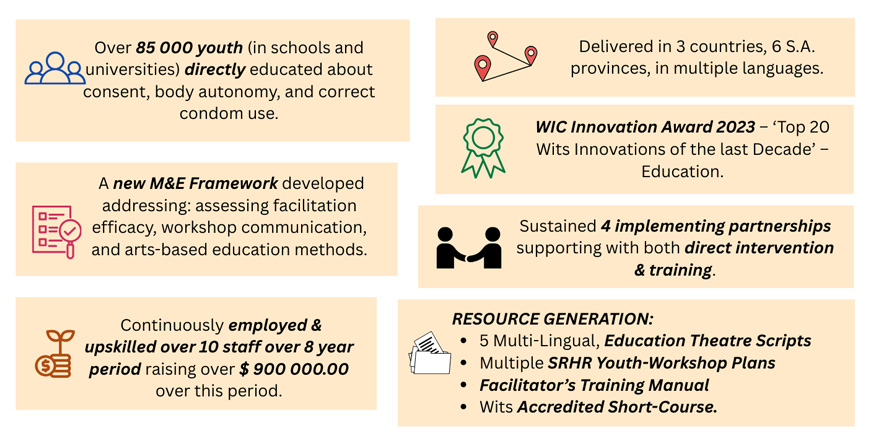
The project enabled interaction with numerous and varied stakeholders including community-based NGOs nationwide, Wits-affiliated research and service units, and Gauteng high schools. Outcomes were achieved within each grouping that aligned with the objective to address specific Sexual and Reproductive Health and Rights Education (SRHR) needs ‘rooted in the local context and culture’.
.jpg)
An applied theatre practitioner, Mr Hamish Mabala Neill is the Knowledge Unzipped project lead and the Creative Hub Research Director at Drama for Life. He holds a Master’s in Applied Theatre from Wits, awarded for his performance-as-research dissertation which interrogated ‘race’ through performance.
Drama for Life is a unique, internationally recognised postgraduate programme in the Wits School of Arts dedicated to arts for social transformation and healing. Drama for life brings together the disciplines of Applied Drama and Theatre, Performance Ethnography, Performance as Research, Arts Education, Drama Therapy and Expressive Arts Therapies within the context of a critical reflexive praxis.