New Wits-CNRS agreement strengthens scientific ties
- Wits University
Wits University and the French National Centre for Scientific Research (CNRS) launched the first joint International Research Centre (IRC) in Africa.
This comes at a moment when multilateralism and shared scientific endeavours to solve critical, intersecting global challenges are crucial.
Wits is only one of seven IRCs worldwide. Although the CNRS has an extensive international research network, only a small number of IRCs have been established. Professor Antoine Petit, CEO of the CNRS, said the decision to designate Wits as an IRC reflects strategic confidence and a shared belief in science's role in society. “Wits has demonstrated outstanding scientific strength and a deep commitment to the next generation of researchers. This is why we chose Wits as our first African partner,” said Petit.
He added that the strong relationship with the Wits Vice Chancellor, Professor Zeblon Vilakazi, and the remarkable level of joint research output were central to CNRS’s decision.
The IRC is the product of a partnership that began in 2021, when Wits and the CNRS signed a Memorandum of Understanding to open new pathways for collaboration, particularly in early-career research development. A joint PhD programme was launched, scientific workshops held, and publications co-authored. In four years, 400 articles have been co-published across paleosciences, physics, mathematics, global change and environmental sciences.
“Doctoral and postdoctoral work will continue to sit at the heart of our partnership. Through collective research, we can help address the complexity of climate change, biodiversity loss, energy transitions and global health threats. The Wits-CNRS IRC signals a joint commitment by South Africa and France to uphold the integrity of science and invest in the next generation of researchers who will carry this work forward,” explained Petit.
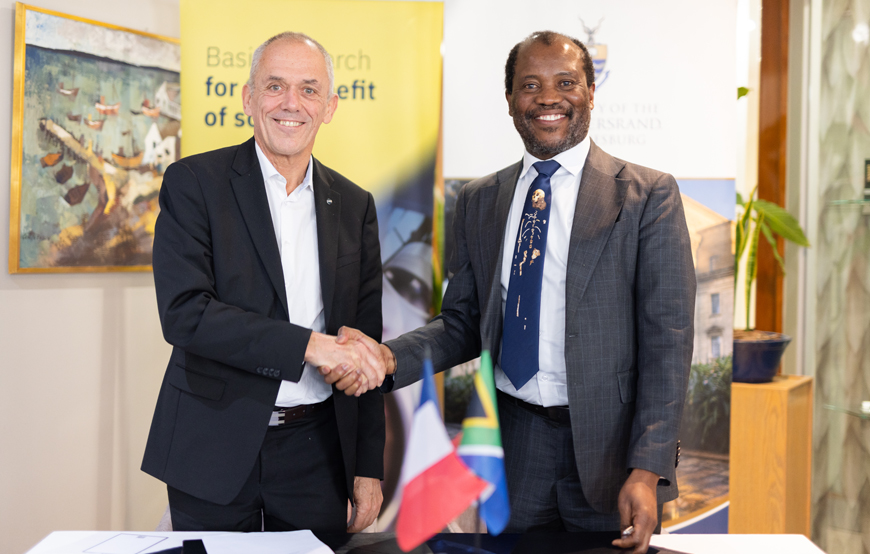
Professor Lynn Morris, Deputy Vice Chancellor for Research and Innovation at Wits, hosted the launch ceremony, while Alain Mermet, Head of the CNRS European and International Office, delivered an opening address on behalf of the CNRS. Representing the Faculty of Science, Deputy Dean Professor Willem Conradie described the IRC as a platform for continental and global collaboration that strengthens interdisciplinary research and supports mobility and mentorship across institutions.
The newly appointed Co-Directors of the IRC, Professors Marion Bamford and Laurent Bruxelles, spoke to the vision that will guide the centre. They explained that the IRC is intended not only as a research structure but also as a training environment that nurtures early-career researchers, strengthens postgraduate programmes, and builds new pathways between South Africa and France.
Presentations from researchers across the four pillars illustrated the breadth of collaboration. Work in paleosciences, physics, mathematics and environmental science has already produced substantial joint outputs, with many projects now incorporating Artificial Intelligence as a core methodological and transversal tool.
In his address at the Memorandum of Agreement signing, Vilakazi explained that AI for science will be one of the defining themes of the next decades and will reshape research from astronomical data analysis to mathematical modelling to palaeoecological reconstruction.
“The new IRC and the further cementing of our relationship with the CNRS highlights Wits’ commitment to scientific leadership, African scholarship and global cooperation. The Wits-CNRS IRC stands for the idea that strong science must be built collaboratively and that Africa plays a central role in shaping global knowledge. This IRC is a powerful statement in favour of multilateral science and African research excellence to solve common challenges. Wits is honoured to partner with the CNRS, and we are committed to ensuring that this IRC becomes a home for frontier discoveries and new opportunities for young researchers,” said Vilakazi.
The Wits-CNRS IRC aims to be a continental hub for high-impact research, data-intensive discovery and transformative education.