

“We know how to engineer solutions. Now we must engineer SA's future”
- Wits University
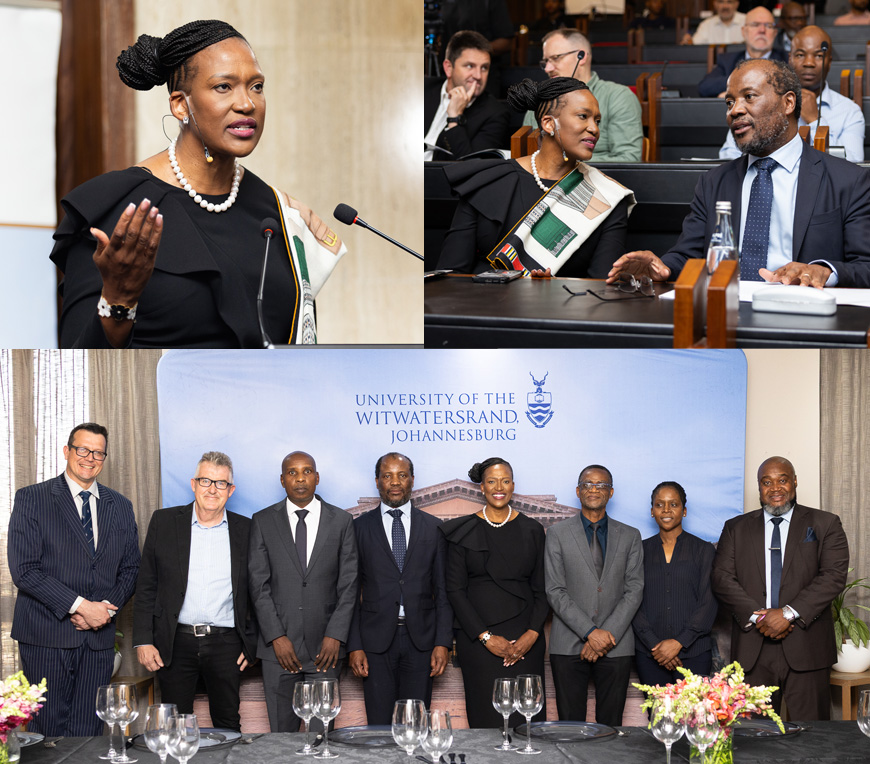
Wits alumna Mpumi Zikalala, CEO of Kumba Iron Ore, delivered the John Orr Memorial Lecture.
From a young girl in Vryheid who knew nothing about engineering to one of South Africa's leading mining executives, Wits alumna Mpumi Zikalala challenged engineers to build a future where no talent is overlooked.
South Africa has extraordinary mineral wealth, worldclass engineering expertise and exceptional human talent. Yet unemployment, inequality, failing infrastructure and sluggish economic growth continue to constrain its potential.
Why then is a country so richly endowed struggling to translate these strengths into prosperity for our people?
These were the challenges posed by Mpumi Zikalala, CEO of Kumba Iron Ore, who delivered the 2026 John Orr Memorial Lecture at Wits University on 27 October 2026. Hosted by the South African Institution of Mechanical Engineering (SAIMechE), the lecture challenged engineers to rethink their contribution to society.
"Engineering is most powerful when it is used to address the challenges that matter most to people, our communities and broader society," said Zikalala. "Engineers are architects of progress."
Engineering the conditions for prosperity
Zikalala argued that engineering's greatest achievements are not necessarily machines, structures or systems, but the opportunities that they create.
“A bridge connects communities to jobs and markets. A power station enables businesses, schools and hospitals to function. A mine creates livelihoods, infrastructure and economic opportunities that should endure beyond its operational life,” she said. “South Africa's electricity, transport, logistics and water challenges are fundamentally engineering problems that can be diagnosed, measured and solved.”
She called for stronger partnerships between government, business, academia and civil society to address the structural constraints holding South Africa back.
Mining responsibly
Drawing on Kumba Iron Ore's operations, Zikalala shared how engineering innovation could deliver economic, environmental and social benefits. She added that artificial intelligence, automation and remote operations also offer opportunities to improve safety, efficiency and sustainability.
Zikalala warned that technological advancement must never compromise human judgement, accountability or safety. "Every injury and fatality is one too many," she said, stressing that it is the mining industry's collective responsibility to protect lives.
The young girl from Vryheid
Zikalala shared a personal reflection – she was a young girl growing up in Vryheid, KwaZulu-Natal, who knew little about engineering and the possibilities of a career in mining. Everything changed for her when representatives from Anglo American visited her school and introduced learners to engineering and opportunities that they had never imagined.
"What they offered was more than information about a career in engineering. They offered possibilities. They helped me believe in a future that I had not previously been able to envision for myself," she recalled. She shared her journey from Vryheid to Wits, where she graduated in chemical engineering and ultimately rose to the helm of Kumba Iron Ore.
"Sometimes the most powerful thing we can do is to help a young person believe that a future is possible," she said. She challenged South Africans to remove barriers facing women and young people, including discrimination and gender based violence.
Honouring a legacy, shaping the future
Wits Vice-Chancellor Professor Zeblon Vilakazi welcomed Zikalala back to Wits and said: "The measure of our legacy is not only in what we have achieved but what we make possible for those who come after us.” He added: “South Africa possesses an immeasurably large reserve of mineral resources, and engineering expertise and scientific talent, yet we are confronted by unemployment and inequality. We must ensure that those capabilities help build an economy not only on what we extract from the Earth but what we create through knowledge, innovation and human ingenuity.
Professor Nthabiseng Maledi from the School of Chemical and Metallurgical Engineering reflected on John Orr's pioneering contribution to engineering education and the lecture's role in inspiring future generations. “Great achievements are often built on the work of those who came before us…and I believe that this is what this lecture represents,” she said.
The occasion, attended by Professor Cuthbert Musingwini, Dean of the Faculty of Engineering and the Built Environment and Professor Daniel Wilke, Head of the School of Mechanical, Industrial and Aeronautical Engineering, also recognised Professor Robert Reid, the former Head of School, with an honorary fellowship from the Institute.
The CEO of the SAIMechE, Uncel Mhelembe, reaffirmed its longstanding partnership with Wits and the importance of professional engineering registration. “Our relationship with Wits is undeterred,” he said, speaking about the ongoing events and activities between the two entities. “The SAIMechE has elected and honorary fellow, Professor Robert Reid who is with us today. Congratulations!”
Zikalala’s concluded with hope for the future: "Our legacy will not be defined only by the mines we develop, the infrastructure we build or the technology we master. It will be defined by the lives we improve, the barriers we remove and the possibilities we create for those who come after us. We know how to engineer solutions. Now we must engineer a future in which no talent is wasted, no potential is overlooked and where progress is felt in the lives of our people."