

Wits congratulates Justice Navi Pillay
- Wits University
Nobel Peace prize winner recognised for a lifetime of advancing justice, human dignity and human rights.
The University of the Witwatersrand extends its warmest congratulations to distinguished South African jurist, human rights advocate and Wits honorary graduate Justice Navanethem ‘Navi’ Pillay, on being awarded the 2026 Nobel Peace Prize. This exceptional global honour recognises a lifetime devoted to advancing justice, human dignity and human rights, and celebrates a South African whose courage and leadership has made an enduring impact on the world.
Justice Pillay’s remarkable journey has taken her from challenging injustice in apartheid South Africa to serving at the highest levels of international law and human rights. In 2022, Wits proudly conferred an Honorary Doctorate on Justice Pillay in recognition of her groundbreaking contribution to law, justice and human rights.
The University is proud to count Justice Pillay among its honorary graduates and congratulates her on this extraordinary recognition of a lifetime spent advancing justice and human dignity across the world.
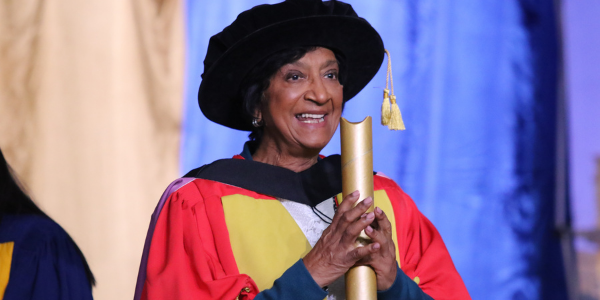
Read Justice Pillay’s Wits honorary degree citation below:
Citation: Navanethem (Navi) Pillay
Navi Pillay was born on 23 September 1941 in Durban, KwaZulu-Natal. The daughter of a bus driver, she attended the University of Natal, with the assistance of donations from the local Indian community, to obtain a BA in 1963 and an LLB in 1965. She served her legal articles with Narainsamy Naicker, a banned member of the South African Indian Congress and Natal Indian Congress and qualified as an attorney.
Navi Pillay has broken barriers all her life. Unable to secure work, she became the first black woman to open her own law practice in Natal in 1967, inter alia, to provide legal assistance to anti-apartheid activists. During her 28 years of practice, she contributed to exposing the use of torture on detainees in police custody and the effects of and solitary confinement. She also worked to secure the rights of prisoners on Robben Island, in particular the right of access to lawyers.
She mixed practice with postgraduate study and teaching, as well as community work. In 1982, she obtained an LLM from Harvard Law School, followed by an SJD in 1988, the first South African to be awarded a legal doctorate from Harvard. During this period, she also lectured at the University of Natal. A particularly strong advocate for survivors of gender-based violence, she used her considerable energy and drive to co-found the Advice Desk for the Abused and run a shelter for victims of domestic violence at a time when little else was available to women seeking assistance and shelter. In her legal practice, she assisted many survivors of gender-based violence.
During the early 1990s, she was a member of the Women's National Coalition, a broad-based alliance uniting women around gender equality and inclusion in the new South African Constitution. In 1992, she co-founded Equality Now, an international women's rights organisation. After the 1994 democratic elections, Navi was invited to act as a judge in the High Court - the first black woman to do so.
However, it is in her work on International Criminal Law and International Human Rights that she has achieved global recognition. Indeed, she was soon asked to play a role in the International Criminal Tribunal for Rwanda (ICTR) and was elected by the UN General Assembly to be serve as a judge in 1995, the first woman to do so. She served in this capacity for eight years, until 2003. In the last four years of her tenure, she was the President of that Court. She played a critical role in developing its jurisprudence on freedom of speech and hate propaganda, as well as rape and genocide. The landmark trial of Jean-Paul Akaseyu established that rape and sexual assault during armed conflict could constitute genocide. Pillay is quoted as saying: 'From time immemorial, rape has been regarded as spoils of war. Now it will be considered a war crime. We want to send out a strong signal that rape is no longer a trophy of war' (Washington Post).
When her term ended, she was snapped up for the newly formed International Criminal Court in The Hague. In February 2003, she was elected for a six-year term to its first panel of judges, where she served on the Appeals Chamber.
She resigned in 2008 to take up the position as 5th UN High Commissioner for Human Rights, appointed by UN Secretary-General, Ban Ki-moon. Her appointment was not without controversy as the US initially opposed her based on her strong commitment to women's rights and abortion. Here she served two 2-year terms until 2012. Amongst her important contribution to human rights in this position is her role in securing the recognition of sexual orientation and gender identity in International Human Rights Law.
In April 2015, she became the 16th Commissioner of The International Commission Against the Death Penalty, which advocates for the abolition of the death penalty in all regions of the world. In 2017, she was appointed to the Advisory Council of the International Nuremburg Principles Academy, which focuses on International Criminal Law and justice and is based in Nuremburg, Germany.
Navi Pillay is a distinguished and renowned South African jurist and advocate for Human Rights. Alongside her many prestigious international appointments, she has been honoured with many awards, including the Inaugural Grueber prize for Women's Rights in 2003 and honorary degrees from Durham University, the City University of New York School of Law, the London School of Economics, Erasmus University, Rotterdam, the University of Leuven, Rhodes University, and the Durban University of Technology.
Her ground-breaking roles in law, justice and human rights, and in smashing the glass ceiling for black women on a global stage, it is befitting for the University of the Witwatersrand, Johannesburg, to award Navi Pillay an Honorary Doctorate.