

Universities should turn regional cooperation into action
- Wits University
SADC Vice-Chancellors' meeting says region needs to move beyond policy discussions and build practical systems that allow knowledge to move across borders.
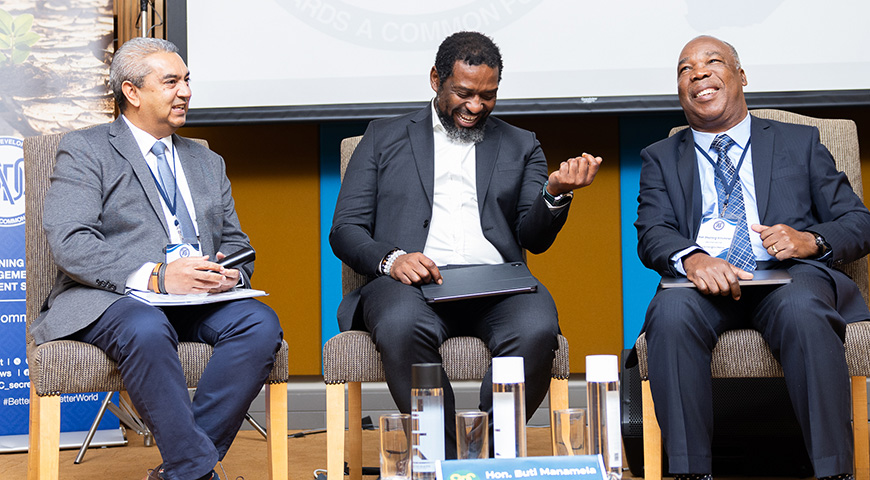
Southern African universities must move beyond regional agreements and build practical systems that allow students, qualifications, research and skills to move more freely across borders, higher education leaders said at a regional meeting hosted by the Wits Business School.
This was one of the key messages at the Vice-Chancellors’ Strategic Meeting on Regional Higher Education Transformation in the Southern African Development Community (SADC), hosted by Wits from 31 August to 1 September 2026.
The meeting brought together vice-chancellors, university leaders, government representatives, the SADC Secretariat, the Southern African Regional Universities Association (SARUA), quality assurance bodies and development partners. Discussions focused on the SADC Higher Education Strategy, the proposed SADC University of Transformation, a regional higher education data system, and micro-credentials and flexible learning pathways.
Standing in for Professor Zeblon Vilakazi, Wits Deputy Vice-Chancellor Professor Garth Stevens welcomed delegates to Wits.
Stevens said regional cooperation is closely aligned with Wits’ history and its role as an African university.
“Our students come from across the region and beyond. Our academics collaborate across borders, and our research partnerships connect us to institutions throughout Africa and internationally,” he said.
Universities are operating in a period of rapid change, shaped by new technologies, shifting labour market demands, demographic pressures and growing demand for more flexible forms of learning.
These challenges, Stevens said, are making regional engagement increasingly important.
“Universities bring people together across disciplines, across institutions, across countries,” he said.
Minister of Higher Education and Training Buti Manamela called on universities to become central players in Southern Africa’s industrialisation and development.
“Universities are therefore not just observers of regional integration. They’re part of its infrastructure,” said Manamela.
Manamela said the region needs practical systems that make it easier for students to transfer credits, for qualifications to be recognised across borders, and for universities to share research, infrastructure and expertise.
He also called for the proposed SADC University of Transformation to operate as a network linking existing institutions rather than as another conventional university.
Professor Stephen Simukanga, Executive Director of SARUA, also urged universities to focus on implementation, arguing that regional initiatives must produce measurable benefits for students, academics and societies.
“The strength of SADC higher education will ultimately depend not only on the quality of our individual universities but also on the willingness and ability to work together as a region,” he said.