

Carol Crosley: A legacy of service excellence
- Wits University
After almost three decades at Wits, the Registrar retires and leaves a legacy of commitment, service excellence, and inspired people.
Those who have worked with Carol Crosley during her 30 years at Wits, describe her as a person of exceptional integrity, the epitome of service excellence, and an exceptional leader with a remarkable work ethic, who respects and inspires people to do their best.
For Crosley herself, it is the last of these that matters most.
“As I reflect on my journey at Wits, what stays with me is not the meetings I’ve attended, nor the policies written, nor the problems that have been solved. It is the people – the colleagues who became friends, the students whose lives intersected with mine, the laughter, the difficult days, the challenges that we somehow found our way through, and the memories that will stay with me long after I leave.”
Carol retired as the Registrar from Wits University on 31 August 2026 after 30 years at Wits. She is succeeded by Tasneem Wadvalla who was appointed as the Registrar from 1 September 2026.
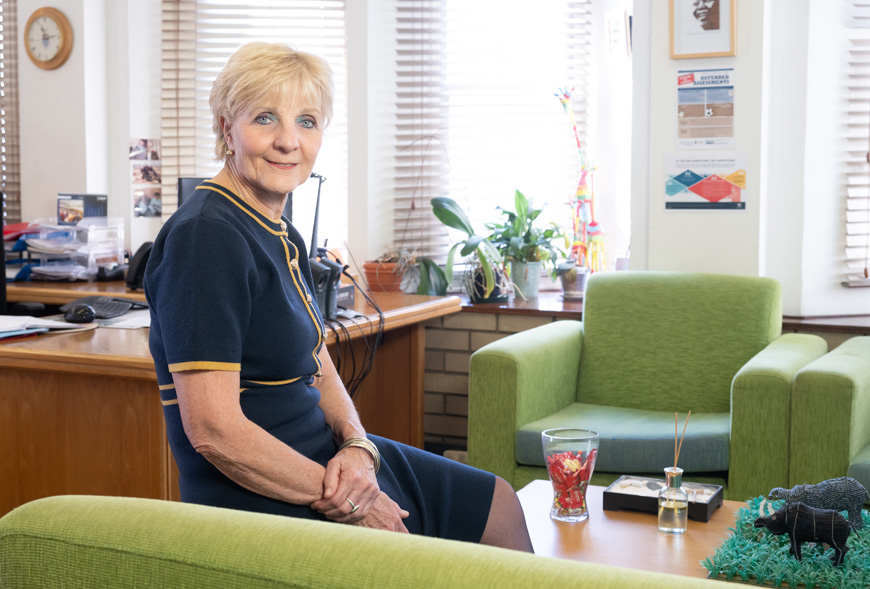
The epitome of service excellence
Crosley has a reputation for high standards - she is meticulous, decisive and intolerant of mediocrity. Those who worked with her knew that she expected people to deliver but also that she would never ask of others what she was unwilling to do herself.
“For me, it has always been that I need to set the example,” she says. “I can’t expect you to do something if I’ve never tried to do it myself or never tried to understand how to do it.”
This meant being prepared to step in to manage queues when registration was under pressure, to work through Christmas and other holidays to ensure that students received their offers on time, and to lead the sector when developing policies and procedures that could benefit all.
Vice-Chancellor and Principal Professor Zeblon Vilakazi describes this commitment as central to Crosley’s leadership. “Carol has brought more than institutional knowledge. She has brought judgement, consistency, certainty and a clear sense always of what is in the best interests of the University.”
The Registrar’s role is one that requires deep knowledge of governance, policy, people and the institution itself, and it is the glue that keeps the University together. Vilakazi praised Crosley for navigating this complexity with exceptional judgement. “Thank you for the standards that you have upheld and lifted, and for your unremitting commitment to excellence.”
This was echoed by Nicoleen Potgieter, who worked with Carol for 24 years, and who spoke on behalf of the Registrar’s Office. “Carol’s leadership has been about service. She has led with conviction, but she has also led with compassion. No matter how demanding her schedule, she would always find time to listen, advise, and support not only staff but also our students. Many of us have benefited from her wisdom, her guidance, and her willingness to lend a listening ear when we needed it most.”
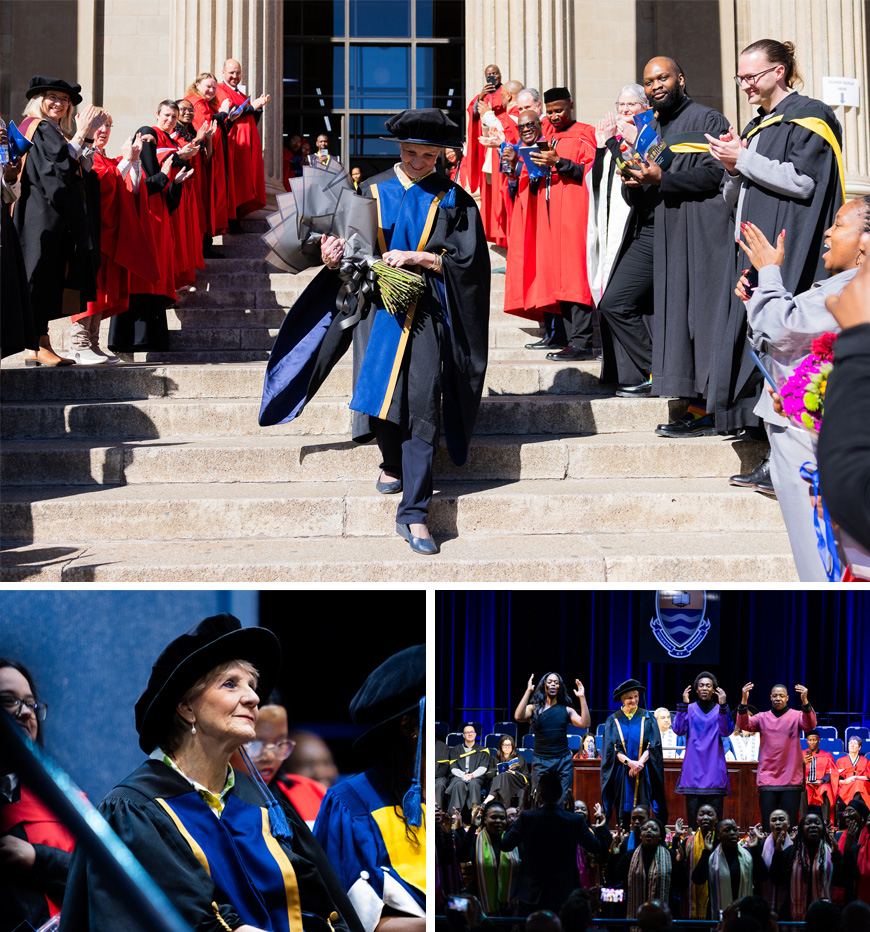
Putting Wits first
Deputy Vice-Chancellor: Research and Innovation Professor Lynn Morris says: “Carol has always put Wits first in her life. Her car is the first one in the parking lot, and the last one out. Now, I hope that she has some time to put herself first.”
Crosley’s response relates to her work ethic, responsibility and the importance of showing up. “I was brought up to show up, especially when things are difficult,” she says.
These words help explain her leadership through some of the most testing periods in Wits’ recent history. She was appointed Registrar in 2014, shortly before the #FeesMustFall protests. She remembers flying back from a higher education conference in Durban as events unfolded at Wits and later sitting on the concourse with students during what she recalls as a defining period for the University.
“Universities are not simply about our buildings, or systems, or qualifications,” says Crosley. “They are about communities of people – Wits is a family, and that has always mattered to me.”
Behind every process is a person
Universities are complex places filled with policies, processes and systems. An application may be a transaction on a system. A registration may be a process. An appeal may be a case number. For Crosley, there was always a person on the other side. “Behind every application, every registration, every appeal, every graduation, is a person, a family, hope, and often a sacrifice,” she says.
Morris recalls a day when a distressed student and his grandmother were waiting outside Crosley’s office. Crosley brought them in, sat with them and carefully took them through his academic transcript, explaining why he could not register. “That level of explanation, really making people understand, and the care, was really remarkable,” recalls Morris.
It is telling that after decades spent improving systems and processes, Crosley’s advice to her successor is not about either. “Start with the people, and then the other stuff will come,” she says.
It is a lesson that she learnt while helping to establish the Wits Student Enrolment Centre. Creating the new one-stop centre required rethinking infrastructure, business processes, systems, job descriptions and staffing from the ground up. “You can have the best systems, the best processes, the best everything,” says Crosley. “However, if you don’t have people who are committed, hard-working and ethical, it’s never going to work.”
Her successor, Tasneem Wadvalla, captured this dimension of Crosley’s legacy at her farewell. “It is about how you make people feel. This is about mentorship, integrity, commitment, care and the kindness that Carol shows to all.”
Adapting to change
The University that Crosley leaves in 2026 is almost unrecognisable from the University that she joined nearly three decades ago. She remembers an era before instant communication and automated offers, when staff worked late into December preparing thousands of letters and getting them to the post office before Christmas Eve because somewhere a young applicant was waiting to discover whether Wits would be part of their future. Her sons, Ryan and Jason, were sometimes drafted into helping. Since then, she has helped navigate technological transformation, new student systems, changing admissions regimes, governance changes, shifting expectations of universities, student protests and the Covid-19 pandemic.
The concept of “change” is an intricate part of Crosley’s career – her Masters of Education qualification also focused on change management and resilience. She says that adaptability is not about abandoning one’s principles. It is about knowing which things must change and which values should not. For Carol, those values have been integrity, fairness, respect, hard work and service.
Valerie John, speaking on behalf of the Faculty Registrars explains: “Over the years, Carol became much more than a colleague - she was a trusted advisor and mentor. When circumstances were stressful, she remained calm. When policies changed, she provided stability. When difficult decisions had to be made, she approached them with wisdom and fairness. What always stood out was her remarkable ability to understand both the strategic importance of a decision and the practical impact it would have on people. That balance is rare.”
A teacher at heart
Carol trained as a school teacher before she joined Wits. Professor Garth Stevens, Deputy Vice-Chancellor: People Development and Culture, observed Carol’s farewell. “Teachers have been the most profound influence in my life, and I have to say that Carol ranks amongst the best that I have ever had the opportunity to encounter.”
The Wits journey
Carol arrived as an 18-year-old student from Phalaborwa, completed a BA and a Higher Diploma in Education, and lived in Sunnyside residence. She remembers Wits opening her eyes to people whose backgrounds, experiences and perspectives differed markedly from her own. She graduated, and after teaching at King Edward VII School, working at Johnson & Johnson and returning to teaching at Sandown High School, she came back to Wits as a staff member.
She started in Functions and Events, moved into faculty administration and around 1999, was asked to help establish the Student Enrolment Centre. She went on to lead the Centre and later assumed broader responsibility for enrolment, schools liaison and financial aid and scholarships, before becoming Registrar in 2014.
Consistency on the road
Crosley is an accomplished runner who has completed 20 Comrades Marathons. Her running story began when, as a young teacher responsible for cross-country, she became convinced that some of her pupils were taking shortcuts. The only way to catch them, she decided, was to run with them around Munro Drive just off Louis Botha Avenue. “I very quickly realised that I wasn’t fast, but I was consistent, and I have been running ever since,” she says.
Using this analogy, and speaking on behalf of academic staff, Professor Maria Marchetti-Mercer says: “Carol has navigated the complexities of academic administration with grit and determination, even through difficult moments in the University's history. Her example reminds us that leadership is not a sprint - it is a marathon, or maybe in her case, even an ultramarathon.”
The end is the beginning
Professor Ian Jandrell the Deputy Vice-Chancellor: Systems and Operations, thanked Crosley for her great contribution to Wits. “When there was an issue or crisis, Carol was always on the line, and the problem was solved. She is the most remarkable human being and for many of us, to think of this University without her is almost impossible.”
Shirona Patel, speaking on behalf of Professional and Administrative Staff, says that staff will remember Crosley for her professionalism, commitment and dedication to people. “We all work at Wits for a time, as custodians of this University. For the years that it is entrusted to us, our responsibility is to care for Wits, to strengthen it and to leave it in a better place than when we arrived. Carol, after some thirty years of service, I think we can say without hesitation that you have left Wits better than you found it - and that’s no easy feat.”
“This has been more than a place where I worked,” concludes Crosley. “It has been part of my life for almost three decades, and it has helped shape the person I am. For that privilege, for the friendships, for the memories, for everything I have learnt, and for allowing me to play a small part in the lives of so many students, I value this remarkable institution, and I will always carry a part of Wits with me.”