

Commitment key to governing Gauteng beyond the ballot box
- Wits University
Elections contradict long-term planning, and no party wants to implement what they cannot claim credit for – GP colloquium.
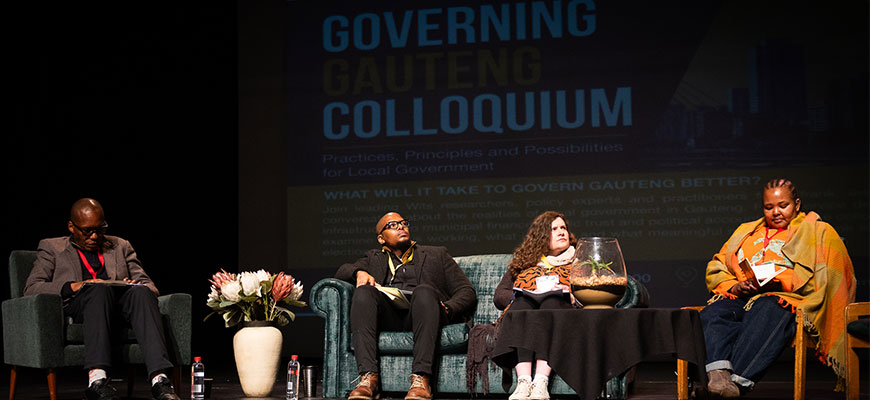
South Africa’s economic hub, the Gauteng province, faces the challenge of sustaining the political commitment, institutional integrity and shared responsibility needed to make it work beyond election cycles.
This emerged at the Governing Gauteng Colloquium hosted by the School of Social Sciences at Wits, where academics, practitioners, students and residents considered how the province could move from diagnosing its problems towards making deliberate choices about its future.
Opening the colloquium, Wits Deputy Vice-Chancellor: People Development and Culture Professor Garth Stevens asked whether "our system still possess the political support, institutional capacity and structural alignment necessary for governance itself to work – is our system governable?"
He argued that effective institutions require capacity, authority, legitimacy and accountability, warning that these have become increasingly disconnected.
Dr Mpho Tlaldi, Deputy Director: Integrated Development and Business Planning, City of Johannesburg, illustrated the consequences through Johannesburg’s long-term planning and infrastructure challenges.
Non-revenue water increased from 29.4% in 2007 to 44.8% in 2025, while Johannesburg faces an infrastructure renewal backlog of about R26 billion. Tladi stated that the reversal of such deterioration requires sustained commitment across administrations.
Up until now, that continuity has proved difficult. Between 2016 and 2026, Johannesburg installed 10 mayors involving eight people, while the execution of the Growth and Development Strategy 2040 stalled.
Both speakers, however, pointed beyond political instability towards the values required to make government work. Read Steven's opening remarks, and
Tladi’s speech titled Governing the ‘Ungovernable’ City: How Coalition Instability Causes the Symbolic Foreclosure of Long-Term Planning in Johannesburg.
Stevens called for a renewed social contract based on political responsibility, professional public service, responsible business and communities participating as co-producers of the public realm.
Tladi argued that long-term plans should similarly transcend political ownership, draw authority from residents and have statutory protection.
“Each incoming administration should surrender the right to author the city's future,” he said.
"If we do it the way we have done it since 2016, it (development plan strategy) will be authored by whoever holds the executive chair, resented by whoever does not, and dead by next election," Tlali.
The colloquium featured three pane sessions - panel one focused on the changing shape of local governance, panel two was themed Policy, budgets, and the nuts and bolts of governance today, panel three examined the Different faces of Governance. View programme and speaker details..
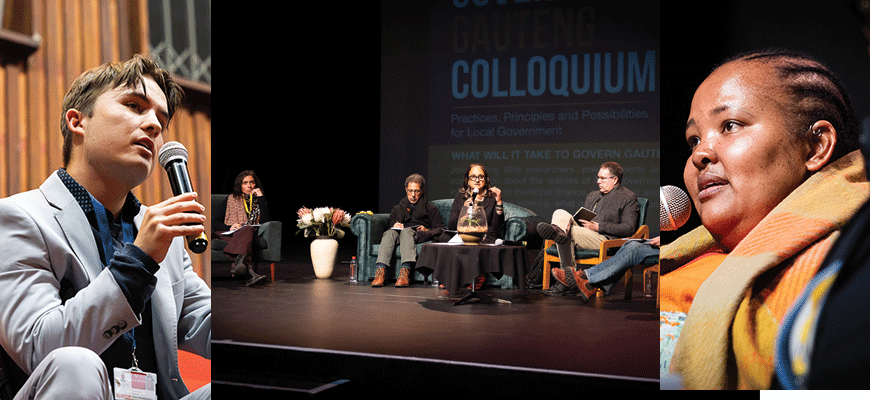
Thinking solutions
Explaining the motivation behind the colloquium, Head of the School of Social Sciences Prof. Lorena Núñez Carrasco said the discussion was important ahead of the local government elections set to take place on 4 November 2026.
“We are at a turning point, and a crucial time where change is urgently needed. These challenges (in the province) call for citizens, communities, civil society organisations, and institutions to play an active role in shaping the future of Gauteng,” she said.
Panelists and delegates agreed that the province is too important to fail.
“Gauteng is the future of South Africa. It is the most populous, wealthiest, and potentially most inequitable of the country’s nine provinces. Its success or failures foretell the country’s social, economic, and political trajectories” said Joel Quirk, Head of Political Studies at Wits.
Wits social scientists said at the core of their scholarship is the call to provide solutions to challenges facing society.
“The purpose of scholarship in a moment like this is not to provide convenient answers. It is to make the questions harder, and ultimately, more useful,” Stevens.
“A university situated in Gauteng has an obligation to understand the province in which it is located and to bring its intellectual resources into conversation with the practical challenges of public life. That means bringing research into conversation with practice; listening to communities as well as governments; challenging assumptions (including our own); and confronting uncomfortable evidence, even when it complicates the political narratives we would prefer to tell,” Stevens.