City Forum examines spatial inequality and development futures at Frankenwald
- Wits University
The forum brought research, local knowledge and policy discussions into one setting, centred on the realities of Stjwetla and Alexandra’s Far East Bank.
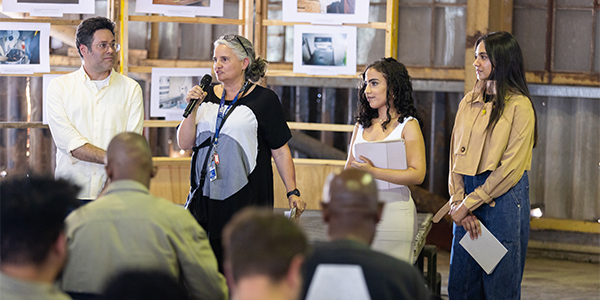
A disused warehouse on the former Frankenwald estate was converted into a City Forum on 28 October, creating a shared space for community participants, students, researchers and policymakers to engage with two years of work by the Centre for Urbanism and Built Environment Studies (CUBES) and the Wits School of Architecture and Planning.
Frankenwald, which Wits University transferred to Bankenveld District City (Pty) Ltd in October 2024, sits between long-established residential and industrial areas and rapidly growing low-income settlements. Although the Gautrain provides a key transport link through this corridor, it also reinforces a visible socio-economic divide, with the Jukskei River as the only crossing point between contrasting urban conditions.
South of the Gautrain line are Extension 7 of Alexandra’s Far East Bank and Stjwetla, a dense settlement of food gardens, narrow pathways, small shacks and double-storey micro-homes. Stjwetla originated as an apartheid-era transit camp in 1986 and stretches from Old Alexandra along the river towards Marlboro Gardens.
The Kelvin-Alexandra-Frankenwald City Studio, jointly run by CUBES and the School of Architecture and Planning, used this setting to examine how spatial and economic inequalities are produced, represented and contested. Through teaching, fieldwork and collaboration with residents, the studio explored planning discourses, documentation practices and possibilities for alternative futures.
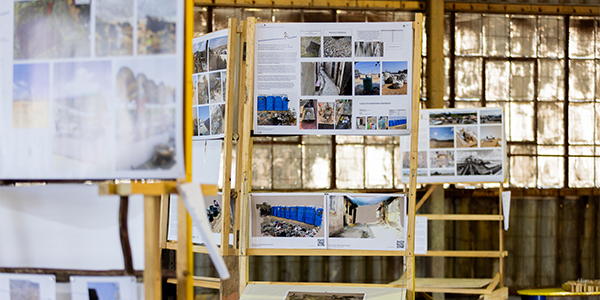
In the lead-up to the forum, third-year architecture students worked with artisans from Stjwetla to design and build exhibition stands and branding material, supported by funding from the Portuguese Embassy. Twenty postgraduate students presented research through posters, while student-artisan teams created structures using reclaimed materials. These structures are intended for future use in Stjwetla to support safety initiatives and local artisanal work from 2026.
Outputs from a week-long collaborative mapping workshop held in Stjwetla in September, supported by Wits-University College London (UCL) seed funding—were also showcased. These included a 3D-printed model, stitched facades, 3D scans, photovoice material and a locally produced documentary illustrating everyday experiences in the area.
The University of the Western Cape’s Governing the Just Urban Transition project partnered with the City Studio for the forum, presenting further photovoice work on infrastructure challenges in Stjwetla and contributing to discussions between residents, academics and government representatives.
The forum concluded with two panel discussions that linked community insights with national and municipal policy processes on housing and informal settlement upgrading. Looking ahead, the City Studio plans to offer advocacy and technical support to emerging development plans in 2026 while continuing to reflect on the collaborative research generated through this work.