

Wits innovation moves from ideas to impact
- Wits University
A group of tech transfer officers from Africa visited Wits to learn more about how the Universty enables, manages and commercialises Intellectual Property.
Technology Transfer Officers (TTOs) play a critical role within universities by connecting research with external stakeholders and managing institutional innovations and Intellectual Property (IP). Wits University, as the top-ranked institution in the region for innovation performance, prides itself as a leader in this field.
A delegation of technology transfer officers from across Africa visited Wits on the 4th of February to learn about how the University enables, manages and commercialises its Intellectual Property. The event was facilitated by the Royal Academy of Engineering and the British High Commission to South Africa. They were hosted by a team from the Wits Innovation Centre (WIC), its Innovation Support team, the Research Office and Wits Commercial Enterprise.
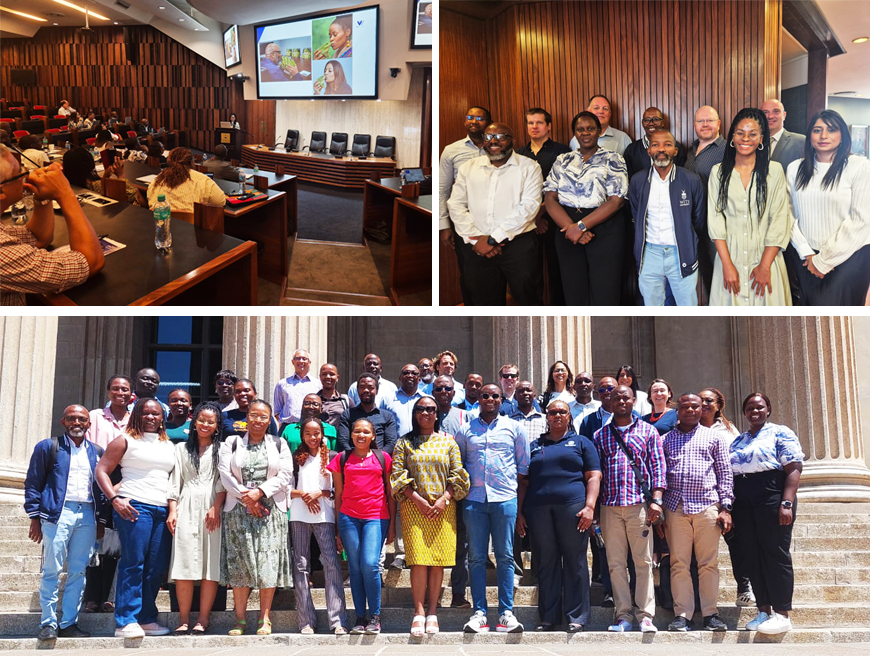
Professor Brett Bowman, Senior Director for Research at Wits, noted that such engagements demonstrate the shared commitment of Wits and universities across the continent to strengthening innovation efforts that deliver real‑world solutions. “Technology transfer in this context is not simply about commercialisation in the narrow sense, but about building pathways from ideas to impact,” he said.
Angus Baker, Principal Consultant for Commercialisation at the Royal Academy of Engineering, explains that this visit is part of the Academy’s larger programme to equip tech transfer professionals from around the Continent. As part of this, delegates have visited universities in the United Kingdom and across South Africa.
“Wits seems to have a similar model as in the U.K.,” Baker says. “It’s impressive to see, and the team are doing very well, being ranked first for innovation performance. It’s great to see that you’ve come a long way so quickly.”
He highlights that the Wits Innovation Support team take steps towards sunsetting patents that aren't being taken up. “This is something that universities don't necessarily think about, that patent costs quickly mount up, so this is a proactive approach, saving time and money."
“For me, it's been mind-blowing,” said Loice Alusala, the Science and Technology Network Officer at the British High Commission in Pretoria. “It's been really nice to see how the process works at Wits with the structure of the different entities and how they intersect, and I think that's been very valuable for the team.”
Andrew Hope‑Jones, Chief Executive Officer of Wits Commercial Enterprise, highlighted the complex role technology transfer offices play in aligning diverse stakeholder interests. “It's to look at the needs of industry, government, and funders to understand what they are trying to solve and to be a sort of matchmaker to find the experts within the university to provide solutions.”
Hope-Jones explains that Wits supports this process from the beginning of an idea through to commercialisation and beyond, which includes facilitating the launch of successful spin-out companies.
Letlotlo Phohole, Director of the Wits Innovation Centre, explained that Wits takes a deliberately holistic approach to innovation. “Innovation is often associated with only a few faculties, such as Engineering or Science,” he said. “At Wits, we wanted an approach that is broader and inclusive of the entire institution.”
This approach is reflected in the Wits Strategic Plan for Innovation (2022–2026), which was developed through multidisciplinary engagement to establish a shared institutional vision and break down traditional silos. The Wits Innovation Pathway enables a connected innovation ecosystem that brings together multiple units, platforms, and incubators.
Another distinctive feature of Wits’ technology transfer approach is its Innovation Readiness Levels (IRLs). This framework assesses the readiness of innovations across five dimensions: technology, manufacturing and production, market readiness, investment readiness, and intellectual property.
Phohole explains that the IRLs allow for a shared understanding when it seems that academics and industry professionals are speaking different languages. “We needed a structured way to gather metrics of readiness beyond publications and patents,“ he says. Tebogo Machethe, Head of Innovation Support at Wits, emphasised the importance of structured and intentional support for innovators across these dimensions.
In addition, the delegation undertook a site visit to the Wits Innovation Centre’s Innovation Systems Lab, led by Moses Mogotlane. During this visit, delegates were able to see, in practice, how early-stage ideas are translated into prototypes and products, using systems thinking and design thinking approaches to deliver valued, real-world solutions.
The delegation thereafter visited Professor Willie Cronje, a key figure in the development of PeCo Power, who emphasised that this success demonstrates the capability of African-developed solutions to compete on a global stage. PeCo Power aims to enable communities to bypass traditional infrastructure constraints, allowing access to safe, affordable, and reliable electricity. Dr Muhammed Aswat, Chief Technology Officer of the spin-out company, showcased the technical operations and manufacturing processes underpinning the technology.
The visit once again highlighted how Wits leverages its innovation ecosystem to prioritise effective technology transfer and intellectual property protection. “We do not innovate for the sake of innovation alone,” Phohole said. “Our focus is not on collecting papers and patents, but on delivering real societal benefit. Impact is central to everything we do.”