

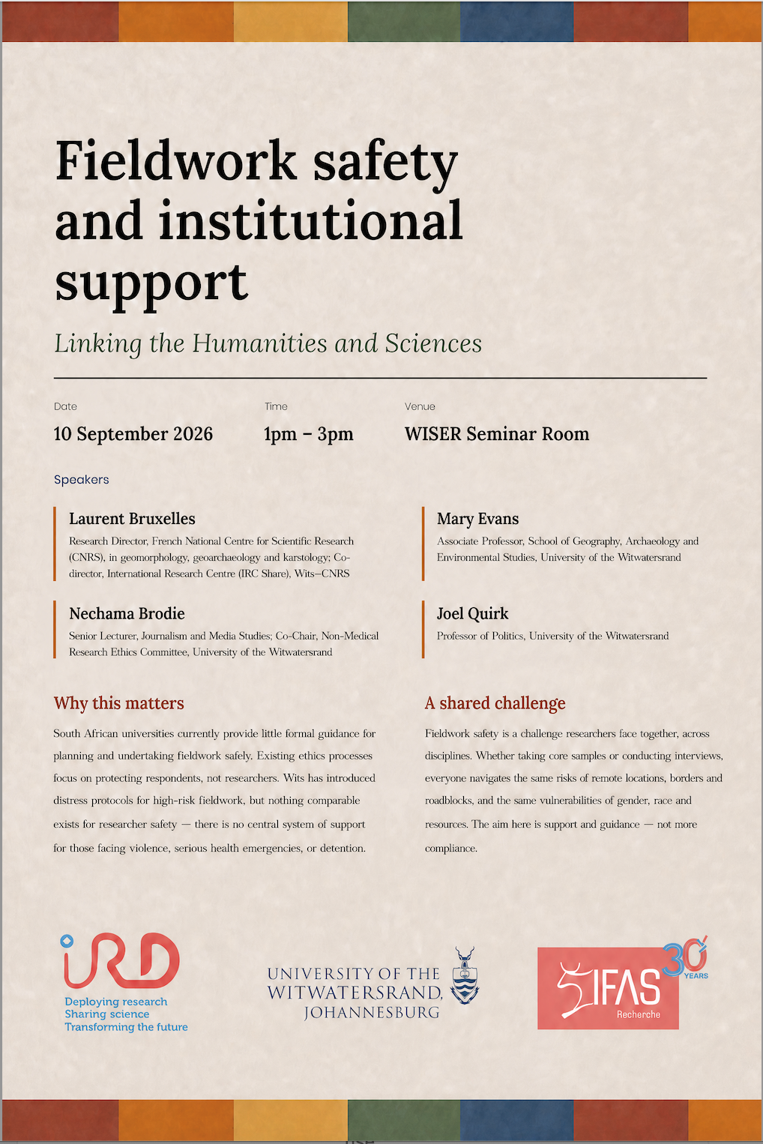
Fieldwork safety and institutional support: Linking the Humanities and Sciences
| When: | Thursday, 10 September 2026 |
| Where: | WiSER Seminar Room |
| Start time: | 13:00 |
| Enquiries: |
Linking the Humanities and Sciences
Speakers:
- Laurent Bruxelles, research director at the French National Centre for Scientific Research(CNRS) in geomorphology, geoarchaeology and karstology, and co-director of the International Research Center (IRC Share) between Wits and the CNRS.
- Mary Evans, Associate Professor in the School of Geography, Archaeology and Environmental Studies, University of the Witwatersrand
- Nechama Brodie, Senior Lecturer in Journalism and Media Studies and co Chair of the Non-Medical Research Ethics Committee, University of the Witwatersrand
- Joel Quirk, Professor of Politics, University of the Witwatersrand
Fieldwork safety and institutional support
Despite some recent advances, universities in South Africa currently provide little or no safeguards for and guidance to their researchers when it comes to planning and undertaking of fieldwork safely and with integrity. Existing ethics processes tend to focus on respondents (such as consent and confidentiality) and have less to offer on researcher safety. It is clear, moreover, that compliance considerations are typically prioritised over the more challenging and contextually specific challenges associated with undertaking fieldwork in delicate, difficult, and/or distant spaces. Wits has recently introduced additional distress protocols for fieldwork deemed to carry an elevated risk where respondents might suffer distress. However, there is nothing comparable for researcher safety and support. Good supervisors will handle this responsibility for their students, but not all are aware of these issues or capable of providing effective guidance. Currently, there is no central system or support for researchers facing (sexual) violence, serious health emergencies, or detention by police or other authorities. The duty of care that institutions owe to their staff and students should also encompass specific protocols for their safety and well-being in the field.
Linking the Humanities and Sciences
Guidance, support and training around fieldwork safety and integrity are challenges that researchers in both the Humanities and Sciences face together. Safety considerations while undertaking fieldwork are equally applicable when doing both core samples and undertaking interviews. Everyone risks getting sick in remote areas irrespective of disciplinary background. Visas, border guards and roadblocks are challenges which everyone needs to navigate. Vulnerabilities and positionalities associated with gender, race, resources are both crucial and inescapable, yet South African universities and other institutions are not currently offering sufficient training or guidance. Our aim here should be to provide support and guidance, rather than to expand compliance. Ethics approval processes are undoubtedly necessary, but they also have a poor reputation when it comes to prioritising legal liability over everything else. Adding more boxes to tick and report on should not be confused with taking fieldwork safety and integrity seriously.
Towards best and better practice?
This isn’t just a question of personal safety. It is also a question of the larger challenges and complications which tend to arise when planning and undertaking extended fieldwork in both the sciences and humanities. Here are some of the larger questions and considerations at stake here:
- What kinds of ethical obligations do researchers (and institutions) owe to the individuals and communities where they conduct their research?
- How can risks and dilemmas associated with fieldwork be planned for and managed better?
- What kinds of practical steps and planning need to be taken to ensure researcher health and safety, especially for younger female researchers?
- How should researchers respond to requests for, and/or raised expectations of, help from vulnerable individuals while doing fieldwork in impoverished communities?
- When and how much should researchers compensate their respondents for their time and expertise?
- What are the best ways of successfully negotiating roadblocks and police stops?
- How do concerns about safety and risk affect the kinds of data that can and should be collected?
- How should universities and other actors both plan for and respond to dangers and dilemmas encountered in the field?
- What strategies and responses are required if/when the worst happens?
- How should researchers handle the challenges presented by dominant modes of extractivism and associated knowledge economies?
 Add event to calendar