BEGIN:VCALENDAR
PRODID:-//TERMINALFOUR//SITEMANAGER V7.3//EN
VERSION:2.0
BEGIN:VEVENT
DTSTART:20260901T130000
LOCATION:
DESCRIPTION:WiCDS and the Innovation Foundation for Democracy are thrilled to present a distinguished lecture by Patricia McFaddenBecoming contemporary in the context of Southern Africa: Feminism and the alternative future
This presentation will focus on several key elements that underpin my argument that becoming Contemporary is an essential and necessary imperative to shifting the current socio-political reality of the societies of Southern Africa ( and Africa) into a future premised on alternative ideas and possibilities. I begin by redefining what has come to be understood in spatial terms as the geographical region of Southern Africa, and in more recent decades, has been re-conceptualized as SADC – a trading block of 16 neocolonial societies. This established idea does not depart from an imperialist centuries old extractive ideology and infrastructure which defined the region as a major source of primitive accumulation for white capital, through the relentless exploitation of the resources and labor of the people of the region. SADC therefore perpetuates the hegemonic neo-liberalist view that is part and parcel of the normative reality of a raced, gendered and classist life. My contention is that out of the centuries of resistance by the working people of Southern Africa, which culminated in liberation struggles in several of the societies of the region, a vibrant and dynamic energy and agency was unleashed which portends a different, Alternative perspective and possibilities for the region, and beyond. At the core of the Alternative that is emerging in terms of a different future, is the ideology and political vibrancy of Feminism – as the only Epistemic, Discursive and Activist worldview that can deliver a Sufficient, Dignified and Inclusive alternative to Neo-liberal capitalism. Southern Africa (and not just South Africa), represents the vortex of a new ideological and socio-cultural, political and economic social formation, which can shift the meaning of lived reality for all those who inhabit it, and for the continent at large. With the exception of Algeria, in North Africa, Guinea Bissau, Sao Tome and Cape Verde along the West African coast, which were French and Portuguese colonies respectively, Southern Africa is the only region on the African continent that was able to reach beyond the narrow confines of conservative (sometimes pseudo radical) Nationalism, and thus to create a revolutionary consciousness which provides the materialist premise for a foundational transition to new and different societies. This is not to say that other African societies do not have the potential to move in directions that are radically different from the dominant capitalist system. The entire continent is poised for an alternative to the voraciously predatory imperialist infrastructures that have rendered the majority of Africans destitute and impoverished. However, the trajectory of each country and region (even when defined within the confines of the established colonial systems) present interesting possibilities for radical political economy analysis and discourse.
Patricia McFadden is a radical eco-feminist who aspires to a life of Freedom and Joy. She lives as an organic vegan on an ancient mountain in Eastern Swaziland, where she strives towards a balanced, respectful relationship with Nature, encompassing all sentient beings, while searching for new feminist impetuses and insights from her eco-feminist reality. Her recent publications include ‘Women’s Freedoms are the Heart Beat of Africa’s future: a Sankarian Imperative’; ‘A Feminist Conversation: Situating our Radical Ideas and Energies in the Contemporary African Context’ (with Patricia Twasiima); ‘Critiquing Conventional Discourses on Girls and Gendered Female Identities in Africa’; ‘Contemporarity: sufficiency in a Radical African Femi’; ‘The Nexus of Neo-liberalism and Precarity: Struggles for Alternative Societies’; ‘Learning to love the Earth: Eco-feminism is the way back to Nature through love of the self’; and ‘Subjectivity is the Critical Foundational Expression of Feminist Contemporarity’.
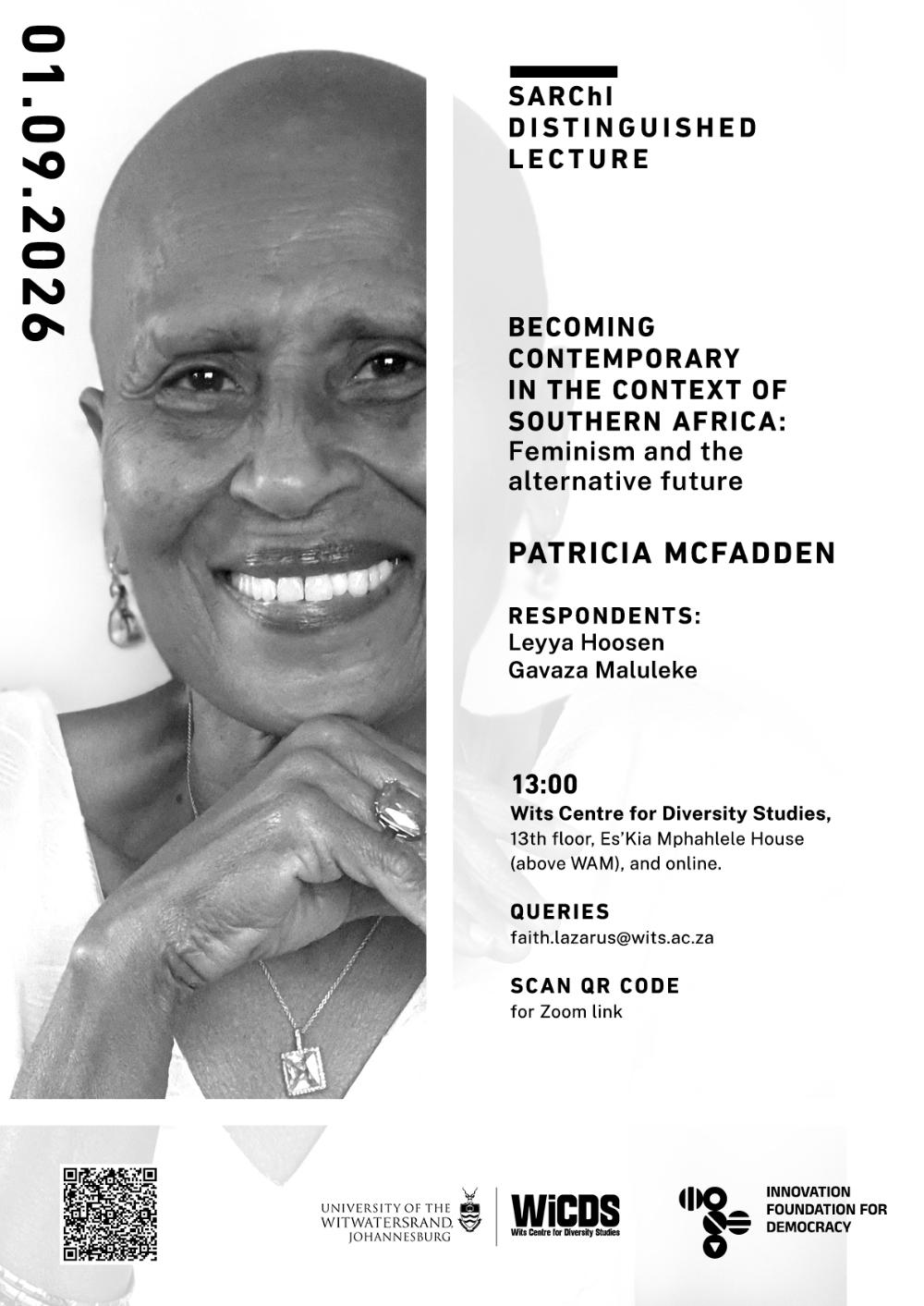
Dr McFadden will be in conversation with Leyya Hoosen and Gavaza Maluleke. Lunch will be served for those attending in person. For online attendance, please scan the QR code on the poster.
X-ALT-DESC;FMTTYPE=text/html:WiCDS and the Innovation Foundation for Democracy are thrilled to present a distinguished lecture by Patricia McFaddenBecoming contemporary in the context of Southern Africa: Feminism and the alternative future
This presentation will focus on several key elements that underpin my argument that becoming Contemporary is an essential and necessary imperative to shifting the current socio-political reality of the societies of Southern Africa ( and Africa) into a future premised on alternative ideas and possibilities. I begin by redefining what has come to be understood in spatial terms as the geographical region of Southern Africa, and in more recent decades, has been re-conceptualized as SADC – a trading block of 16 neocolonial societies. This established idea does not depart from an imperialist centuries old extractive ideology and infrastructure which defined the region as a major source of primitive accumulation for white capital, through the relentless exploitation of the resources and labor of the people of the region. SADC therefore perpetuates the hegemonic neo-liberalist view that is part and parcel of the normative reality of a raced, gendered and classist life. My contention is that out of the centuries of resistance by the working people of Southern Africa, which culminated in liberation struggles in several of the societies of the region, a vibrant and dynamic energy and agency was unleashed which portends a different, Alternative perspective and possibilities for the region, and beyond. At the core of the Alternative that is emerging in terms of a different future, is the ideology and political vibrancy of Feminism – as the only Epistemic, Discursive and Activist worldview that can deliver a Sufficient, Dignified and Inclusive alternative to Neo-liberal capitalism. Southern Africa (and not just South Africa), represents the vortex of a new ideological and socio-cultural, political and economic social formation, which can shift the meaning of lived reality for all those who inhabit it, and for the continent at large. With the exception of Algeria, in North Africa, Guinea Bissau, Sao Tome and Cape Verde along the West African coast, which were French and Portuguese colonies respectively, Southern Africa is the only region on the African continent that was able to reach beyond the narrow confines of conservative (sometimes pseudo radical) Nationalism, and thus to create a revolutionary consciousness which provides the materialist premise for a foundational transition to new and different societies. This is not to say that other African societies do not have the potential to move in directions that are radically different from the dominant capitalist system. The entire continent is poised for an alternative to the voraciously predatory imperialist infrastructures that have rendered the majority of Africans destitute and impoverished. However, the trajectory of each country and region (even when defined within the confines of the established colonial systems) present interesting possibilities for radical political economy analysis and discourse.
Patricia McFadden is a radical eco-feminist who aspires to a life of Freedom and Joy. She lives as an organic vegan on an ancient mountain in Eastern Swaziland, where she strives towards a balanced, respectful relationship with Nature, encompassing all sentient beings, while searching for new feminist impetuses and insights from her eco-feminist reality. Her recent publications include ‘Women’s Freedoms are the Heart Beat of Africa’s future: a Sankarian Imperative’; ‘A Feminist Conversation: Situating our Radical Ideas and Energies in the Contemporary African Context’ (with Patricia Twasiima); ‘Critiquing Conventional Discourses on Girls and Gendered Female Identities in Africa’; ‘Contemporarity: sufficiency in a Radical African Femi’; ‘The Nexus of Neo-liberalism and Precarity: Struggles for Alternative Societies’; ‘Learning to love the Earth: Eco-feminism is the way back to Nature through love of the self’; and ‘Subjectivity is the Critical Foundational Expression of Feminist Contemporarity’.
Dr McFadden will be in conversation with Leyya Hoosen and Gavaza Maluleke. Lunch will be served for those attending in person. For online attendance, please scan the QR code on the poster.
SUMMARY:SARChI Distinguished Lecture: Patricia McFadden
END:VEVENT
END:VCALENDAR