BEGIN:VCALENDAR
PRODID:-//TERMINALFOUR//SITEMANAGER V7.3//EN
VERSION:2.0
BEGIN:VEVENT
DTSTART:20260420T143000
LOCATION: Honours presentation room, Physics building, Wits University
DESCRIPTION:Talk by Professor Monika Ritsch-Marte - Director of the institute of Biomedical Physics Medical University of Innsbruck.Large bio-samples, such as organoids or cancer spheroids are often optically too opaque for imaging under illumination from only one side. Rotating or re-orienting the sample for multi-angle illumination is a solution to this problem, enabling 3D tomographic reconstruction of the refractive index distribution. Tailored optical and acoustic waves can both exert controlled forces on microscopic biomedical samples in suspension in a non-contact way. However, large and therefore heavy particles can only be levitated by acoustic forces - optical tweezers would be either too week or induce damage. By tuning standing MHz ultrasound waves it is possible to rotate or re-orient a sample inside a micro-fluidic chamber, thus avoiding the ‘missing-cone’ problem which commonly leads to artifacts. As examples, the 3D reconstruction of a levitated zebrafish larva by optical coherence tomography (OCT) and of cell clusters by optical diffraction tomography (ODT) will be presented.
X-ALT-DESC;FMTTYPE=text/html:Talk by Professor Monika Ritsch-Marte - Director of the institute of Biomedical Physics Medical University of Innsbruck.Large bio-samples, such as organoids or cancer spheroids are often optically too opaque for imaging under illumination from only one side. Rotating or re-orienting the sample for multi-angle illumination is a solution to this problem, enabling 3D tomographic reconstruction of the refractive index distribution. Tailored optical and acoustic waves can both exert controlled forces on microscopic biomedical samples in suspension in a non-contact way. However, large and therefore heavy particles can only be levitated by acoustic forces - optical tweezers would be either too week or induce damage. By tuning standing MHz ultrasound waves it is possible to rotate or re-orient a sample inside a micro-fluidic chamber, thus avoiding the ‘missing-cone’ problem which commonly leads to artifacts. As examples, the 3D reconstruction of a levitated zebrafish larva by optical coherence tomography (OCT) and of cell clusters by optical diffraction tomography (ODT) will be presented.
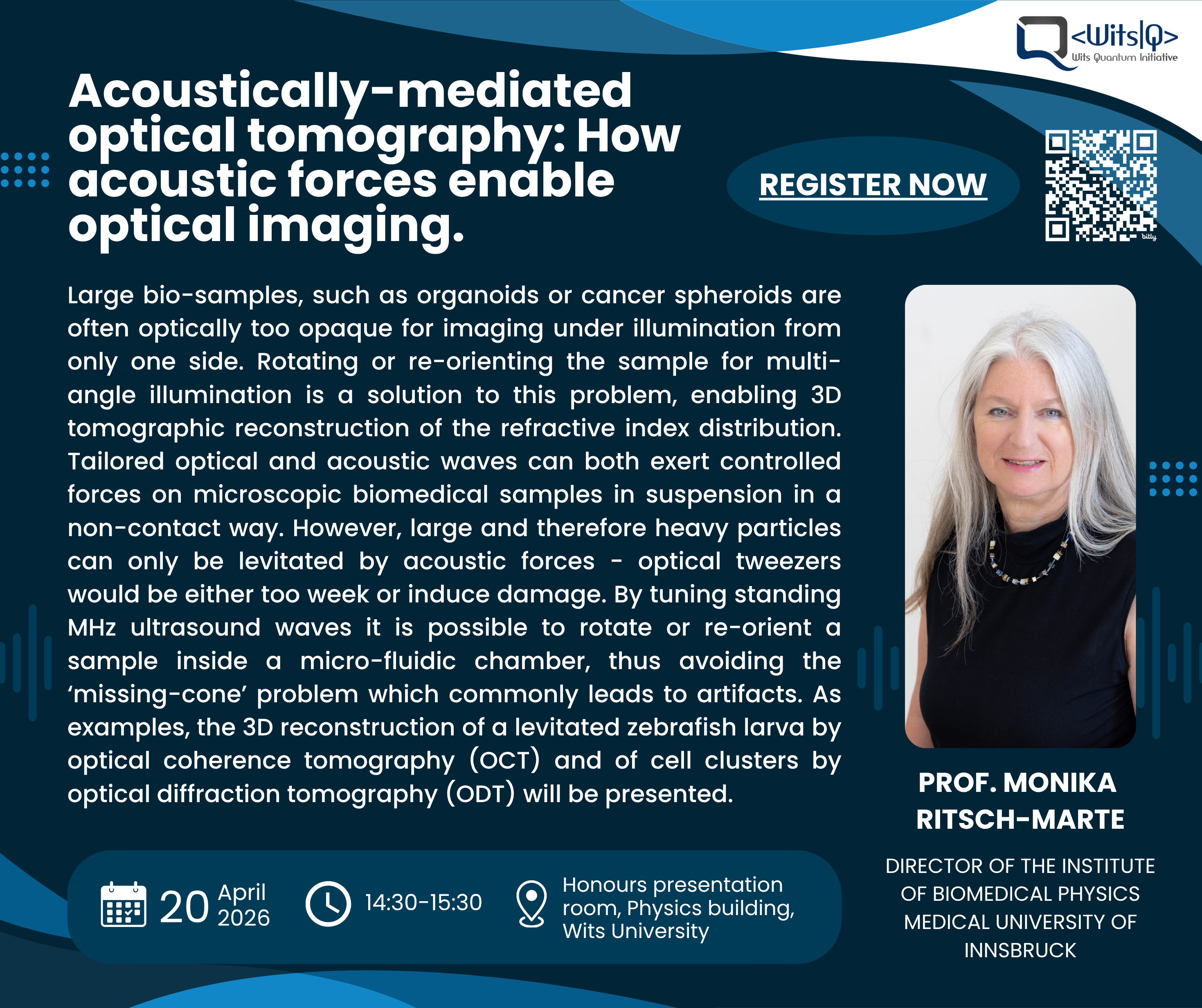
SUMMARY:Acoustically-mediated optical tomography: How acoustic forces enable optical imaging
END:VEVENT
END:VCALENDAR